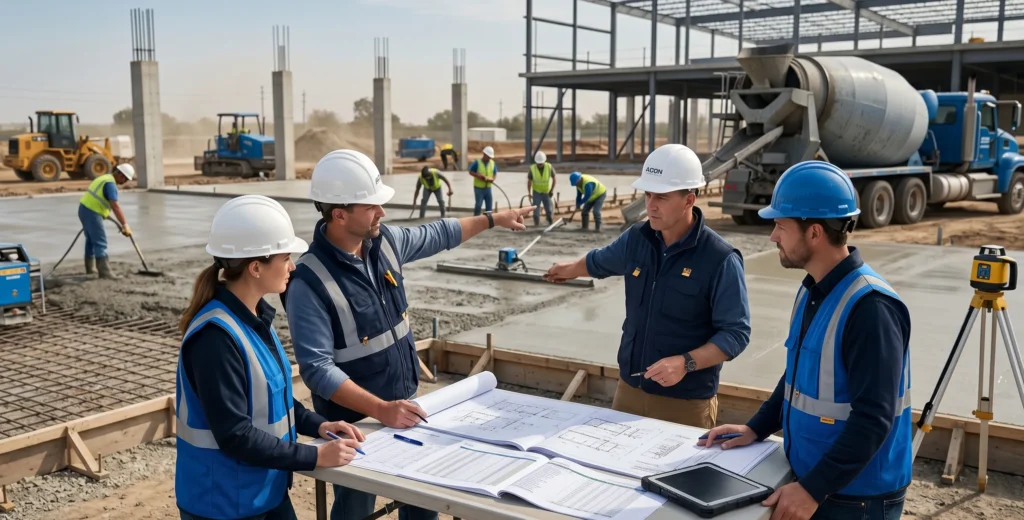
A standard concrete slab costs between $6 and $12 per square foot. When you factor in complex site preparation, specialized finishes, and premium ready-mix concrete, the total price can quickly reach $18 or more per square foot. Your final concrete slab cost depends heavily on structural factors such as slab thickness, the extent of ground leveling required, and how easily contractors can access your property.
A concrete slab is a flat, horizontal structural element used in construction to create a durable, level surface. It serves as the primary foundation for buildings, garages, and sheds. Because of its high load-bearing capacity, this type of flatwork provides a solid, long-lasting platform that supports walls, vehicles, and daily foot traffic.
This guide breaks down the true costs of pouring a slab. We will provide exact price estimates for common slab sizes, separate material expenses from labor rates, and highlight the specific variables that drive your final quote up or down.
Cost to Pour a Concrete Slab
Pouring a concrete slab generally costs between $6 and $12 per square foot, with the national average sitting closer to $10 to $12 per square foot. The final price depends entirely on the size of the project and the thickness of the concrete. For instance, a typical 4-inch thick, 30×30 concrete slab costs around $7,000+. Variables such as site access, the amount of reinforcement needed, and the type of finish applied will push your specific quote up or down within that range.
Concrete Slab Price by Size
Estimating your budget is much easier once you know your project dimensions. Professional Construction Takeoff Services help quantify slab dimensions, reinforcement materials, and concrete volumes before procurement and contractor bidding begin. Assuming a standard 4-inch thickness, the total price scales directly with the size. Small projects like sheds keep expenses low, while massive foundations require a larger budget for the increased material volume.
| Concrete Slab Size | Square Feet | Estimated Cost |
| 8×8 | 64 sq ft | $250 – $500 |
| 8×10 | 80 sq ft | $500 – $1,600 |
| 10×10 | 100 sq ft | $600 – $2500 |
| 12×12 | 144 sq ft | $1000 – $2,600 |
| 16×20 | 320 sq ft | $1900 – $3850 |
| 20×20 | 400 sq ft | $2,400 – $5,500 |
| 24×24 | 576 sq ft | $4,100 – $6,500 |
| 30×30 | 900 sq ft | $5,500 – $13,000 |
| 30×50 | 1,500 sq ft | $9,000 – $18,000 |
| 40×60 | 2,400 sq ft | $12,000 – $30,000 |
Concrete Slab Price by Project Type
The intended use of your slab determines the necessary thickness and structural reinforcement. A load-bearing house foundation or a two-car garage floor requires much more structural support and a larger budget compared to a basic backyard shed base. If you are adding a utility room or a guest suite to your slab, knowing how to estimate plumbing costs for new construction will keep your total project numbers accurate from the start. Large commercial slabs must also comply with strict building codes that include fire resistance requirements, which is why many contractors consult professional Fireproofing Estimating Services to accurately price these safety measures before bidding begins.
| Project Type | Example Size | Estimated Cost |
| Shed Foundation | 100 sq. ft. | $600 |
| Driveway | Standard | $3,200 |
| Patio Slab | 400 sq. ft. | $4,500 |
| Garage Floor (2-Car) | 576 sq. ft. | $5,000 |
| House Foundation (Single-Story) | 2,000 sq. ft. | $20,000 |
| Large Commercial Building Slab | 2,000 sq. ft. | $22,000 – $24,000 |
Concrete Slab Price by Thickness
Thicker concrete slabs require more raw materials and heavier labor to pour. Moving from a standard four-inch slab to an eight-inch depth means you also need stronger reinforcement and extra finishing work.
| Slab Thickness | Estimated Cost (Per Sq. Ft.) |
| 4-inch | $5 – $8 |
| 5-inch | $5.50 – $6.50 |
| 6-inch | $6 – $10 |
| 8-inch | $10 – $18 |
Factors Influencing Concrete Slab Costs
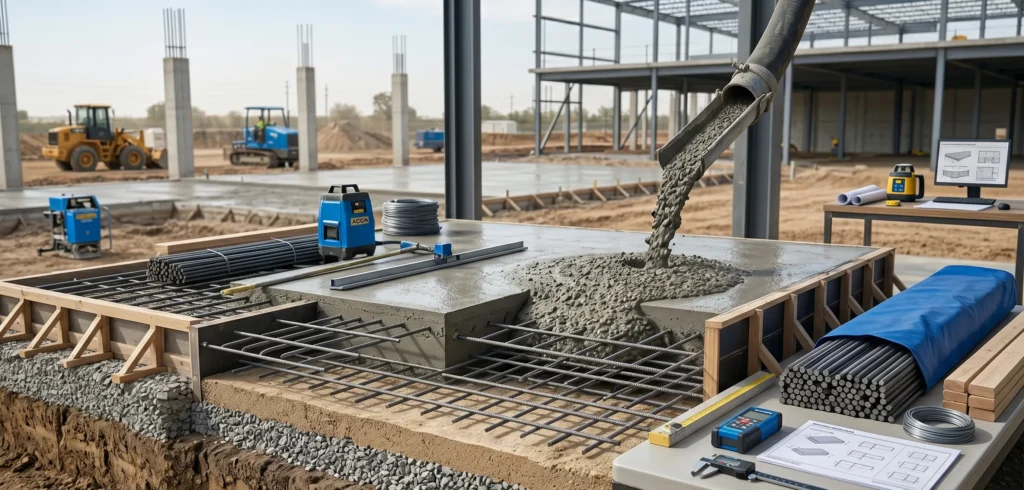
Concrete slab prices fluctuate based on the physical dimensions of the pour and the specific conditions of your job site. Knowledge of these main cost drivers helps you project an accurate budget before a contractor starts working on it.
- Size and Thickness: The total square footage and depth dictate your material volume. Upgrading from a standard four-inch slab to a six-inch depth requires significantly more concrete.
- Site Preparation: A successful pour needs a flat, stable dirt base. If your property requires heavy grading, tree root excavation, or the removal of an old, cracked concrete pad, this prep work adds a major expense to the project.
- Reinforcement Materials: Standard slabs usually sit on a gravel base, but load-bearing structures need structural support. Adding steel rebar or wire mesh prevents the concrete from cracking under pressure and increases your material costs.
- Concrete Mixture: You pay more for strength. Upgrading to a high-PSI mix or adding special curing chemicals for extreme weather conditions costs more per cubic yard than standard ready-mix concrete.
- Finishes and Treatments: A basic broom finish keeps costs low. If you want decorative stamped patterns, colored dyes, or a high-gloss polished surface, the specialized labor and tools will increase your final quote.
- Labor Costs: Setting wooden forms, spreading wet concrete, and leveling the surface takes physical effort and precision. The local going rate for this manual work makes up a large portion of your bill.
- Site Accessibility: Concrete mixer trucks are heavy and hard to maneuver. If the truck cannot pull directly up to the pour site, contractors must use specialized pump trucks or wheelbarrows to move the material, adding extra time and equipment fees.
- Project Location: Where you live plays a big role in your final bill. Local labor rates change drastically between metropolitan areas and rural towns, and soil conditions can change the slab design entirely. Expansive clay along Colorado’s Front Range often rules out a standard slab-on-grade and pushes the foundation toward caissons or piers, which is why our Colorado estimating services price the soil work into the takeoff. The price of raw materials also goes up or down based on your distance from the nearest concrete supplier.
- Building Permits: This requirement is standard for load-bearing structures like house foundations or large garages. Getting this approval adds a fixed fee to your overall budget and requires a site inspection before the work begins.
Note: Calculating these variables manually often leads to budget overruns. Professional construction estimating services help homeowners and contractors understand material quantities, labor costs, and site-related expenses before purchasing materials or starting the pour.
Labor and Material Expenses for Concrete Slabs
To get a clear picture of your budget, you have to split the total quote into raw materials and physical labor. On average, a finished concrete slab costs between $10 and $13 per square foot nationwide. The materials alone, which cover the ready-mix concrete and the gravel base, usually run between $3 and $7 per square foot.
The actual installation makes up the rest of the bill, typically adding another $4 to $6 per square foot. This labor fee covers the crew’s work to build the wooden forms, pour the concrete, and finish the surface before the concrete dries. If your yard requires extensive leveling or sits in a hard-to-reach spot that requires a pump truck, expect that installation rate to climb toward the higher end of the scale.
Most Common Types of Concrete Slabs
Concrete slabs come in several structural designs built to handle specific weight loads and ground conditions. Selecting the exact type of slab you need depends on the size of your project, the local soil stability, and whether you are building a commercial high-rise or a residential garage.
- Monolithic Slab: Crews pour this slab all at once, forming both the footing and the main floor in a single pass. It is fast, efficient, and mainly used for residential garages and simple outbuildings.
- Raft Slab: This is a thick, highly reinforced concrete mat used for building foundations. It spreads heavy structural loads evenly across the ground to prevent sinking.
- Waffle Slab: Builders pour concrete over a grid of polystyrene foam blocks to create a series of structural ribs underneath the floor. This method provides immense strength for ground-level structures.
- Flat Plate Slab: This slab sits directly on vertical columns without any supporting beams. It creates a smooth, flat ceiling profile and offers high flexibility for interior room layouts.
- One-Way Slab: This structure is supported on just two opposite sides. It transfers the physical weight load in only one direction across the span.
- Two-Way Slab: Supported on all four sides, this slab transfers the structural load in two directions. Builders use it frequently in multi-story structures to maintain lower ceiling heights.
- Ribbed Slab: This design features a series of parallel concrete ribs underneath the flat surface. The ribs reduce the overall weight of the floor while allowing builders to span longer distances between support columns.
- Ultra-High Performance Concrete (UHPC): This is one of the strongest concrete mixes on the market. Engineers rely on it primarily for heavy commercial projects and heavy-duty industrial bridges.
- Stamped Concrete: Contractors press rubber molds into wet concrete to create patterns that look like expensive stone or brick. It costs more than a standard broom finish but delivers a beautiful aesthetic upgrade.
- Permeable Concrete: This porous mix allows rainwater to pass directly through the surface into the ground. It is an excellent choice for driveways and storm drains to reduce water runoff.
Concrete Slab Installation Process
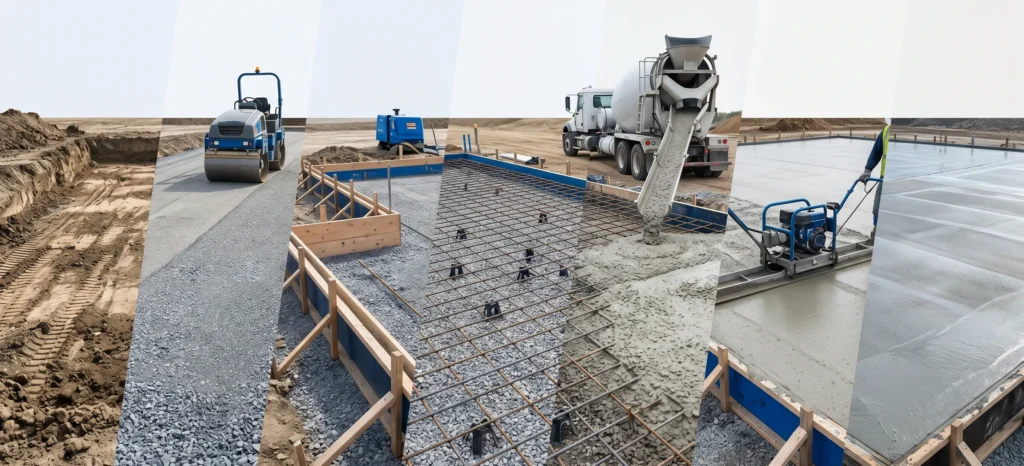
Pouring a slab requires precise timing and physical labor. Whether you do it yourself or hire a professional, the project follows a strict sequence to ensure the concrete cures flat and strong.
1. Site Preparation
The crew marks underground utility lines, clears the area of debris, and digs out the topsoil. They grade the dirt to create a slope for water runoff, then lay down a thick gravel base and pack it down tightly.
2. Setting the Forms
Workers build a rigid wooden frame around the perimeter of the project site. They drive wooden stakes into the ground to hold the boards securely and use a laser level to ensure the wet concrete stays at the exact required depth.
3. Reinforcement and Preparation
To give the slab structural strength, the crew places steel rebar or wire mesh inside the wooden forms. They often lay a plastic vapor barrier underneath to block ground moisture. Finally, they lightly wet the gravel base so the dry dirt does not pull moisture out of the fresh concrete.
4. Mixing and Pouring
A ready-mix truck arrives to deliver the concrete. The crew pours the wet mix continuously into the forms. They use shovels and mechanical vibrators to consolidate the material, moving it into the corners and removing trapped air pockets.
5. Finishing the Surface
Workers pull a straight screed board across the top of the forms to strike off the excess concrete and level the surface. They use a bull float to push aggregate down and bring the smooth paste to the top. Next, they run an edger along the sides and cut straight control joints into the slab to control future cracking. Finally, they apply a textured broom finish or trowel it completely smooth.
6. Curing and Form Removal
The concrete needs time to harden and gain its full strength. The crew often sprays the surface with a curing compound or covers it with plastic sheets to keep the moisture trapped inside. After the concrete hardens sufficiently, they pull the stakes and remove the wooden forms.
DIY vs. Hiring a Contractor for Concrete Slab Construction
Labor usually makes up half of your total bill. But you take on big risks. A bad pour leaves you with a bumpy and weak surface. For an outdoor project, a poor slope might push rain directly into your house foundation.
If you need a simple 10×10 shed pad or a short walking path, doing it yourself makes sense. You work on your own timeline. You also avoid the minimum service fees that contractors charge for small jobs. The main issue is the physical work and the exact timing required. Mixing wet concrete by hand takes a lot of energy.
Hiring a concrete professional often doubles the overall project price. Many homeowners use professional Residential Estimating Services to compare contractor pricing and understand total slab construction costs before starting the project. But a contractor brings the right tools and years of experience. For a large driveway, a garage floor, or a house foundation, you need an expert. They grade the dirt perfectly. They also set the steel reinforcement correctly so the slab stays intact. If you try a large DIY pour and fail, you have to pay a laborer to break up the bad concrete and start over. That mistake costs much more than hiring a pro from the start.
Expected Repair Costs for Concrete Slabs
Repairing a damaged concrete slab costs between $500 and $6,000. Your final price depends on the specific repair method, the total damage, and how easy it is to reach the site. Small surface problems cost very little to fix. Structural breaks require a much bigger budget.
Crack filling is your cheapest option. Patching small lines on the surface costs around $100 to $500. If the entire top looks rough or flaky, you can pay a laborer to resurface it. Concrete resurfacing costs about $3 to $5 per square foot. This method gives the old slab a brand new top layer.
Sometimes a concrete slab sinks unevenly into the ground. Concrete leveling fixes this issue for about $2,000 to $3,000. This process saves you money because it is much cheaper than tearing out the whole foundation. Plumbing leaks under the floor create a different challenge. Fixing a slab leak costs between $3,000 and $4,500. Plumbers must cut open the concrete to reach the broken pipe.
If the slab has massive structural breaks, simple repairs will not work. A complete concrete slab removal and replacement will cost between $8,000 and $10,000.
Smart Ways to Save on a Concrete Slab Project
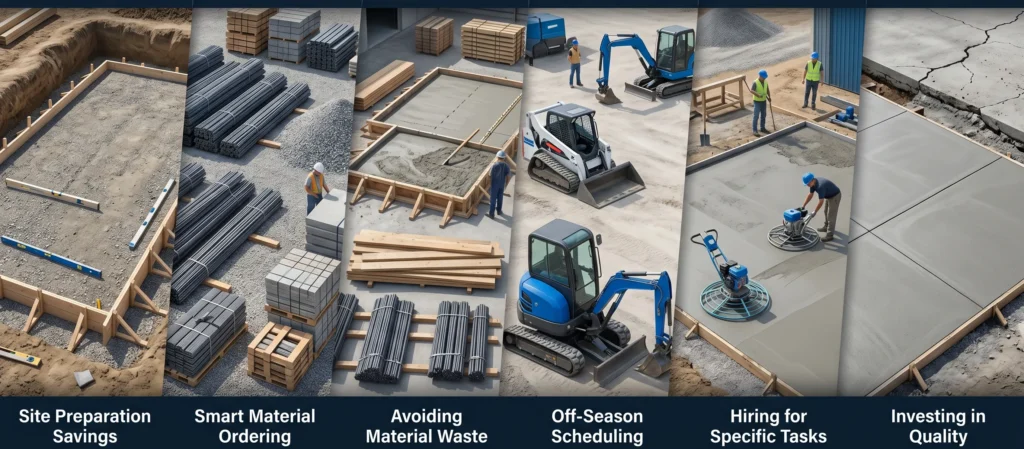
You can lower the price of a concrete project by managing parts of the work yourself and planning your purchases carefully. Taking out professional labor and material waste helps you stay within a tight budget. Small choices in the preparation phase lead to big savings on the final bill.
- Handle the Site Prep: You can save a lot by doing the digging and leveling on your own. Build your own wooden forms and install the gravel sub-base before the contractor arrives. This removes several hours of manual labor from your contractor’s quote.
- Order Materials Wisely: Look for local suppliers that offer discounts or lower prices for bulk orders. You can also ask for concrete mixes that use fly ash or slag cement instead of 100% Portland cement to reduce costs.
- Avoid Material Waste: Measure your project site multiple times to get an exact count. Buying only the material you need prevents you from paying for extra wet concrete that goes to waste. You can also find used materials like rebar or form boards on Craigslist or Facebook Marketplace.
- Schedule During the Off-Season: Contractors often charge less when they have fewer projects. Getting multiple quotes and scheduling your pour during their slow months helps you find the best rate.
- Hire for Specific Tasks: Consider hiring a pro only for the pouring and finishing work. Try to manage the setup by yourself and the final site cleanup to keep the hourly labor costs low.
- Invest in Quality: While it sounds odd, hiring an expert saves you money over time. A professional pour lasts much longer and resists cracking. Choosing a cheap, unskilled worker often leads to structural failure, which forces you to pay for a full replacement later.
Get Accurate Concrete Slab Estimates with ACON Engineering
ACON Engineering provides professional construction takeoff services and a complete cost analysis for any slab project. We provide professional outsource estimating services that help you understand your total expenditure before you sign a contract.
Our certified estimators help you control costs by calculating exactly how much material you need to buy. This prevents you from overspending on ready-mix concrete or steel reinforcement. We provide affordable and efficient estimating services that help you understand your total expenditure. With our detailed reports, you can manage your project more effectively and avoid the financial stress of manual math errors.
Frequently Asked Questions (FAQs)
How do you know when a concrete slab needs to be replaced?
You need to replace a concrete slab when you see deep, widening cracks or significant sinking across the surface. Severe spalling, crumbling edges, and persistent water drainage issues also signal a failing structure. If the steel rebar is exposed and rusted, or the slab is past its 30-year lifespan, simple repairs will not fix the problem, and you must replace the entire pour.
What is the difference between concrete and cement?
Cement is just one ingredient used to make concrete. It acts as a dry binding powder. Concrete is the final, durable building material created by mixing cement powder with water and aggregates like sand and gravel.
How much does it cost to add a bathroom on a concrete slab?
Adding a residential bathroom on an existing concrete slab generally costs between $5,000 and $75,000. The total price varies greatly based on the necessary plumbing trenches, the size of the room, and the overall complexity of the building structure.
How much does concrete slab removal cost?
Removing an old concrete slab costs about $2 to $7 per square foot. For a standard residential patio or driveway removal, most homeowners expect to pay an average of $1,400 to break up the material and haul the debris away.
What is the lifetime of a concrete slab?
A properly poured concrete slab lasts between 30 and 100 years. Routine maintenance and a stable gravel base help the surface reach its maximum lifespan without major structural failures. After the slab cures, you might also consider the cost to install vinyl plank flooring if you plan to turn the space into a finished room or office.

Tim C. is a construction estimating expert and Director at ACON Engineering, specializing in construction cost estimating, quantity takeoffs, and preconstruction planning. He has led thousands of successful project bids and helps contractors make informed, profitable decisions.