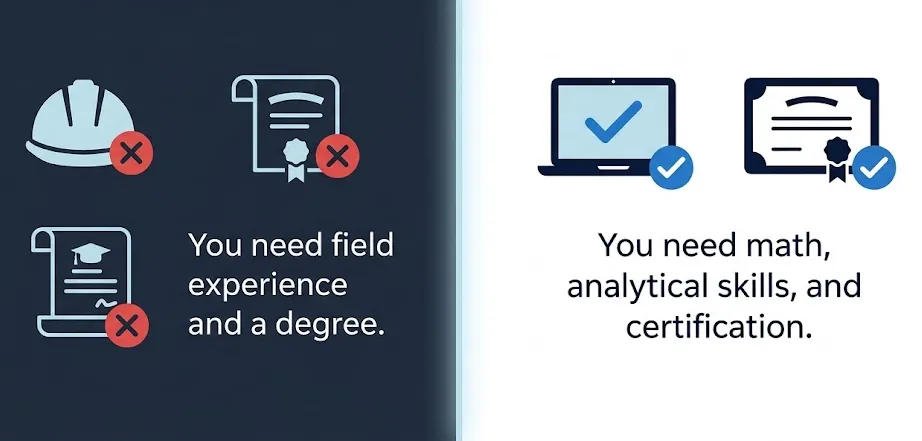
You do not need a decade in the field. No engineering degree required. You can start without any construction background at all.
A construction estimator figures out what a project will cost before the first shovel hits the dirt. They price the materials, the labor, the equipment, and the time. Some call them cost estimators. The title changes depending on the employer, but the job is the same: turn blueprints and specs into a number that keeps the project alive and the company profitable.
The pay is solid. The median salary sits around $77,070 per year, and experienced estimators pull in well over six figures. Demand is steady too. Even with automation creeping into other trades, someone still has to read the drawings, talk to the subcontractors, and decide whether that concrete bid is realistic or a fantasy.
So how do you get in if you have never stepped on a job site?
This guide will show you exactly how to become a construction estimator without any prior background. We will walk through what the job actually involves, which skills matter most, and how to build them from zero. You will learn the education paths that work, the certifications that open doors, and the stepping-stone jobs that get your foot in when you have no connections. By the end, you will have a clear career path from where you are now to your first estimator role.
What Is a Construction Estimator? (Definition, Duties, and Daily Work)
A construction estimator reads the plans, counts the materials, and turns everything into a price. They figure out how much steel, concrete, labor, and equipment a project needs, then build a bid that wins the job without bankrupting the company. Some work for general contractors chasing big commercial projects. Others work for subcontractors who only handle electrical or concrete. A few work directly for owners who want an independent opinion before they sign a contract.
The Bureau of Labor Statistics calls the role a cost estimator. That is the broader occupational title. A construction estimator is simply a cost estimator who specializes in buildings and infrastructure. The skills are the same. The math is the same. The only difference is the industry.
The core duties stay consistent regardless of employer. An estimator will:
- Prepare cost estimates for materials, labor, equipment, and time
- Read and interpret bid documents, specifications, and schematic drawings
- Build and maintain a directory of subcontractors, vendors, and suppliers
- Analyze quotations and compare pricing across multiple sources
- Conduct feasibility studies to see if a project is even worth bidding
- Monitor costs throughout the project lifecycle and report spending against the budget
- Advise on tender procedures, assess bids, and recommend awards
Most of this work happens in an office. The estimator sits at a desk with dual monitors, estimating software, and stacks of drawings. But they do not stay there. They visit job sites to see conditions firsthand. They walk the dirt. They measure existing structures. They meet with project managers and architects to clarify scope gaps. Some estimators spend eighty percent of their time in the office and twenty percent in the field. Others flip that ratio depending on the project phase.
That mix is what makes the job different from pure accounting or engineering. You need the head for numbers and the stomach for mud.
What Does a Construction Estimator Do?
A construction estimator figures out what it will cost to build something before anyone breaks ground. They study the drawings, count every beam and bolt, and turn those quantities into a dollar amount that the company can bid with confidence.
The process starts with material estimation, labor estimation, and equipment estimation. Accurate quantity takeoff services help estimators calculate materials and labor requirements more efficiently. The estimator calculates how much concrete, steel, lumber, roofing, and finishes the job requires, then factors in waste, delivery constraints, and price fluctuations. They determine man-hours for each trade, accounting for productivity rates, weather delays, and union rules. They price cranes, excavators, scaffolding, and temporary power, whether rented or owned.
Once quantities are tallied, the estimator runs cost analysis using historical pricing data, supplier quotes and Construction Estimating Services to improve bid accuracy and build a competitive final proposal. They compare supplier quotes against historical data from similar jobs, then adjust for location and market conditions. The final step is to prepare cost estimates in a formal bid package that goes to the owner or general contractor. That number either wins the project or sends the team back to the drawing board.
Construction Estimator vs. Cost Estimator: What’s the Difference?
The Bureau of Labor Statistics calls them all cost estimators. That is the occupational umbrella. It covers anyone who calculates the time, money, materials, and labor needed to deliver a product or service before work begins. Construction, manufacturing, software development. If you predict costs, you fall under this title.
A construction estimator is simply a cost estimator who works in the building industry. They price bridges, hospitals, apartment complexes, and strip malls. Their world revolves around concrete and steel instead of factory assembly lines.
A manufacturing estimator does the same math but for production runs and industrial equipment. A project estimator might float across industries, pricing everything from infrastructure to interior fit-outs depending on the employer. The skills transfer. The software overlaps. The only real difference is the context.
So when you see cost estimator in a government report or salary survey, know that construction estimators are already included in that number. When you see construction estimator in a job posting, the employer is looking for someone who knows building trades, bid procedures, and the rhythm of a job site.
Where Do Construction Estimators Work?
Construction estimators work wherever someone needs a number before committing to a build. The employer type shapes the job more than most people realize.
- General contractors hire estimators to bid on entire projects. They need someone who can price every trade, manage risk across the full scope, and defend the bid in front of the owner.
- Subcontractors hire estimators who specialize. A concrete subcontractor wants an estimator who knows rebar, formwork, and pour rates cold. They do not need someone who prices HVAC.
- Construction managers sometimes embed estimators into their preconstruction teams. These estimators work early in the design phase, feeding cost data back to architects before the drawings are finalized.
- Design teams bring estimators in to keep the project realistic. The estimator tells the architect whether that glass curtain wall will blow the budget before it gets drawn in detail.
- Owner’s representatives hire independent estimators to check the contractor’s numbers. This is the oversight role. The estimator acts as a watchdog, not a bidder.
- Construction companies of all sizes need estimators, from small residential builders with one estimator wearing multiple hats to national firms with dedicated departments chasing billion-dollar portfolios.
Where you work determines what you estimate, who you report to, and how much pressure you face on bid day.
Can You Become a Construction Estimator Without Experience?
Yes. It happens more often than most people think.
I have seen estimators walk into six-figure roles with nothing but a high school diploma and a willingness to learn. Former retail managers, military logistics specialists, and accounting clerks pivot into estimating inside of two years. The industry cares about results, not pedigree. If you can read a drawing, run the math, and build a bid that wins work, nobody asks where you went to college.
Employers look for three things. Education. Experience. Presentation. You do not need all three at the start. You need enough of two to cover the gap in the third.
The paradox is simple. Every posting asks for experience. But you cannot get experience without a job. The way around this is to build it in roles that sit next to estimating. Procurement assistant. Field surveyor. Junior project coordinator. Each puts you in the same building as the estimators. You learn to read vendor quotes, translate physical space into numbers, and track how costs move in real time.
Other backgrounds transfer fast. Military veterans understand vendor relationships and material movement. Accounting professionals know cost tracking and discrepancy spotting. Retail managers understand pricing psychology and supplier negotiation. Even tradespeople bring field knowledge no classroom can replicate.
Now, there is one thing you might be concerned about. If you have zero construction background, you may wonder whether anyone will take you seriously. They will. But you have to show them something. A certificate. A portfolio of practice estimates. Software fluency. Proof that you understand the work.
You do not need ten years. You need a start that points toward estimating. The rest compounds faster than you expect.
The Reality of Breaking Into Estimating With No Background
Three myths keep people from even trying. Let me kill them here.
Myth one: You need an engineering degree. You do not. I know estimators running eighty-million-dollar bids who never finished college. They learned on the job, got certified, and built reputations one accurate bid at a time. An engineering degree opens doors faster, no question. But it is not a lock on the door.
Myth two: You need years of field experience. Helpful. Not required. Field experience teaches you what things actually cost when the weather turns or a supplier flakes. But you can learn that through mentorship, site visits, and paying attention during takeoffs. Plenty of estimators started in offices and visited their first job sites after they were already employed.
Myth three: You need to know someone. Connections help in every industry. But construction estimating has a labor shortage. Companies need people who can do the work. If you show up with a certificate, software skills, and a portfolio of practice estimates, you become someone worth knowing.
The truth is messier than the myths. Breaking in takes effort. You will face rejection. You will start at a lower salary than you want. But the barrier is not a wall. It is a slope. Steep at first, then gradual once you get moving.
Transferable Skills That Speed Up Your Entry
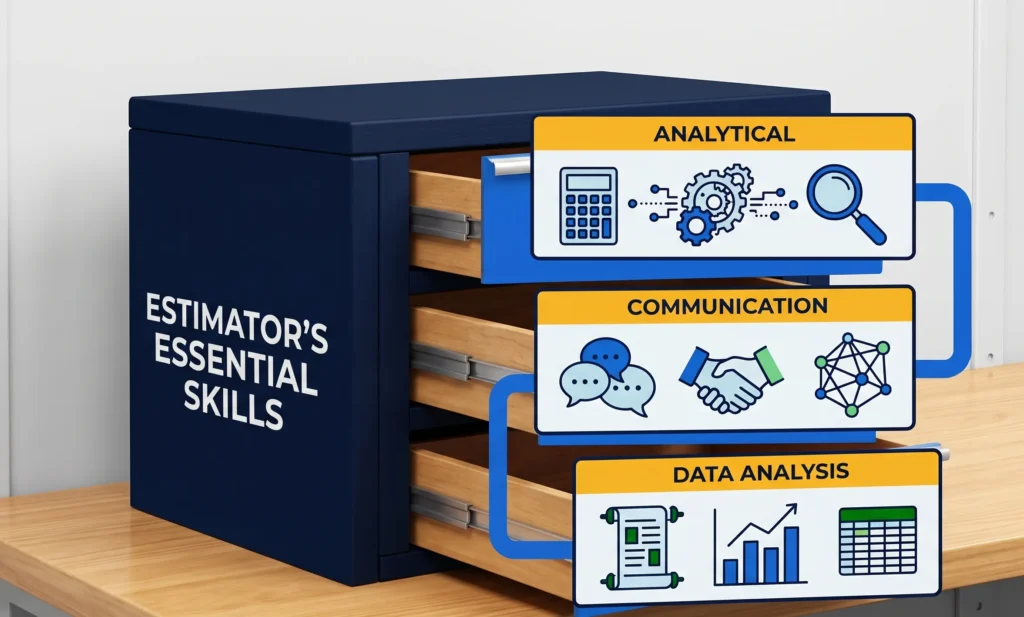
You already have more of the required skills than you realize.
- Math skills. Estimating is arithmetic and algebra at its core. You add, subtract, multiply, and divide quantities against unit prices. If you can handle a budget or balance a checkbook, the math will not stop you.
- Analytical skills. Every estimate is a puzzle. You compare three supplier quotes, spot the outlier, and figure out why one bid is ten percent lower than the others. If you have ever negotiated a car purchase or analyzed an insurance claim, you have done this already.
- Computer skills. Modern estimating lives in software. Spreadsheets, takeoff programs, and cost databases are your tools. If you are comfortable in Excel, you are closer than you think.
- Communication skills. Estimators defend their numbers in meetings. They ask subcontractors for clarifications. They explain to owners why the concrete bid came in high. If you have presented in a meeting or handled a difficult client call, you have the foundation.
- Data analysis. You will read hundreds of pages of specifications, drawings, and vendor quotes. The ability to extract the numbers that matter and ignore the noise separates good estimators from great ones.
- Detail-oriented. One missed line item can cost a company six figures. If you are the person who catches typos in emails or notices when a receipt does not add up, this trait will serve you well.
None of these require construction experience. They require habits. And habits transfer across industries faster than job titles do.
Stepping-Stone Jobs That Lead to Estimating
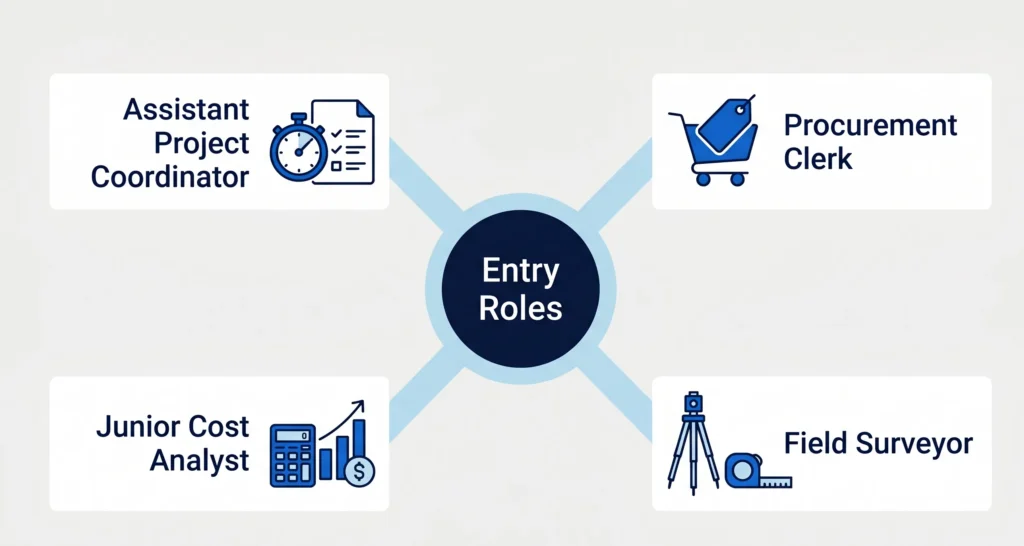
You do not need to start with the title. You need to start with the work.
- Assistant Project Coordinator. You track budgets, update schedules, and distribute documents. You learn how costs move in real time and how projects fall apart when communication breaks down. That is estimating in slow motion.
- Procurement Clerk. You request quotes, compare vendor pricing, and build purchase orders. You learn what materials cost, who delivers on time, and who pads their bids. That is half of material estimation right there.
- Field Surveyor. You measure existing conditions, document site constraints, and translate physical space into digital data. Estimators rely on that data to build accurate quantities. You learn to see what drawings miss.
- Junior Cost Analyst. You review historical project data, build cost reports, and assist senior estimators with takeoffs. You sit next to the people doing the job you want. That proximity is worth more than any online course.
- Trade Apprentice. Electricians, carpenters, and concrete finishers learn how buildings go together from the inside out. When they transition to estimating, they already know where the risks hide. That field knowledge is impossible to fake.
Each of these roles pays the bills while you build the portfolio. Stay twelve to eighteen months, learn aggressively, and start applying for estimator positions with real stories to tell.
Construction Estimator Education Requirements: Degree, Certificate, or Self-Taught?
There is no single door into this career. There are three, and they all lead to the same room.
A bachelor’s degree is the traditional route. Employers prefer construction management, civil engineering, architecture, quantity surveying, or building science. These programs teach structural systems, scheduling, and contract law. They signal that you can finish something hard. The downside is four years of tuition and time.
Certificate programs compress the essentials into weeks or months. You study estimating fundamentals, cost analysis, and software basics. The American Society of Professional Estimators runs an Estimating Academy. RSMeans offers a self-paced Fundamentals course. Certificates do not replace a degree, but they prove intent and competence to employers who need doers, not talkers.
The self-taught path is the slowest and most common among career switchers. You read unit price books, practice takeoffs on public drawings, and build a portfolio of sample estimates nobody asked for. Nobody checks your homework. Nobody hands you a credential. But pair self-study with a stepping-stone job and you close the gap fast.
Most working estimators took a hybrid path. A high school diploma. A few years in a related role. Some on-the-job training from a senior estimator. Maybe a certificate later. Construction respects results more than paperwork. If you can build a bid that wins work, your pedigree becomes irrelevant.
So which path should you take? If you are twenty-two with four years to invest, get the degree. If you are thirty-five with bills and a mortgage, get the certificate and start applying. If you have nothing but time and determination, build the portfolio and prove yourself through the work.
Do You Need a Degree to Be a Construction Estimator?
No. But it opens doors faster.
If you are choosing a degree specifically for this career, construction management sits at the top. It teaches estimating, scheduling, contract law, and project delivery methods. Employers recognize it immediately. Civil engineering comes next. It builds deep structural knowledge and mathematical rigor. The tradeoff is less business training. You graduate knowing how bridges stand up, but you may need extra study to learn how bids get built.
Architecture degrees work too, especially for estimators who specialize in complex commercial or institutional projects. You understand design intent, drawing conventions, and how architects think about scope. That empathy helps when you are arguing about whether that curtain wall detail is realistic or aspirational.
Quantity surveying is the most direct path, though it is more common in the UK and Commonwealth countries than in the US. Building science degrees cover materials, moisture management, and building envelope performance. Niche, but valuable for estimators who specialize in technical or high-performance construction.
Here is the honest hierarchy. A construction management degree gets you interviewed first. A civil engineering degree gets you respected fastest. An architecture degree gets you invited to the design meetings. Anything else, business, finance, economics, works if you pair it with a certificate and some field exposure.
The degree is a filter. Employers use it to shrink the applicant pool. But once you are in the interview, the portfolio matters more than the diploma. And once you are on the job, the accuracy of your bids matters more than either.
Construction Estimating Certificate Programs
Certificate programs strip away the general education requirements and give you only what you need to start estimating. They run from a few intensive weeks to a full semester, depending on the depth and delivery format.
Most programs cover the same core ground. You learn how to read construction drawings and specifications. You practice quantity takeoffs for concrete, steel, and finishes. You study cost databases, unit pricing, and markup strategies. You build at least one complete estimate from scratch, usually based on a real project that has already been bid, so you can compare your number against the actual outcome.
The American Society of Professional Estimators runs an Estimating Academy with courses that follow an eight-week schedule. Some are live virtual sessions. Others are fully on-demand. They bring in subject matter experts who have run bids for major contractors, not just academics who have read about it.
RSMeans offers a self-paced Fundamentals of Construction Cost Estimating course. Eight lessons. Real examples. Hands-on practice with bid documents, quantity takeoffs, and pricing. The advantage of self-paced is that you keep your day job. The disadvantage is that nobody holds you accountable when motivation dips.
These certificates will not replace a four-year degree on a resume. They will not guarantee a job. What they do is prove that you have done the work to understand the work. They give you vocabulary, frameworks, and a sample estimate you can show in an interview. For career switchers who cannot afford four years of tuition, that is often enough to get the first yes.
Estimating Seminars, Classes, and Online Training
Not everyone needs a certificate. Sometimes you need a single skill, fast.
Seminars run from a half-day to three days. They cover narrow topics. A seminar on concrete estimating. A workshop on Building Information Modeling (BIM) takeoffs. A weekend intensive on reading structural drawings. These are perfect if you already work in construction and need to fill one gap before asking for a promotion. They are also ideal for career switchers who want to test the waters before committing to a full program.
Classes stretch longer, usually four to twelve weeks with weekly sessions. They offer more structure than seminars and more flexibility than degree programs. You get homework, feedback, and a cohort of peers who are also grinding through the material. The accountability matters. Self-study fails most people not because the content is hard, but because nobody checks whether they did the work.
Online training covers everything from free YouTube tutorials to subscription platforms with hundreds of hours of content. The quality varies wildly. A good rule is to look for instructors who have held estimator titles at real companies, not just trainers who learned training from other trainers. The best online courses include practice drawings you can download and estimate yourself.
Continuing education is not just for beginners. Certified estimators also need professional development units to maintain their credentials. Seminars and classes count toward those requirements. So the same seminar that gets you started can also keep you current a decade later.
The key is to match the format to your life. If you have forty hours a week, take the certificate. If you have forty hours a month, take the class. If you have forty hours total, take the seminar and start applying what you learned immediately.
The High School Diploma Path: Is It Enough?
Yes, if you bring something else to the table.
I have met estimators who never spent a day in college. They started as laborers, learned the trades from the ground up, and gradually moved into the office. They know what a cubic yard of concrete looks like because they have placed it. They know when a subcontractor is padding a bid because they have been that subcontractor. That knowledge is worth more than any degree when the numbers have to match reality.
But this path takes longer. You need years of practical experience to compensate for the missing credential. You need to prove yourself in roles that do not have “estimator” in the title. You need to volunteer for extra work, ask questions that reveal intent, and build relationships with the estimators who might hire you later.
The specific conditions that make this path work are non-negotiable. You need field experience. Not a summer internship. Real, sustained exposure to how buildings go together. You need software proficiency. If you cannot navigate estimating programs and spreadsheets, the high school diploma becomes a liability, not a neutral fact. You need a portfolio of sample estimates that show you can do the work. And you need patience, because the promotions come slower and the rejections sting more when you cannot point to a certificate or degree as shorthand for competence.
This path fits a specific person. Someone who learns by doing. Someone who thrives in the field and does not mind starting at the bottom. Someone who would rather spend five years earning while learning than four years paying for a classroom education they are not sure they need.
If that is you, the high school diploma is enough. But only if everything else is better than average.
How to Become a Construction Estimator: A 5-Step Roadmap
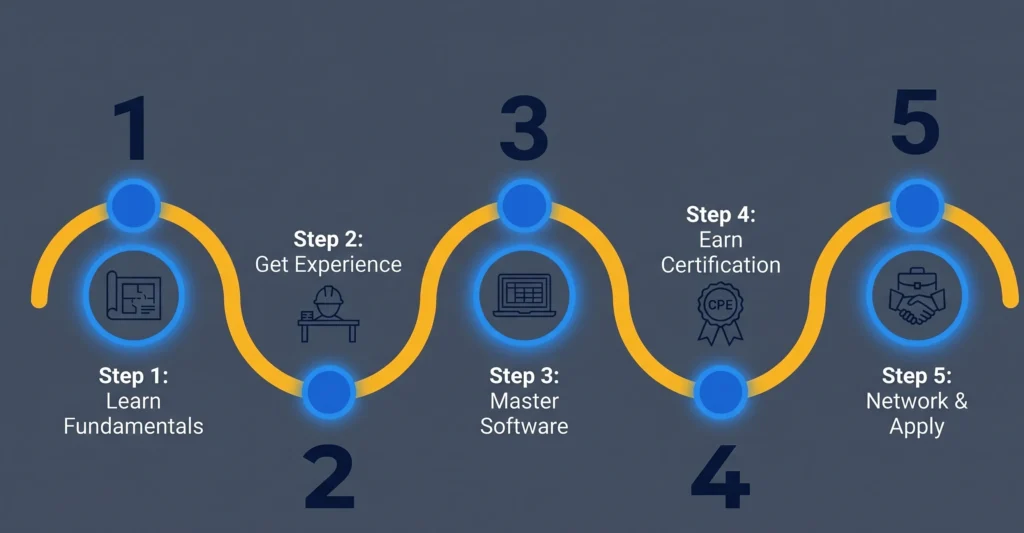
Everything we have covered so far sets the table. This is the meal.
The roadmap below works whether you have a degree or a high school diploma, whether you have ten years in the field or ten days of curiosity. Each step builds on the last. Learn the fundamentals. Get experience any way you can. Master the software. Earn a certification. Then build the relationships that turn credentials into job offers.
Step 1: Learn Construction Estimating Fundamentals
Before you touch software or apply for jobs, understand what you are estimating.
Start with cost estimation itself. Learn how projects break into phases, how risk layers into contingency, and how quantities, unit prices, and historical patterns build a structured prediction. Then study cost analysis. Compare your calculated numbers against reality. Check whether the concrete actually cost what you predicted. If not, was the quantity wrong? The price? The waste factor? Good estimators obsess over this feedback loop.
Understand the three cost pillars. Material costs fluctuate with commodity markets and delivery constraints. Labor costs shift with union rates, productivity assumptions, and overtime rules. Equipment costs depend on whether you rent, own, or subcontract the machinery.
Learn to read bid documents. Specifications tell you the quality level, while understanding the construction bidding process helps estimators prepare accurate proposals. Schematic drawings show the scope. Addenda change things mid-process. Miss one line in a spec and your entire flooring estimate collapses.
Resources are cheap. David Gerstel’s Nail Your Numbers is the closest thing this industry has to a bible. RSMeans unit price books give baseline pricing for thousands of line items. Many public agencies publish past bid results online so you can reverse-engineer real projects.
Your action step this week: download public project drawings, pick one trade, and attempt a manual quantity takeoff using the same methods applied in professional construction takeoff services. Count the doors. Measure the drywall. Look up unit prices. Build one line item from scratch. It will be wrong. That is the point. You need to see where the gaps are before anyone else does.
Step 2: Get Hands-On Field or Office Experience
You cannot learn estimating from a book alone. At some point you have to touch the work.
Start in roles that sit next to estimating without requiring the title. Procurement clerk. Assistant project coordinator. Field surveyor. Junior cost analyst. Trade apprentice. Each puts you in the same building as the estimators, sometimes literally at the next desk.
Use that proximity. Ask to shadow an estimator for a day. Most will say yes if you frame it as professional development. Watch how they read drawings, what questions they ask subcontractors, and how they track changes across bid revisions. Take notes. Build a private library of observations.
Volunteer for tasks that edge toward estimating. Compile vendor quotes. Review the monthly cost report before it goes to the project manager. Sit in on bid review meetings, even if you say nothing. The goal is to accumulate stories you can tell in an interview later.
Mentorship accelerates everything. Ask specific questions, not generic ones. “How did you decide to add ten percent contingency on the concrete?” lands better than “How do I become an estimator?” Over time, senior estimators start handing you small tasks. A takeoff on a minor trade. A quote comparison for routine material. That is your foot in the door.
Expect 12-24 months in a stepping-stone role before you can credibly apply for estimator positions. The variable is not talent. It is exposure. The more estimating-adjacent work you do, the shorter the gap.
Step 3: Master Estimating Software and Technology
The estimators who get hired fastest today can sit down at a computer and produce a number without someone holding their hand. Software fluency is no longer a bonus. It is the price of entry.
Start with estimating software. These programs combine quantity takeoffs, cost databases, and bid assembly into one workflow. You draw measurements on-screen, link them to unit prices, and watch the total calculate in real time. Learn one deeply and the others feel familiar within days.
Understand takeoff tools. 2D software lets you measure lengths, areas, and counts directly from PDF drawings. 3D software pulls quantities from BIM models automatically. The industry is shifting toward 3D because it catches conflicts earlier and updates quantities instantly when designs change. You do not need to be an expert in both. But you need to know the difference and speak intelligently about which fits which project type.
Cost databases are your pricing backbone. They contain historical unit prices for thousands of materials and labor tasks, adjusted by location and market conditions. The skill is not finding the number. It is knowing when the database is stale, when to call a supplier for a current quote, and when to override the default with local knowledge.
Cloud-based software now lets multiple estimators work on the same bid simultaneously from different offices. Project managers review your work in real time. The days of emailing spreadsheets back and forth are ending.
You can learn most of these tools without spending money. Many vendors offer free trials or limited-feature versions. Download one. Import a public project drawing. Build a practice estimate. Break things. Fix them. Repeat. The portfolio you build becomes more valuable than any certificate when you walk into an interview.
Demonstrate this by bringing a laptop. Walk through a takeoff while the hiring manager watches. Talk about what you did, why you did it, and what you would do differently next time. That carries more weight than any resume bullet.
Step 4: Earn Your Certified Professional Estimator (CPE) Credential
Certification turns self-taught knowledge into third-party credibility. It tells employers that someone other than yourself has verified you understand the work.
The Certified Professional Estimator from the American Society of Professional Estimators is the most recognized credential in construction estimating. The exam covers estimating principles, cost analysis, project management, and professional ethics. Pass rates sit around fifty percent. That is the point.
AACE International offers the Certified Cost Professional, which spans industries beyond construction. It carries weight with owners and government agencies who hire estimators for large infrastructure projects.
For candidates without degrees, certification is the great equalizer. It does not erase the diploma gap. But it narrows it. When an employer sees CPE after your name, they know you have passed a standardized test, adhered to a code of ethics, and committed to continuing education. That is often enough to get past the resume screen and into the interview room.
Do not rush to certify before you have experience. The exam assumes you have seen real projects, real problems, and real cost overruns. Study for it while you work your stepping-stone job. Take it after 18-24 months of estimating-adjacent exposure. By then the concepts will stick because you have lived them, not just read them.
Step 5: Build Your Professional Network and Apply Strategically
The best estimator jobs rarely hit public job boards. They travel through relationships first.
Start with ASPE membership. Local chapters meet monthly. You sit in rooms with estimators who have decades of experience and hiring authority. Bring business cards. Ask questions. Follow up. These relationships turn into job leads, mentorship offers, and references that carry more weight than any resume bullet.
Industry events work the same way at larger scale. Regional conferences and preconstruction summits pack hundreds of professionals into one building. The hallway conversations are where careers get made. Introduce yourself as an aspiring estimator, not someone looking for any job. Specificity signals intent. Vagueness signals desperation.
LinkedIn is your digital storefront. Post about projects you are studying. Share observations about cost trends. Comment thoughtfully on posts from established estimators. Hiring managers check LinkedIn before they call. Make sure what they find matches the professional you claim to be.
When you interview, lead with stories, not credentials. Do not say “I am a fast learner.” Say “I built a complete drywall takeoff for a mock project and came within eight percent of the actual bid.” Do not say “I have good communication skills.” Say “I presented a cost comparison that saved twelve thousand dollars on a material order.” Specificity builds trust. Abstractions build skepticism.
Your professional reputation starts forming before you have the title. Every interaction, every follow-up email, every public post contributes to it. Build it deliberately. Protect it carefully. In an industry this tight-knit, your name travels faster than your resume.
Construction Estimator Salary: How Much Do Estimators Make?
Money is not the only reason to choose a career, but it is the reason most people start researching one.
The sections below break down exactly what construction estimators earn, from first-year rookies to certified veterans pulling down six figures. You will see the official government numbers, the variables that push pay up or down, and what the job market looks like through 2034.
Median Pay, Hourly Wage, and Entry-Level Salary
A construction estimator in the United States earns a median annual wage of $77,070, which breaks down to roughly $37.05 per hour according to the Bureau of Labor Statistics. Entry-level estimators typically start between $36,500 and $50,000. Experienced and certified professionals routinely clear $100,000, with top performers reaching $132,000 or more.
| Level | Annual Salary | Hourly Equivalent |
| Entry-Level | ~$36,500 – $50,000 | ~$17.55 – $24.00 |
| Median (BLS 2024) | $77,070 | $37.05 |
| Experienced / Certified | ~$100,000 – $132,000 | ~$48.00 – $63.50 |
That $77,070 figure from the BLS reflects W-2 median wages for full-time cost estimators across all industries. Third-party aggregators like ZipRecruiter report higher averages, around $88,500, because they include contractor compensation, overtime, bonuses, and independent estimator fees. Both numbers are accurate. They just measure different pools. If you are evaluating whether this career supports your lifestyle, use the BLS median as your conservative baseline and the higher figures as your upside target.
Pay scale shifts dramatically based on where you work, who employs you, and whether you have pursued estimator certification. The next section breaks down those variables.
What Factors Affect a Construction Estimator’s Salary?
The gap between $50,000 and $130,000 is not random. It is explained by five variables you can partially control.
- Location. Estimators in major metros earn twenty to forty percent more than those in rural markets. San Francisco, New York, and Seattle lead the pack. But cost of living eats much of that premium. A $95,000 salary in Houston often outperforms a $120,000 salary in Manhattan once housing gets factored.
- Employer type. Large general contractors and specialized engineering firms pay more than small residential builders. Independent estimators who consult directly for owners can earn the most, but they carry the risk of irregular work and no benefits.
- Certification. The CPE or CCP credential does not guarantee a raise. But it removes the ceiling. Certified estimators qualify for senior roles, government contracts, and consulting engagements that uncertified estimators cannot touch.
- Years of experience. The first five years are steep. You might see ten to fifteen percent annual bumps as you prove accuracy and speed. After year ten, the curve flattens unless you move into management or start your own practice.
- Industry specialization. Electrical and structural estimators command premiums because the technical complexity weeds out generalists. Manufacturing estimators often earn less than commercial construction estimators because the projects are smaller and more repetitive.
Consider two estimators with identical job titles. One works for a mid-sized residential builder in Ohio, has four years of experience, no certification, and prices single-family homes. The other works for a national contractor in Texas, has eight years of experience, holds a CPE, and specializes in healthcare construction. The first earns $58,000. The second earns $118,000. The title is the same. The factors are not.
Job Outlook and Employment Demand Through 2034
The Bureau of Labor Statistics projects that cost estimator employment will decline four percent between 2024 and 2034. That is roughly 9,300 fewer jobs nationwide over the decade. The headline sounds alarming. The reality is more nuanced.
That decline reflects automation and software consolidation, not a dying profession. Companies are merging estimating departments. Software is handling routine takeoffs faster than humans. But buildings are not pricing themselves. Someone still has to validate the software output, negotiate with subcontractors, and defend the final number to owners who do not trust algorithms.
Here is what the headline misses. Despite the projected decline, the industry will still produce about 16,900 job openings every single year. Every one of those openings comes from replacement demand. Retirements. Career changes. Promotions into management. The people leaving estimating are not being replaced by robots. They are being replaced by other people.
For new entrants, this is actually favorable. A shrinking pool of total jobs sounds scary. But a steady stream of replacement openings in a field where experienced workers are aging out creates a conveyor belt of opportunity. You are not competing for new positions that may or may not materialize. You are competing to fill seats that are emptying on a predictable schedule.
The practical implication is simple. Do not expect the wild growth of tech or healthcare. But do expect stability, decent pay, and a clear path from entry-level to senior roles. The estimators who thrive will be the ones who adapt to software, specialize technically, and build relationships that algorithms cannot replicate.
Essential Construction Estimator Skills (Hard, Soft, and Technical)
Employers do not hire estimators for one skill. They hire for a bundle that spans three categories.
Hard skills are the technical abilities you can test and measure. Math, cost analysis, quantity takeoffs, bid assembly. Soft skills are the human abilities that determine whether your bids get accepted or rejected. Communication, negotiation, time management, attention to detail. Technical skills are the digital abilities that separate modern estimators from the ones who retired with slide rules. Software fluency, BIM literacy, database navigation.
The sections below break down what each category contains and why missing any one of them creates a ceiling you will not break through.
Math, Data Analysis, and Cost Awareness
Estimating is not calculus. It is arithmetic with consequences.
You add lengths to get totals. You multiply quantities by unit prices. You divide square footage by coverage rates. If you can handle a spreadsheet and remember how percentages work, the math will not stop you. What trips people up is not complexity. It is volume. A single estimate might contain five hundred line items. Each one needs to be right. The math is simple. The discipline to check every cell is not.
Data analysis is where you turn raw numbers into decisions. Three subcontractors bid the same scope. One is twenty percent lower. Is that a bargain or a trap? A good estimator analyzes the bid breakdown, checks the unit prices against historical data, and calls the low bidder to ask why their number diverges. Sometimes the answer is legitimate. Sometimes it is a mistake that would have cost everyone later. Data analysis is the skill that catches the mistake before it becomes a change order.
Cost awareness is the instinct that develops over time. You learn what concrete costs in January versus July. You know that steel prices spike when tariffs shift. You sense when a labor estimate is optimistic because you have seen crews work in similar conditions. This is not something you study. It is something you absorb through repetition and attention. New estimators build it by reviewing past projects, comparing their predictions against actual costs, and asking senior estimators why the numbers diverged.
The math threshold is lower than most people fear. Algebra and spreadsheet logic are enough. What separates candidates is not mathematical brilliance. It is the patience to organize five hundred line items and the humility to check the total twice.
Communication, Presentation, and Negotiation
Your estimate is only as good as your ability to defend it.
Every bid ends up in a room where someone questions the number. Owners want to know why the project costs more than their budget. Project managers want to know where the contingency went. Subcontractors want to know why you cut their scope. The estimator who cannot explain their work loses credibility fast. The estimator who can earns trust that outlasts any single project.
Communication skills show up in small moments. A clear email to a supplier asking for a revised quote. A phone call to a subcontractor clarifying a scope gap. A weekly cost report that tells the project manager exactly where the budget stands without making them dig through spreadsheets. Each interaction builds or erodes confidence in your numbers.
Presentation skills matter in the big moments. You stand in front of an owner with twenty slides and ten minutes. You explain how you arrived at the total. You show the alternatives. You acknowledge the risks. You do not read from the spreadsheet. You translate the spreadsheet into a story about what the project actually costs and why. The owners who trust your presentation trust your number. The ones who do not trust your presentation hire someone else to check it.
Negotiation is where estimates become contracts. You negotiate with subcontractors to sharpen their bids. You negotiate with owners to justify contingencies they do not want to pay for. You negotiate internally with project managers who want to cut your number to win the job. Every concession you make has a cost. The skill is knowing which concessions are sustainable and which ones will destroy the project later.
The cost of getting this wrong is not a bad meeting. It is a lost bid, a blown budget, or a lawsuit. An estimator who builds perfect numbers but cannot explain them becomes a back-office technician. An estimator who builds solid numbers and defends them masterfully becomes indispensable.
Estimating Software, Building Information Modeling (BIM) Tools, and Digital Takeoffs
The estimators who get hired today are not just good with numbers. They are good with systems.
Estimating software is the foundation. These programs combine quantity takeoffs, cost databases, and bid assembly into one workflow. You measure from drawings, link quantities to unit prices, and build a proposal that looks professional enough to submit. The specific program varies by company. The underlying logic does not. Learn one deeply and the others become familiar within days.
BIM tools are changing how estimators work, especially in projects involving BIM HVAC estimating integration. Building Information Modeling creates a three-dimensional digital version of the project before construction starts. Estimators extract quantities directly from the model instead of measuring manually from two-dimensional drawings. The advantage is speed and accuracy. Change a wall thickness in the model and every related quantity updates automatically. The disadvantage is that models contain errors too. A missing object in the digital file becomes a missing line item in the estimate. Good estimators verify the model, not just trust it.
2D takeoff software still dominates smaller projects and residential work. You open a PDF, draw lines and areas over the drawings, and the software calculates lengths and counts. It is simpler than BIM. It requires less setup. For projects without a model, it is still the fastest path to a number.
3D takeoff software works with BIM models directly. You navigate the building in three dimensions, click on objects, and extract quantities. The learning curve is steeper. The payoff on complex commercial projects is substantial. An estimator who can work in 3D completes takeoffs in hours that used to take days.
Cost databases live inside most estimating programs. They contain historical pricing for materials and labor, adjusted by location and market conditions. The skill is not finding the number. It is knowing when the database is stale, when to call a supplier for a current quote, and when to override the default with local knowledge.
Cloud collaboration means multiple estimators can work on the same bid simultaneously from different offices. Project managers review your work in real time. Owners see cost impacts the moment you adjust a quantity. The days of emailing spreadsheets back and forth are ending. Modern estimators work in shared environments where transparency is expected.
Tech-savvy candidates have a measurable hiring advantage. Not because they know every program. Because they learn the next one faster. Construction software changes constantly. The estimator who adapts keeps working. The estimator who resists becomes obsolete.
Demonstrate this in interviews by bringing a laptop. Open a practice estimate. Walk through a takeoff while the hiring manager watches. Talk about what you did, why you did it, and what you would do differently on the next one. That demonstration carries more weight than any certification or degree.
Types of Construction Estimators and Career Specializations
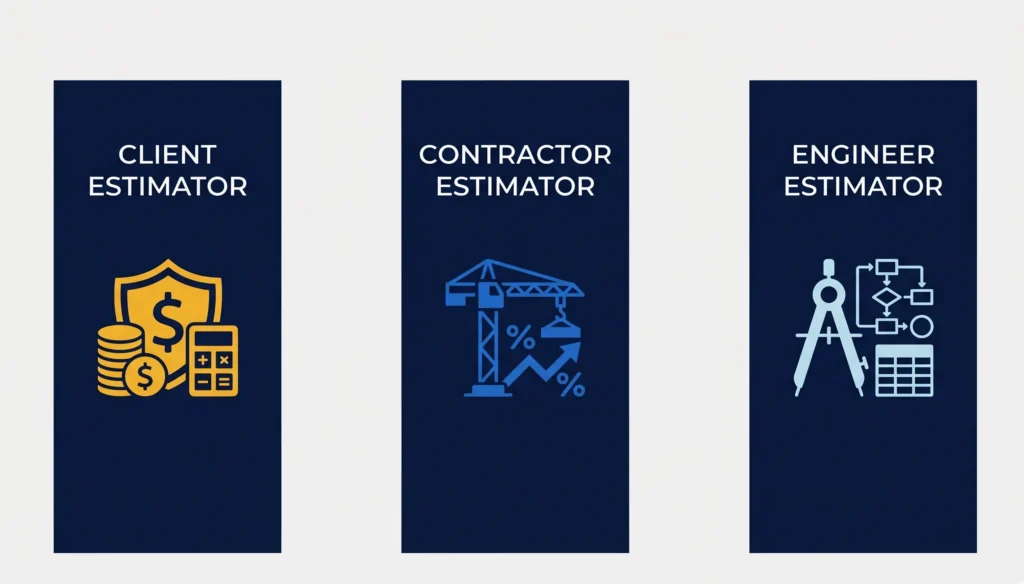
Not every estimator does the same work. The title changes based on who pays you and what you estimate. Understanding these distinctions early helps you aim at the right jobs and avoid roles that will box you in.
Generally, construction estimators fall into the following three categories.
- Client estimators: These estimators work for owners. They evaluate whether a project is worth building, negotiate contracts, and monitor costs after construction starts. Their loyalty is to the budget, not the builder.
- Contractor estimators: They work for construction firms. They build bids to win work. Their loyalty is to the company margin, which means they need deep knowledge of their own equipment, labor rates, and preferred subcontractors.
- Engineer estimators: They usually work for design firms or as consultants. They evaluate alternative construction methods and present budget-friendly options to clients who have not committed to a direction yet.
The industry-specific split is also there. Residential construction estimators price houses, apartments, and small developments. The projects are smaller, the cycles are faster, and the software is often simpler. Commercial construction estimators price offices, hospitals, schools, and retail complexes. The projects are larger, the teams are bigger, and the BIM requirements are heavier. Industrial and manufacturing estimators work in factories, power plants, and process facilities. The technical complexity is higher. The safety requirements are stricter. The pay often reflects both.
Specialization is not something you do on day one. It is something you earn. Start broad. Learn a little about every trade. Work on projects across multiple industries. After two or three years, you will notice where your strengths cluster. Maybe you have a knack for electrical systems. Maybe you understand healthcare construction better than your peers. Maybe you thrive in the pressure of high-rise bids. That is when you specialize. Not because a blog told you to. Because the market is already telling you where you add the most value.
The estimators who earn the most are rarely the generalists. They are the specialists who can price what others cannot.
Contractor Estimator, Client Estimator, and Engineer Estimator
Who signs your paycheck changes everything about the job.
A contractor estimator works for the company building the project. Their job is to win work without losing money. They know their own equipment costs cold. They maintain relationships with subcontractors who give them preferred pricing. They understand which construction methods their crews execute best. When they build a bid, they are not just pricing the drawings. They are pricing their own capability to deliver. The pressure is front-loaded. Bid day is intense. The reward is seeing your number turn into a project your company builds.
A client estimator works for the owner or the owner’s representative. Their job is to protect the owner’s investment. They review contractor bids for reasonableness. They recommend whether to accept, negotiate, or reject. They monitor costs during construction and flag overruns before they spiral. Their loyalty is to the budget, not the builder. The pressure is distributed across the project timeline. They do not chase bid deadlines. They chase accuracy and accountability.
An engineer estimator usually works for a design firm or engineering company. They operate at the earliest project phase, often before the drawings are complete. They run rough-order-of-magnitude estimates to test whether the owner’s vision matches their budget. They evaluate alternative materials and methods. They advise the architect on cost implications of design decisions. Their work is less precise than a contractor’s final bid, but more influential. A decision made at this stage saves more money than any value engineering done later.
An independent estimator works for themselves. They consult for owners who want a second opinion. They help contractors who lack estimating staff. They testify in disputes where cost claims are contested. The pay is highest here, but so is the risk. No projects means no income. No reputation means no projects. This path suits estimators who have spent a decade building relationships and a track record that sells itself.
Autonomy follows a clear hierarchy. Contractor estimators have the least. They answer to operations managers and division presidents. Client estimators have more. They answer to owners who need their expertise. Engineer estimators have influence without direct accountability. Independent estimators have complete control and complete exposure.
Most people start as contractor estimators. It is where the jobs are. It is where you learn fastest. But it is worth knowing the other paths exist, because the skills you build in one often transfer to another later in your career.
Residential vs. Commercial Construction Estimator
The split between these two paths is wider than most people realize.
Residential estimators price single-family homes, townhouses, and small multi-family buildings. The drawings are simpler. The trades are fewer. A residential estimator might handle framing, roofing, and finishes in a single bid. The software is often basic. Spreadsheets and simple takeoff programs get the job done. The cycle is fast. A custom home might go from first conversation to signed contract in six weeks. That pace suits people who like variety and quick wins. It also means more bids per year and more rejection. You learn to move on fast.
Commercial estimators price offices, hospitals, schools, hotels, and retail complexes. The drawings are dense with specifications that run hundreds of pages. The trades are numerous and interdependent. A commercial estimator rarely prices everything themselves. They coordinate a team of specialists, each handling a portion of the scope. BIM is standard. 3D models, clash detection, and automated quantity extraction are part of the daily workflow. The cycle is slow. A major commercial project might spend twelve to eighteen months in preconstruction before breaking ground. That pace suits people who like depth and complexity. It also means fewer bids per year, but each one carries more weight and more pressure.
The pay gap is real but not dramatic at the entry level. Residential estimators in hot markets can earn as much as commercial estimators in slow ones. Over time, commercial specialization tends to pull ahead because the projects are larger and the career ladder extends higher. Director of Preconstruction at a national contractor is a commercial path. There is no residential equivalent at that scale.
Personality matters here. If you like talking to homeowners, making quick decisions, and seeing projects finished in months, residential fits. If you like navigating complex teams, managing massive data sets, and working on buildings that reshape skylines, commercial fits. Neither is better. They are different games with different rules.
Electrical, Structural, and Manufacturing Estimator Roles
Some estimators choose to go deep instead of broad. They pick one trade or one industry and learn it better than anyone else.
Electrical estimators price power distribution, lighting systems, fire alarms and low voltage networks. The material costs are volatile.Structural estimators focus on the skeleton of the building concrete, steel and masonry and often work alongside trades requiring Fireproofing Estimating Services to ensure code compliance and accurate cost coverage on fire protection systems. Copper prices swing with commodity markets. Labor rates vary dramatically between union and non-union crews. The specifications are dense with code requirements that change by jurisdiction. Because of this complexity, electrical estimators often earn a premium.
Structural estimators focus on the skeleton of the building. Concrete. Steel. Masonry. Timber. They understand how loads transfer through a frame. They know when a connection detail will cost more than the beam it supports. They work closely with structural engineers and often catch design errors that generalist estimators miss. The work is heavy on technical document analysis. You spend more time in the structural drawings than in the architectural ones.
Manufacturing estimators work in a different world entirely. They price production equipment, assembly lines, and industrial process facilities. The projects are less about buildings and more about machinery. You estimate the cost of installing a bottling line, not just the room that houses it. The cycles are longer. The clients are corporations, not homeowners. The estimating methods borrow from construction but drift into industrial engineering.
Specialization pays more for a simple reason. Fewer people can do it. A generalist estimator can price a drywall package. A specialist estimator can price a hospital’s emergency power system. The generalist is replaceable. The specialist is not. The market rewards scarcity.
The path into specialization usually runs through a stepping-stone job in that trade. Work as an electrical apprentice. Spend time in a structural steel detailing office. Get hired by a manufacturing contractor. Learn the vocabulary. Then transition into estimating with knowledge that no classroom can replicate.
Construction Estimator Certifications and Licensing
Certification separates the estimators who get interviewed from the estimators who get hired. It does not replace experience. It validates it.
National certifications carry the most weight across state lines. State and local licenses matter if you plan to work independently or in jurisdictions that regulate estimators directly. Continuing education keeps both current. The sections below cover what each credential requires, where it applies, and whether the return justifies the investment.
ASPE Certified Professional Estimator (CPE)
The American Society of Professional Estimators offers the CPE, the most recognized credential in construction estimating. To sit for the exam, you need a blend of education and experience. The exact formula shifts based on your background. A high school diploma requires eight years of estimating-related work. A bachelor’s degree cuts that to four. The exam itself spans estimating principles, cost analysis, project management, and professional ethics. Pass rates sit around fifty percent, which tells you the standard is real, not decorative.
The Associate Estimating Professional is ASPE’s entry-level credential. Less experience required. Foundational coverage. Designed for people early in their careers who want to signal seriousness while building toward the full CPE.
The value is credibility. When a hiring manager sees CPE after your name, they know a third party has verified your competence. That matters most for candidates without degrees, because it narrows the gap. It also matters for independent estimators who need clients to trust their numbers without a company backing them up.
State and Local Licensing Requirements
Some states require estimators to hold a license or registration. The rules vary widely. California, Nevada, and a handful of others regulate cost estimators who work on public projects. Most states do not. Local municipalities sometimes add their own layers, especially for estimators involved in public bidding.
The typical requirement is passing an exam and documenting your education and experience. The exam usually covers construction law, estimating methods, and business practices. The experience requirement ranges from two to five years depending on your degree level.
If you plan to work as an employee for a general contractor, licensing may not affect you. The company holds the licenses. You work under their umbrella. If you plan to consult independently or start your own firm, you need to research your specific state and city requirements before you hang a shingle.
Continuing Education and Professional Development
Certification is not a finish line. It is a maintenance requirement.
ASPE requires continuing education to keep the CPE active. You earn professional development units through seminars, courses, conferences, and industry events. The exact number varies by certification cycle, but the principle is consistent: stay current or lose the credential.
This is not bureaucratic harassment. Construction changes constantly. New materials enter the market. Software updates shift workflows. Building codes evolve. The estimator who stops learning becomes obsolete faster than most trades because their work is built on current data. Historical knowledge decays quickly when prices, methods, and regulations shift.
The best estimators treat continuing education as career insurance, not a checkbox. They attend one major conference per year. They take one deep-dive course per cycle. They read industry publications and benchmark their methods against peers. The investment is modest. The alternative is watching younger, hungrier estimators pass you by.
Frequently Asked Questions About Becoming a Construction Estimator
The questions below come up constantly in search data, Reddit threads, and career counseling conversations. Short answers. Direct information. No fluff.
How Long Does It Take to Become a Construction Estimator?
Anywhere from one to eight years depending on your starting point and your target role.
If you pursue a bachelor’s degree in construction management, you are looking at four years of school plus two to three years of entry-level work before you hold the estimator title independently. If you take the certificate route and land a stepping-stone job immediately, you can credibly apply for estimator positions within twelve to twenty-four months. If you start with a high school diploma and work your way up through field roles, the path stretches to five to eight years, but you earn the entire time.
The eight-year figure you sometimes see refers to licensed or senior estimator roles that combine education, experience, and certification. Entry-level estimating is accessible much faster.
What Is the Best Degree for a Construction Estimator?
Construction management is the most direct path. It covers estimating, scheduling, contracts, and project delivery. Employers recognize it immediately.
Civil engineering follows closely. It builds deep structural knowledge and mathematical rigor. The tradeoff is less business training. Architecture works well for complex commercial projects because you understand design intent and drawing conventions. Quantity surveying is ideal if you can find a program, though it is more common outside the United States.
Business, finance, or economics degrees can work if you pair them with a construction estimating certificate and some field exposure. The degree gets you interviewed. The portfolio gets you hired.
Can You Be a Construction Estimator Without a Degree?
Yes. Certificates, field experience, and software proficiency can substitute.
The high school diploma path is real and well-traveled. It requires more years of practical experience and a portfolio that proves competence. It also demands more patience, because promotions come slower without the credential to accelerate them.
The key is pairing the diploma with something tangible. A certificate from a recognized program. A sample estimate that demonstrates your process. Software skills that let you sit down and produce on day one. Without those compensating factors, the diploma gap becomes a liability.
What Software Do Construction Estimators Use?
Four categories cover most of the work.
Takeoff software for measuring quantities from drawings. Estimating software for building bids and managing cost databases. BIM tools for extracting quantities from three-dimensional models. Collaboration platforms for sharing work across teams and locations.
The specific brands change by company and region. The categories are consistent. Learn one program in each category and the others become familiar quickly.
Conclusion
You do not need a decade in the field. You do not need an engineering degree. You do not also need connections or luck or perfect timing.
You need a starting point and the discipline to follow through.
Learn the fundamentals. Get experience in a role that sits next to estimating. Master the software. Earn a certification that validates your skills. Build relationships with people who hire estimators. That is the complete path. It works whether you are twenty-two or forty-five, whether you have a master’s degree or a high school diploma, whether you grew up in construction or never set foot on a job site until last month.
The construction industry needs accurate estimators. Technology is changing how the work gets done, but it is not replacing the judgment that turns data into decisions. Someone still has to read the drawings, talk to the subcontractors, and stand behind the number when the owner asks why.
That someone can be you.
Start with Step 1. Download a set of drawings. Build one practice takeoff. Get the first estimate wrong, then figure out why. The rest compounds from there.

Tim C. is a construction estimating expert and Director at ACON Engineering, specializing in construction cost estimating, quantity takeoffs, and preconstruction planning. He has led thousands of successful project bids and helps contractors make informed, profitable decisions.