Construction cost estimation is the process of calculating every dollar a project will consume before a single shovel breaks ground.
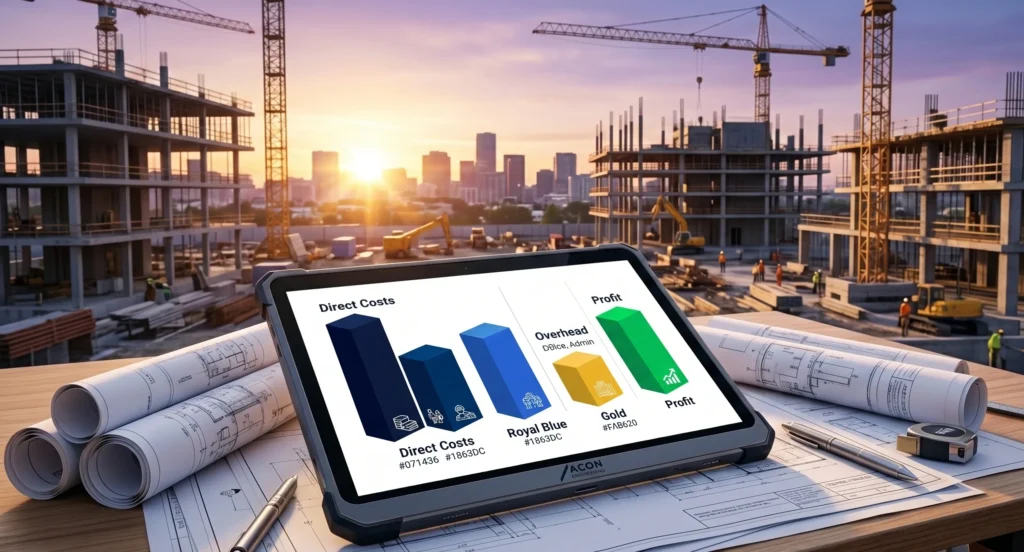
It covers direct costs such as materials and labor; indirect costs such as permits and insurance; as well as overhead, contingency, and profit. When prepared accurately through professional construction estimating services, a construction estimate protects the owner’s budget, gives contractors a competitive edge, and helps keep projects profitable from preconstruction through closeout.
In 2026, the U.S. construction industry is operating at a seasonally adjusted annual rate of $2.19 trillion in total spending, according to the U.S. Census Bureau. With national construction costs rising approximately 2.8% year-over-year in early 2026, and material price volatility driven by tariffs and labor shortages pushing total project escalation toward 7–10% in some markets, accurate cost estimation is no longer optional. It is the single most important financial act in any construction project.
What Is Construction Cost Estimation?
Construction cost estimation is the systematic process of forecasting the total financial investment required to complete a building project. Professional cost estimating services translate blueprints, specifications, and site conditions into a dollar figure that owners use to secure financing, contractors use to submit competitive bids, and project managers use to control spending throughout the build.
The Construction Management Association of America (CMAA) describes the construction estimate as “typically one of the first and most important steps taken during the infancy phase of any construction project management process,” directly impacting the “bottom line for the leading contractor.”
Estimation vs. budgeting: an estimate predicts what a project will cost based on scope and current market rates. A budget is the financial ceiling approved for spending. Both numbers must align before a project moves forward.
Who Needs a Construction Cost Estimate?
Construction cost estimates serve a wide range of stakeholders, each with a distinct purpose:
| Stakeholder | Why the Estimate Matters |
| General Contractors | Submitting competitive and profitable bids |
| Subcontractors | Pricing individual trade scopes accurately |
| Architects and Designers | Validating that design decisions stay within client budgets |
| Developers and Owners | Securing lender financing and managing investor expectations |
| Home Builders | Setting realistic residential project budgets |
| Industrial Firms | Planning large-scale capital expenditure projects |
Every stakeholder listed above relies on the same underlying discipline: a methodical, data-driven approach to construction costing that accounts for every line item, from structural concrete to site mobilization fees. Professional construction estimating services help project teams organize these costs into accurate budgets, bid packages, and procurement plans before construction begins.
How Much Does Construction Cost in 2026? Key Benchmarks
Understanding cost-per-square-foot benchmarks gives every estimator a defensible starting point. These figures reflect 2026 U.S. market conditions.
Residential Construction Cost per Square Foot
Residential construction costs in the United States range from $150 to $450 per square foot in 2026, depending on location, finish level, and project type. Custom luxury homes in high-demand coastal markets can exceed $500 per square foot once premium materials, complex design features, and site-specific challenges are factored in. Soft costs such as permits, design fees, and financing charges can add 10–15% beyond hard construction costs alone.
Commercial Construction Cost per Square Foot
Commercial building construction costs in 2026 range from $240 to $870 per square foot across the United States, with a mid-range average of approximately $560 per square foot for standard office and mixed-use buildings. The table below breaks down 2026 benchmarks by building type:
| Building Type | Cost per Square Foot (2026) |
| Warehouse / Light Industrial | $65 – $210 |
| Basic Retail Shell | $150 – $300 |
| Office (Single-Story Suburban) | $150 – $220 |
| Office (Mid-Rise) | $330 – $870 |
| Office (High-Rise) | $430 – $1,000+ |
| Restaurant (Full-Service) | $375 – $500+ |
| Educational (K–12) | $300 – $380 |
| Hospital / Medical Facility | $700 – $1,500+ |
Urban areas in the Eastern U.S. such as New York City, Boston, and Washington D.C. command a 25-40% premium over the national average. The Midwest and South remain the most cost-competitive regions, with commercial builds ranging from $240 to $760 per square foot.
A table of benchmarks is a starting point, not a final answer. Every number above must be adjusted for local labor rates, site conditions, specific material selections, and current market pricing before a contractor submits a bid.
The 5 Types of Construction Cost Estimates
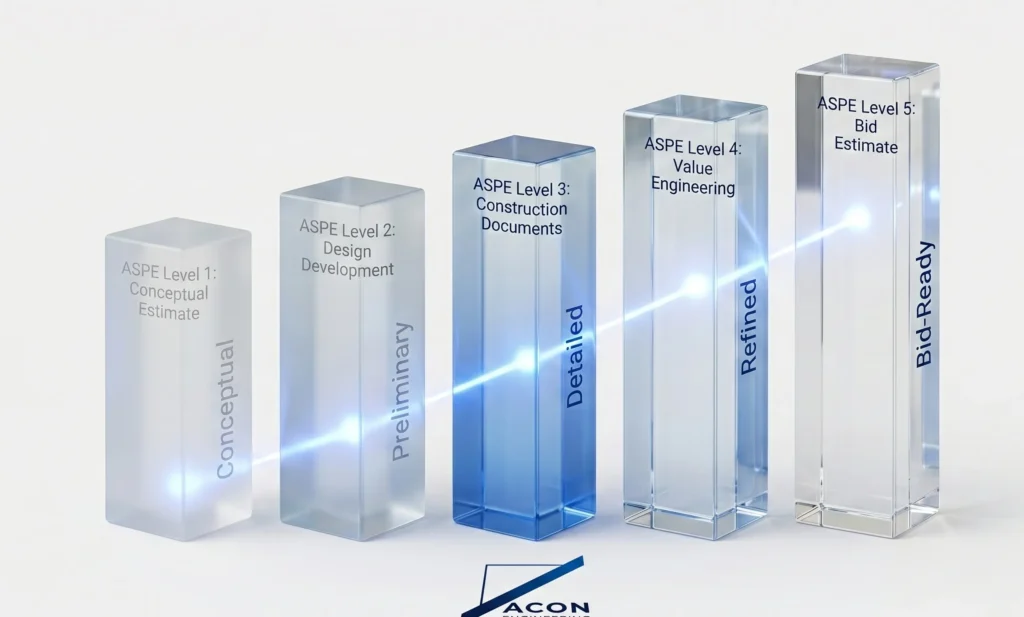
Not every estimate serves the same purpose. The American Society of Professional Estimators (ASPE) classifies estimates across five levels of accuracy, each aligned with a specific stage of project development.
Construction professionals at ACON Engineering apply the right estimate type at the right project phase, ensuring that no client receives a conceptual-level number when the project demands bid-level precision.
1. Order of Magnitude Estimate
An order of magnitude estimate uses data from comparable past projects to provide a rough sense of cost during the earliest project discussions. Accuracy ranges from minus 30% to plus 50%. Project definition sits between 0% and 2%. Owners use this estimate to determine whether a project concept merits deeper evaluation.
2. Schematic Design Estimate
A schematic design estimate applies cost-per-square-foot calculations to early building layouts and similar existing structures. Accuracy improves to roughly plus or minus 25%. This estimate helps owners make early decisions about project scale and program.
3. Design Development Estimate
A design development estimate uses a tentative design, preliminary material lists, and quantity takeoffs to produce a figure with plus or minus 15% accuracy. Project definition stands between 10% and 40%. Lenders frequently request this level before authorizing budget appropriation.
4. Construction Document Estimate
With a near-complete set of drawings and specifications, the construction document estimate delivers plus or minus 10% accuracy. Project definition exceeds 90%. Contractors and owners use this estimate to establish contract values and control cost baselines.
5. Bid Estimate
A bid estimate uses fully completed construction documents to produce the most precise cost forecast, with accuracy within 5–8% for detailed takeoffs. This is the estimate contractors submit in competitive or negotiated bidding. When most construction professionals refer to “estimating,” they mean this level.
The gap between Level 1 and Level 5 accuracy is not trivial. Conceptual estimates carry a 25–30% swing. Detailed takeoffs narrow that range to 5–8%. Choosing the wrong estimate type for a given project phase is one of the most common and costly mistakes in construction planning.Choosing the wrong estimate type for a given project phase is one of the most common and costly mistakes in construction planning. Understanding the factors affecting construction cost estimation accuracy helps estimators select the right method at the right stage.
How to Estimate Construction Costs: The 8-Step Process
Accurate construction cost estimation follows a disciplined, sequential process. ACON Engineering’s estimators apply each step systematically across residential, commercial, and industrial projects, producing estimates that clients can take to lenders, GCs, and bid committees with confidence.
1. Review the Bid Package and Project Scope
The first step in any construction estimating engagement is a thorough review of the bid package. This includes owner-contractor agreements, construction specifications, architectural and structural drawings, mechanical and electrical documents, and any supplementary conditions.
Estimators confirm that all drawings and specifications are present before proceeding. Missing documents lead to missing costs. During this review, general contractors subdivide the project into work packages aligned with CSI MasterFormat divisions: concrete, masonry, metals, finishes, plumbing, HVAC, and dozens more. Each work package, including structural, architectural and MEP Estimating Services, must account for every aspect of the project exactly once. Overlapping packages inflate the bid. Gaps in scope create unfunded liability on the job.
Complete and accurate documentation drives all productivity calculations and pricing models, as confirmed by the Construction Management Association of America. Building Information Modeling (BIM) now supports this process on major commercial projects, reducing coordination errors and potentially saving 5–15% on construction costs by identifying system conflicts before work begins.
2. Conduct a Site Visit
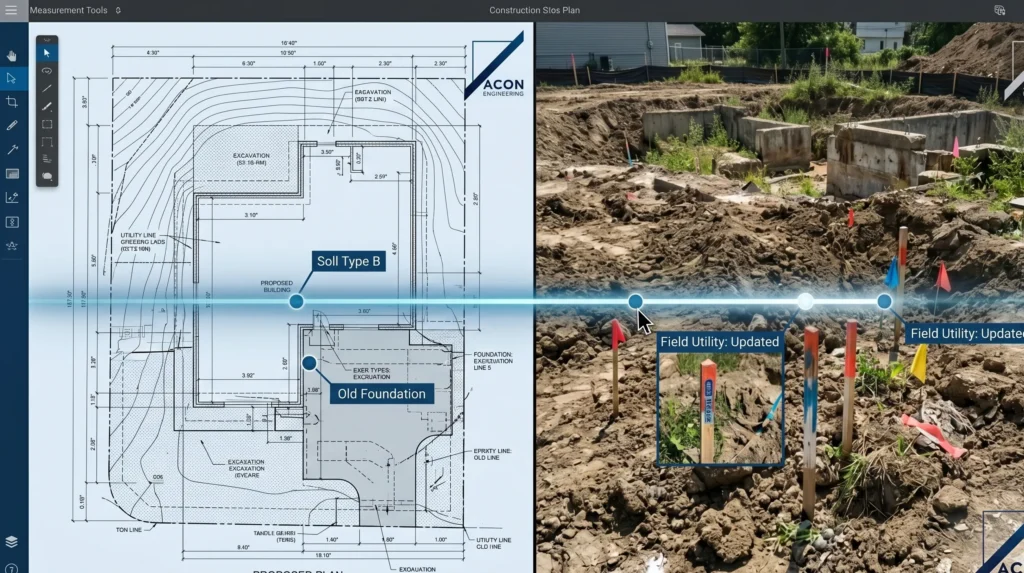
A site visit gives the estimator ground-truth data that no drawing can fully convey. Poor drainage, difficult subsurface soil conditions, adjacent structures, limited equipment access, and poorly located utilities all add cost to a project. Estimators who skip site visits accept risk they cannot price.
During the visit, the estimator documents site constraints, reviews surrounding infrastructure, identifies local permit and noise requirements, and evaluates the availability of specialty contractors in the area. Projects involving highly specialized trades often require professional Specialty Estimating Services to account for unique installation methods, trade-specific productivity, and procurement requirements before pricing begins. For sitework estimating and earthwork estimation specifically, the site visit is indispensable. Soil reports, topographic surveys, and utility maps must all be cross-referenced against field observations before any quantity is priced.
3. Perform a Material Takeoff
A quantity takeoff is the foundation of every accurate cost estimate. Estimators review construction documents and measure every material the project requires. Materials are quantified in their natural units: volume for concrete (cubic yards), area for drywall and flooring (square feet), length for pipe and wire (linear feet), and count for doors, fixtures, and equipment.
Manual takeoffs rely on paper drawings, digital measuring tools, and highlighters. Digital takeoffs, performed through software such as Planswift and Bluebeam, dramatically reduce the time required and allow for rapid revisions when design changes occur. ACON Engineering is proficient in both Planswift and Bluebeam, enabling fast, accurate takeoffs across all project types and delivery formats. The accuracy of the takeoff determines the accuracy of every cost line that follows. Errors at this stage compound through labor pricing, material procurement, and subcontractor bids.
Construction takeoff services cover every trade, from concrete estimating and rebar estimating to drywall takeoff,lumber takeoff and MEP estimating. Each trade requires specialized knowledge of installation methods, waste factors, and regional pricing.
4. Solicit Pricing from Suppliers and Vendors
With a complete material list in hand, the estimator contacts suppliers and vendors for current pricing. Three realities govern this step in 2026.
First, material waste requires ordering above the net quantity. Contractors use historical waste factors from similar past projects to add the right buffer without over-purchasing.
Second, material quotes have limited lifespans. A quote valid for 30 days may expire before bid acceptance. Estimators track quote validity carefully, especially for volatile commodities.
Third, material pricing carries significant uncertainty. Material prices in 2025 averaged approximately 4.2% above 2024 levels. Tariff impacts on steel, aluminum, copper, and other metals are expected to range from 5–25% depending on material type, according to a 2026 analysis of Oxford Economics and Harvard Business School research. Therefore, estimators must include escalation clauses and price-lock provisions for long-lead and tariff-exposed commodities.
5. Evaluate Labor Requirements
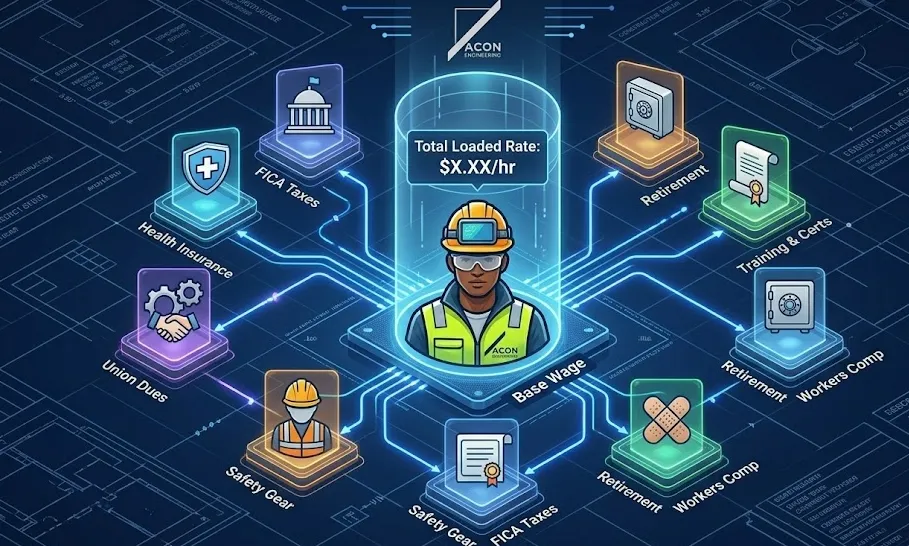
Labor now comprises a larger share of total project costs than at any point in the last four years. Skilled trade shortages persist across electrical, HVAC, plumbing, and specialized concrete and steel work. Nearly 500,000 additional construction workers are needed industry-wide in 2026 to meet projected demand, according to a 2026 industry outlook published by Tax Credit Advisor citing Associated Builders and Contractors data. Approximately 94% of contractors report difficulty filling open positions.
Estimators determine labor requirements by specifying which roles are needed, how many hours each phase of work will consume, and what productivity rates to apply based on crew composition and site conditions. The loaded labor rate – not the base hourly wage – is what enters the estimate. The loaded rate includes wages, payroll taxes, health and dental insurance, workers’ compensation, unemployment insurance, retirement contributions, union dues, and paid leave.
For MEP estimating, mechanical estimating, HVAC estimating, and plumbing estimating, labor is especially complex. Specialty trade labor in Sun Belt cities is running 1–2% above national wage figures in early 2026 due to migration-driven competition for talent. Estimators using regional RS Means data and current union wage schedules produce more accurate labor lines than those relying on national averages alone.
6. Determine Insurance and Bonding Costs
Insurance and bonding costs are real project costs that must appear in every estimate. Most contractors carry general liability insurance at a minimum. Larger projects add builder’s risk insurance, professional liability insurance, inland marine insurance, and commercial auto policies.
Public projects and many private commercial contracts require performance bonds, payment bonds, and sometimes bid bonds. Bond premiums are calculated as a percentage of the contract value and vary based on the contractor’s financial strength, credit history, and current bonding capacity. Annual insurance and bonding costs are typically spread across all active projects during the year. For a specific high-value or high-risk job, additional coverage may be required, adding a direct line item to that project’s estimate.
7. Calculate Overhead and Indirect Costs
Indirect field costs are project-specific but not directly tied to a single work package. They include permits, temporary site offices and trailers, site cleaning and waste removal, professional services, equipment depreciation, fuel, and project management software. These costs exist regardless of whether they appear on a drawing.
General overhead, also called general and administrative (G&A) expense, represents the cost of keeping the business running between projects. Office rent, administrative salaries, accounting and legal services, software subscriptions, utilities, and taxes are all G&A costs. Estimators spread annual G&A across all anticipated project revenue using a percentage allocation. A business projecting $10 million in annual revenue with $1.2 million in G&A would apply approximately 12% overhead to each project estimate.
Underestimating overhead is one of the most common reasons profitable-looking bids turn into unprofitable jobs.
8. Account for Profit and Contingency

After totaling all direct and indirect costs, the estimator adds two final elements: profit and contingency.
Profit is the margin the contractor earns for delivering the project. Each construction business sets its own minimum attractive profit margin based on growth goals, market conditions, and risk appetite. Margins vary by project type, contract structure, and competitive environment.
Contingency is a reserve for the unexpected. Most construction businesses add 5–10% of the contract value for contingency, though complex projects, tight timelines, or high-volatility markets may warrant 10–15%. In 2026, with tariff uncertainty pushing some project escalation scenarios toward 7–10% total cost increases, contingency planning has become a point of competitive differentiation. Estimators who build defensible, well-documented contingency lines win more often because owners trust the transparency.
Construction Cost Estimation Methods
Different projects and different project phases call for different estimation methods. The following methods are standard practice among professional estimators in 2026.
Analogous Estimating
Analogous estimating calculates costs based on known costs from similar past projects. It depends on expert judgment and historical data. This method is used during early planning when scope is limited. Its primary limitation is that no two projects are identical, so analogous estimates carry wide accuracy margins.
Parametric Estimating
Parametric estimating uses statistical relationships between variables, such as cost per square foot, cost per linear foot of pipe, or cost per ton of steel, to calculate total costs. This method is more accurate than analogous estimating and is particularly effective for budget estimating and preliminary estimates where a defined scope exists but detailed drawings are not yet complete.
Bottom-Up Estimating (Detailed Estimating)
Bottom-up estimating, also called detailed estimating, builds costs from the activity level upward. Each work package receives its own material, labor, equipment, and subcontractor pricing. These individual estimates roll up to work package totals, then to phase totals, then to the project total. This is the method used in bid management and competitive procurement. It produces the most accurate estimates but also requires the most time and data.
Three-Point Estimating
Three-point estimating identifies three cost scenarios for each line item: optimistic (best case), pessimistic (worst case), and most likely. A weighted formula, typically the Program Evaluation and Review Technique (PERT) formula, produces the expected cost. This method is particularly valuable for projects with high uncertainty or long timelines, as it explicitly quantifies the range of possible outcomes rather than presenting a single number as fact.
Unit Cost Estimating
Unit cost estimating assigns a known cost per unit to each measured quantity from the takeoff. For example, framing labor and materials might be priced at $12 per square foot of wall area, or concrete at $175 per cubic yard placed and finished. Unit costs are derived from RS Means data, Craftsman Cost Data, proprietary databases, or historical project records. ACON Engineering uses RS Means data, Craftsman, and its own custom databases for zip-code-level pricing accuracy across all U.S. markets.
Analogous estimating vs. detailed estimating: analogous methods are appropriate for feasibility and conceptual decisions. Detailed bottom-up methods are required for bid submission and contract formation. Applying the wrong method at the wrong stage creates cost exposure that neither the owner nor the contractor can absorb.
What Goes Into a Construction Cost Estimate? The Full Breakdown
Every complete construction cost estimate contains six categories of cost. Missing any one of them produces an estimate that will lose money.
1. Direct Costs
Direct costs are expenses that connect directly to construction activity: materials, labor, and equipment. These are the largest category in any estimate and the focus of the quantity takeoff and labor analysis steps.
2. Subcontractor Costs
General contractors assign portions of the work to specialty subcontractors. Subcontractor bids cover the sub’s materials, labor, equipment, overhead, and profit within their scope. GC estimators solicit multiple subcontractor bids for each trade scope and use the most competitive compliant bid in the overall estimate.
3. Indirect Field Costs
Indirect field costs are project-specific but do not attach to a single work package. Permits, temporary facilities, site safety programs, project management fees, and equipment mobilization are common indirect costs.
4. General Overhead (G&A)
General and administrative expenses keep the business running. They are allocated to each project as a percentage of anticipated revenue.
5. Contingency
Contingency reserves protect the estimate against unforeseen conditions, design changes, and market volatility. The appropriate contingency percentage depends on project type, available information, and current market conditions.
6. Profit
Profit is the return on risk that justifies the contractor’s involvement. It is calculated after all costs are identified and must be sufficient to fund business growth, equipment reinvestment, and working capital.
Construction Cost Estimation by Project Type
Different projects require different cost estimation. A residential project may not include the knitty gritty that a commercial or industrial project include, as discussed below:
How to Estimate Residential Construction Costs?
Residential house construction cost estimation benefits from relatively standardized components and well-established unit costs compared to commercial work. The estimated cost to build a house covers foundation and slab, structural framing, roofing, exterior finishes, windows and doors, interior finishes, MEP systems, and site work.
Soft costs for residential projects such as permits, design fees, and financing charges, typically add 10–15% beyond hard construction costs. Custom designs with unique details carry higher estimation uncertainty than production homes following standard plans.
Family residential estimating from ACON Engineering covers all of these components with zip-code-level pricing for accurate, market-specific budgets.
How to Estimate Commercial Construction Costs?
Commercial construction cost estimating involves complex systems, higher performance standards, stricter code requirements, and multiple specialty subcontractors working simultaneously. Contractors providing professional Commercial Estimating Services perform detailed reviews of MEP systems, structural requirements, fire protection, accessibility compliance, and energy code obligations to produce accurate, bid-ready cost estimates.
Healthcare facilities, particularly hospitals, involve some of the most complex construction scopes in the industry, which is why owners and contractors often rely on professional Hospital Estimating Services to accurately budget specialized MEP systems, medical equipment coordination, and regulatory compliance requirements. The Bureau of Labor Statistics tracks separate Producer Price Indexes for distinct commercial building types, recognizing that office buildings, healthcare facilities, retail centers, and industrial structures each carry different cost profiles.
The Bureau of Labor Statistics tracks separate Producer Price Indexes for distinct commercial building types, recognizing that office buildings, healthcare facilities, retail centers, and industrial structures each carry different cost profiles. Commercial estimators must use building-type-specific data, not national averages, for defensible bid-level estimates.
How to Estimate Industrial Construction Costs?
Industrial estimating deals with large-scale capital projects including manufacturing facilities, warehouses, processing plants, and data centers.Industrial estimates are especially sensitive to equipment costs, which is why Mechanical Estimating Services play a critical role in accurately pricing the specialized systems that represent a substantial share of total project spend. Equipment factored estimating, a method that multiplies individual equipment costs by installation factors that include subcontracted labor, materials, and indirect costs, is a standard technique in industrial work.
In 2026, data center construction is driving a surge in industrial estimating demand. Construction spending in this sector jumped significantly in late 2025, according to RSMeans 2026 construction cost trend data. Industrial estimators must factor in specialized electrical, mechanical, and structural requirements that standard commercial databases may not adequately cover.
Common Construction Cost Estimation Mistakes to Avoid
Experienced estimators distinguish themselves not just by getting the numbers right but by systematically avoiding the errors that trap less disciplined firms.
Scope gaps in the bid package review. Every aspect of the project must appear in a work package exactly once. Gaps create unfunded liability. Overlaps inflate the bid.
Skipping the site visit. Site conditions affect every cost category. Poor drainage, difficult soils, and constrained access cannot be priced from drawings alone.
Using national averages instead of local data. Construction costs vary by up to 40–60% between zip codes in the same state, driven by local labor rates, material availability, and permit fees. A Houston estimate built on New York labor rates will be dramatically wrong.
Applying outdated unit costs. Since early 2020, construction input prices have increased more than 43%, according to the U.S. Bureau of Labor Statistics. Fabricated structural metal products rose over 63% during that period. Estimates built on pre-2024 benchmarks are structurally flawed in 2026.
Underestimating the loaded labor rate. Wages alone are not labor cost. Taxes, insurance, benefits, and union dues routinely add 30–50% to the base wage rate.
Ignoring contingency. Projects with clear scope and detailed drawings still experience unforeseen conditions. Projects with incomplete information need larger contingency reserves, not smaller ones.
Omitting soft costs. Design fees, permitting, financing, insurance, and bonding are real costs that must appear in the estimate, not assumptions the owner will cover separately.
FAQs
How Does Location Affect Construction Cost Estimation in 2026?
Location affects every major cost category in a construction estimate. Local labor rates, union jurisdiction, material availability, transportation costs, permit fees, and building code requirements all vary by geography. Urban areas in the Eastern U.S. command 25–40% premiums over national averages. Costs can vary 40–60% between zip codes within the same state. ACON Engineering produces zip-code-level estimates using RS Means and Craftsman databases calibrated to local market conditions across Texas, Florida, New York, Pennsylvania, Nevada, and California.
What Is the Difference Between a Quantity Takeoff and a Cost Estimate?
A quantity takeoff measures the physical amounts of every material and unit of labor a project requires. A cost estimate assigns a dollar value to each of those quantities. The takeoff always comes first. The accuracy of the takeoff determines the accuracy of the estimate.
How Long Does Construction Cost Estimation Take?
Turnaround time depends on project size and complexity. Small projects with simple scope receive estimates within 24–48 hours. Mid-size projects typically deliver in 2–4 days. Large or complex projects with extensive MEP systems, multiple structures, or incomplete drawings may require additional time.
What Is a Preliminary Estimate in Construction?
A preliminary estimate is a design-phase cost forecast prepared when scope is defined but construction documents are not yet complete. Preliminary estimates carry accuracy ranges of plus or minus 10–15% and are used by developers to secure lender approval, by architects to validate design decisions, and by owners to commit to project budgets.
How Do Contractors Use Cost Estimates to Win More Bids?
Contractors who submit estimates that are both competitive and profitable win bids consistently. The margin between winning and losing in competitive bidding is often less than 3–5% of the total contract value. Estimators who use current, zip-code-level pricing data, accurate labor productivity rates, and well-structured contingency assumptions produce bids that are tight enough to win and profitable enough to sustain.

Tim C. is a construction estimating expert and Director at ACON Engineering, specializing in construction cost estimating, quantity takeoffs, and preconstruction planning. He has led thousands of successful project bids and helps contractors make informed, profitable decisions.