
Running a construction business usually starts with a simple goal. You want to do good work and make a fair living. But as your company takes on more projects, you quickly realize that getting off the ground is entirely different from growing the company. Many contractors reach a point where their progress simply stops. They work 60-hour weeks and take on bigger jobs, but their actual take-home profit stays the same.
If you feel stuck, the problem is rarely a lack of hard work. The issue usually connects to outdated operations, poor pricing habits, or trying to manage every single detail by yourself. To move forward, you have to shift from just working in your business to actively managing it.
Why is my Construction Business Failing?
A construction business usually fails due to a combination of financial mistakes, operational breakdowns, and poor management. It rarely comes down to a lack of skill on the job site. Instead, owners run into serious trouble with poor cash flow, delayed client payments, and underpricing their projects. Without sufficient cash in the bank, a single delayed check can bring the whole company down.
Trying to grow without a clear business plan, suffering through constant supply chain issues, and tolerating poor communication between the office and the field will cause massive delays. You also have to watch out for bad contracts. Working without clear, detailed agreements leaves you entirely exposed to unpaid work and legal disputes. On the management side, chronic labor shortages and poor hiring decisions force the owner to pick up the slack, leading to a heavy workload and severe burnout.
This leads directly to one of the biggest traps: the owner’s mindset. When you first start, you handle everything from ordering materials to running the daily crew. As you try to take on more work, holding onto every single task slows down the entire company. You need to build a skilled, reliable team so you can step back from the exhausting physical labor and focus on your long-term plans.
Another major issue is the lack of proper systems. Refusing to adopt modern software leads to scattered schedules, delayed material orders, and financial mismanagement. A single lost invoice or a poorly timed equipment purchase can quickly drain your cash flow.
To grow safely, you have to organize your daily processes and learn when to hand off responsibility. Outsourcing certain tasks makes sense, but you have to be careful who you trust. Cost estimation, for example, is a highly critical part of your business. Not knowing exactly how to estimate construction costs is exactly what causes those financial issues mentioned earlier. If you decide to outsource it to protect your margins, you need a professional and proven partner like ACON Engineering.
11 Practical Strategies to Grow Your Construction Business
If you want to learn how to grow construction business revenue, you need a smart mix of building a reliable team, maintaining strict financial control, and knowing when to outsource complex tasks. These eleven practical strategies will help you create a highly organized system so your company can expand safely and consistently.
1. Focus on a specific construction niche

Trying to be everything to everyone is a quick way to burn out. Selecting a specific niche positions your company as a specialized expert rather than a generalist. This builds a strong reputation in the market and instantly reduces your direct competition.
When you become the go to builder for a specific type of project, you gain serious pricing power. You can set your own rates and enjoy much higher profit margins because clients are willing to pay a premium for your exact expertise.
Focusing on one niche also drastically improves your operational efficiency. You can easily automate your daily systems and optimize your resource management because you are repeating similar workflows every day. Your marketing becomes highly targeted, helping you attract the exact right clients and making your brand highly notable for quality work.
Even your office operations get easier. Specializing simplifies your staffing and onboarding processes because new hires only need to learn one core way of doing things. This focus naturally leads to less worker turnover and a much more confident crew.
2. Hire and onboard the right people
Your company will only grow as fast as your team can handle the work. Because of this, you need to invest heavily in finding the right talent. Before you even set up an interview, pre-qualify your candidates to make sure their core competencies match your exact needs.
To attract high performers, you must offer competitive compensation packages and provide clear, realistic goals to the candidate right from the start. Hiring skilled people who actively care about the work and align with your mission will push your business forward much faster.
Once you make a hire, you must have a proper onboarding strategy in place. Do not just drop new workers onto a job site and expect them to figure things out on their own. You need a clear system that trains them on your specific operations and integrates them naturally into your company culture. You should also offer mentorship programs and ongoing development opportunities.
3. Systemize your daily operations
To run a smooth business, you need clear rules. You must create standard operating procedures for all your key departments. This means building a proper documentation system that defines exactly how to handle field operations, office work, and customer service. Start by drawing a clear organizational chart so every person knows their exact role and responsibilities. When everyone knows who is in charge of what, it improves communication and boosts employee performance across the board.
Once your roles are set, you have to train your team and delegate the work. Teach your staff how to use the “Eat the Frog” method. This simple daily management technique forces them to complete their most important and high-impact tasks at the very start of the day before distractions happen. You should also look for ways to automate repetitive tasks in your office. Building an organized system removes confusion, increases operational efficiency, and creates a solid foundation for your company to expand.
4. Outsource your cost estimation
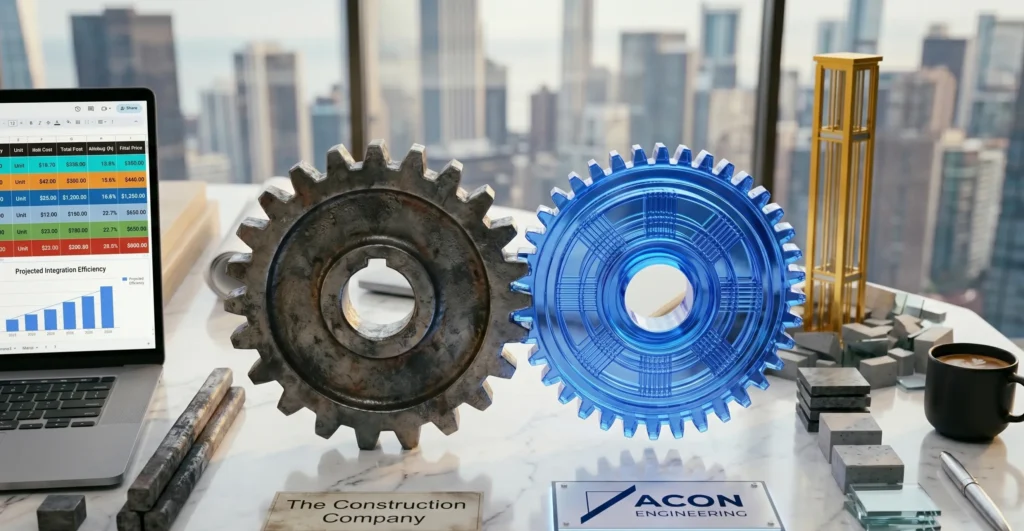
When figuring out how to bid construction projects accurately, outsourcing your cost estimation gives you direct access to specialized experts and advanced technology. This combination allows you to submit highly accurate, competitive bids much faster than doing it on your own. Delivering detailed, professional estimates also heavily improves your reputation in the industry. When you hand this task off, you free up your schedule to focus on core business activities and easily handle high-volume or complex projects without the stress.
You can solve this problem by partnering with a proven company like ACON Engineering. Whether you need to calculate the exact cost to build a house for a residential client or price out massive commercial and industrial projects across the U.S., they provide fast and accurate material takeoffs. Their certified estimators strictly follow AACE and the American Estimators Organization standards.
Using top-tier software like PlanSwift, Bluebeam, and RS Means, they cover all CSI trades, including electrical, general contracting, and architecture. With a guaranteed 24 to 72-hour turnaround, you get your numbers right on time. Outsourcing to ACON Engineering saves you up to 60% compared to hiring an in-house estimator, making your business much more profitable on every single bid.
5. Manage your cash flow strictly

To manage your cash flow correctly, you must maintain a 13-week rolling forecast to track your incoming receipts, operating expenses, and future investments. You need to review your spending constantly and make compromises on your wants versus your actual needs. You also have to connect your field data directly with your accounting software. When your office knows exactly what happens on the job site every day, you can track expenses diligently and build a highly realistic financial plan.
Getting paid on time requires strict rules. You should try to front-load your billings and negotiate favorable payment terms in your client contracts. Be strict about your invoicing and collections, and always aim to keep your accounts receivable under 40 days. At the same time, you have to control how cash leaves your business. Manage your subcontractor payments carefully and work to reduce or eliminate retainages.
Instead of buying all your materials up front, order them just in time for the specific work phase. This reduces premature cash outflows and keeps your bank account healthy. Finally, secure a working capital reserve and set up your financing early. Having a dedicated line of credit ready before an emergency hits ensures you can always cover your payroll and keep your projects moving forward without stress.
6. Be selective to protect your profits
Growing a business does not mean saying yes to every single job that comes your way. To protect your profits, you must use a strict “bid or no-bid” process. You have to analyze your bid-hit ratio to see exactly where you make the most money and figure out how to win construction bids more consistently. Take the time to pre-qualify the project owner and thoroughly vet your potential partners to make sure they are reliable and pay on time.
You also need to understand the complete scope of work before you commit to a contract. Look closely at the blueprints and write down clear exclusions so the client knows exactly what is not included in your price. Understand your true costs and set up active budget management so you can handle future change orders effectively.
7. Expand your service offerings
Once your core operations are stable, you can scale up by expanding into different industry services. Adding specialized models to your business allows you to increase your ticket sizes and win larger contracts. To do this correctly, you must invest in your staff by providing proper training and buying the right equipment to support these new offerings.If you want to expand into new areas like industrial builds or specialized MEP, including HVAC Estimating Services, but feel unsure about the pricing, you can always rely on ACON Engineering’s estimators to provide accurate takeoffs for those unfamiliar trades.
Take full advantage of your existing client relationships and local networks to land your first few jobs in this new category. Pay attention to local building trends so you know exactly what services the market actually demands. When you launch a new service, be completely clear about your price points. Market these new skills directly to your past clients, using your successful projects and great online reviews to position your company as the obvious choice.
8. Grow your local network
Networking requires building real, strategic partnerships. Start by joining local trade associations and industry-specific groups. You should actively attend industry seminars and webinars to meet other professionals in your field.
Take this approach online by using LinkedIn to connect with local developers, architects, and complementary businesses. When reaching out, always offer value first. Sharing helpful advice or providing a free resource, like a quick guide or a lead magnet, starts the conversation naturally and builds immediate trust. Consistency is the most important factor here. You have to show up and talk to people regularly to stay at the top of their minds. You can also reach out to local universities and trade schools. Building strong relationships with these programs helps you secure a steady pipeline of fresh talent and gives you early access to new industry tools and training methods.
9. Upgrade your tools and software

Before you buy a new software program or an expensive piece of machinery, you have to understand your exact pain points. Look closely at your daily workflow and identify the specific loopholes slowing your business down. Use this information to prioritize exactly what you need to fix first. Once you know the problem, select straightforward software and integrated tools that directly solve it.
Upgrading your physical construction tools makes your crew faster and safer on the job site. You can also bring in modern hardware to give you a massive advantage. Using drones for quick site surveys and IoT sensors for site safety tracking provides you with highly accurate field data. However, buying the technology is only the first step. You must strategically implement these tools and provide proper training so your staff actually knows how to use them. Finally, you should continuously review your setup. If a tool saves you time, keep it. If a software program causes more headaches than it solves, drop it immediately and find a better option.
10. Build a reliable marketing system
Word of mouth is great, but actual growth requires a layered marketing approach based on clear SMART goals. Start with your digital foundation. You need a fast, human-first website that is designed specifically to convert visitors into active leads. Once your site looks good, focus heavily on local SEO. Target the exact keywords people in your city use when searching for contractors, and set up a Google Business Profile so your company ranks high on local maps.
To build credibility and trust, use content marketing to answer common building questions your clients have. If you want to bring in leads faster, run targeted advertising campaigns using Google Ads and Facebook to reach people actively planning a project. You should also stay active on social media by posting consistent, high-quality photography of your ongoing job sites to engage with the community. Finally, make sure you track your Key Performance Indicators (KPIs) across every platform.
11. Give clients a great experience
Communication is the absolute easiest way to stand out in the construction industry. You have to answer your phone and return emails quickly. Maintain transparent communication from day one by setting realistic expectations about the schedule and the budget. Make sure you remain accessible to the owner throughout the build. Give them regular updates through quick phone calls or emails, explaining exactly what phase the crew is finishing right now and what the next step looks like.
Beyond communication, your team needs to deliver total professionalism on the ground. Make sure your crew makes a good impression and keeps the job site completely clean at the end of every single day. You can even provide a small, meaningful extra service for free just to leave a great impact. When the physical work is done, keep the handover process smooth. Offer post project support and always ask the client for direct feedback.
Final thoughts
When you identify your core issues and fix them with solid, repeatable systems, your daily efficiency naturally goes up. You stop wasting time on the wrong bids and start optimizing your resources to match your most profitable projects.
Applying these practical steps allows you to position your brand correctly in your local market, attract better clients, and charge exactly what your services are worth.Growth does not happen by accident. It happens when you organize your operations, protect your cash flow, and trust the right partners to handle complex tasks through professional Construction Estimating Services.
Frequently Asked Questions (FAQs)
How long does it take to see real growth in a construction business?
Growth speed depends entirely on your systems and your cash flow. Most contractors see a noticeable shift in their profit margins within six to twelve months after they start tracking their job costs strictly, avoiding bad clients, and outsourcing their complex estimates.
What is the fastest way to get better construction clients?
If you are trying to figure out how to get clients as a contractor, building a strong local network is the fastest method. Reach out to real estate developers, property managers, and other specialty tradesmen to let them know exactly what services you offer. Direct networking brings in high-quality referrals much faster than waiting for someone to find your website.
Should I buy or rent heavy construction equipment to grow my business?
When you are just starting to expand, renting is usually the safer financial choice. Renting keeps your cash flow flexible and prevents you from paying for machinery that just sits in a yard between jobs. You should only buy equipment when you have enough guaranteed, steady work to justify the long-term expense.
When is the right time to expand into new construction services?
You should only add new services after your core operations are highly stable and profitable. If you are struggling to manage your current projects, taking on a new trade will only create more chaos. Get your current house in order first, train your team properly, and then start branching out.
What’s the biggest mistake construction businesses make when trying to grow?
The biggest mistake is saying yes to every single project just to keep cash moving. Taking on jobs outside your core expertise, accepting impossible deadlines, or working for difficult clients usually leads to massive delays and lost profits.

Tim C. is a construction estimating expert and Director at ACON Engineering, specializing in construction cost estimating, quantity takeoffs, and preconstruction planning. He has led thousands of successful project bids and helps contractors make informed, profitable decisions.