Residential construction builds the places where people live. Commercial construction builds the places where people work, shop, receive care, and conduct business. These two sectors share the same fundamental trades but operate under different codes, use different materials, follow different funding structures, and demand fundamentally different approaches to cost estimation.
The cost gap between the two is significant and immediate. Residential construction averages $150 to $450 per square foot nationally. Commercial construction averages $240 to $870 per square foot depending on building type and location, according toHomeGuide’s 2026 commercial construction cost data.
A contractor or developer who applies residential unit costs to a commercial project, or vice versa, is building an estimate on the wrong foundation.
What Is Residential Construction?
Residential construction is the design, engineering, and physical construction of buildings intended for human habitation. It encompasses single-family homes, townhouses, duplexes, condominiums, and small multifamily buildings. Developers planning apartment communities and larger residential complexes often rely on professional Apartments Estimating Services to prepare accurate budgets, material takeoffs, and bid-ready cost estimates before construction begins.
Residential projects are typically commissioned by individual homeowners, small developers, or real estate investors. Design decisions are driven by personal preference, neighborhood standards, and local zoning. Financing comes primarily through individual mortgages, construction loans, and personal capital.
Residential construction follows the International Residential Code, which governs structural requirements, energy performance, fire safety, and mechanical and electrical systems for one- and two-family dwellings. Local amendments apply in many jurisdictions, particularly in states with stringent climate or seismic requirements such as California, Florida, and New York.
Types of Residential Construction Projects
Residential construction covers a wide range of project types, each with its own scope, cost profile, and estimating requirements. Professional Residential Estimating Services help homeowners, builders, and developers calculate accurate budgets before construction begins.
| Project Type | Description |
| Single-family homes | Stand-alone structures built for one household |
| Townhouses | Attached multi-story units sharing party walls |
| Duplexes / triplexes / fourplexes | 2–4 unit attached dwellings on a single parcel |
| Condominiums | Individually owned units in a shared-structure building |
| Small multifamily (under 5 units) | Covered under IRC; above 5 units shifts to IBC |
| Mobile and manufactured homes | Factory-built units placed on site |
| Custom homes | Architect-designed, owner-specified single-family builds |
| Production homes | Standardized plans repeated across a development |
The shift from residential to commercial code happens at the 5-unit threshold for multifamily buildings. A 4-unit building in most U.S. jurisdictions falls under IRC. A 5-unit building falls under IBC, triggering commercial-grade fire suppression, accessibility requirements, and structural review processes. Contractors and developers working on apartments, townhome communities, and other multi-unit housing often rely on professional Multi Family Residential Estimating Services to prepare accurate budgets before construction begins.
What Is Commercial Construction?
Commercial construction is the design, engineering, and physical construction of buildings intended for business operations, public use, institutional purposes, or income-generating real estate.
Commercial projects are commissioned by corporations, developers, government agencies, healthcare systems, educational institutions, and real estate investment firms.
Financing comes through commercial loans, equity partnerships, government appropriations, and bond financing.
The stakeholder structure is more complex and involves architects, structural engineers, MEP engineers, project managers, and legal counsel alongside the general contractor.
Commercial construction follows the International Building Code, which imposes more stringent requirements on structural capacity, fire and life safety systems, egress design, accessibility, energy performance, and occupancy classifications.
Types of Commercial Construction Projects
The commercial sector covers a wider range of building types than residential construction, each carrying distinct estimating complexity and cost profiles.
| Building Type | Typical Cost Range ($/sq ft) |
| Warehouse / Light Industrial | $65 – $210 |
| Basic Retail Shell | $150 – $300 |
| Office (Single-Story Suburban) | $150 – $220 |
| Office (Mid-Rise) | $330 – $870 |
| Office (High-Rise) | $430 – $1,000+ |
| Restaurant (Full-Service) | $375 – $500+ |
| Educational (K–12 School) | $300 – $380 |
| Hospital / Medical Facility | $700 – $1,500+ |
| Hotel / Hospitality | $330 – $550 |
| Data Center | $500 – $1,200+ |
Industrial construction is a third distinct category covering manufacturing plants, distribution centers, cold storage facilities, and data centers. Infrastructure construction covers highways, bridges, utilities, and public works. Both carry cost profiles and estimating disciplines separate from standard residential or commercial work, including ACON Engineering’s industrial estimating services.
Residential vs Commercial Construction: Side-by-Side Comparison
| Factor | Residential Construction | Commercial Construction |
| Primary Code | International Residential Code (IRC) | International Building Code (IBC) |
| Structural System | Wood framing (typical) | Steel, concrete, or heavy timber |
| Cost Per Sq Ft | $150 – $450 (national range) | $240 – $870+ (national range) |
| Permit Complexity | Low to moderate; single agency | High; multiple agencies, longer timelines |
| MEP Systems | Standard residential grade | Engineered, commercial grade |
| Labor Force | Small crews; typically non-union | Large teams; frequently unionized |
| ADA Requirements | Minimal (visitability only in some states) | Full ADA compliance required |
| Fire Suppression | Required above 3 stories in most codes | Required in most commercial building types |
| Timeline | 4–18 months depending on size | 4 months to 3+ years depending on type |
| Financing | Individual mortgage / construction loan | Commercial loan, equity, institutional |
| Stakeholders | Owner, architect, GC | Owner, investors, lenders, tenants, agencies |
| Estimating Complexity | Lower; standard assemblies | Higher; multi-trade coordination |
| Contingency (at CD stage) | 5–10% | 5–15% |
The detailed analysis of the differences between residential and commercial construction are provided below.
Residential vs Commercial Construction: 9 Key Differences
The differences between residential and commercial construction is not simply one of scale. A small commercial project and a large residential project can be similar in size yet require fundamentally different materials, labor forces, permitting processes, and cost estimation approaches. Understanding each dimension below prevents the most common and costly errors in construction planning and bidding.
1. Building Codes and Regulatory Compliance
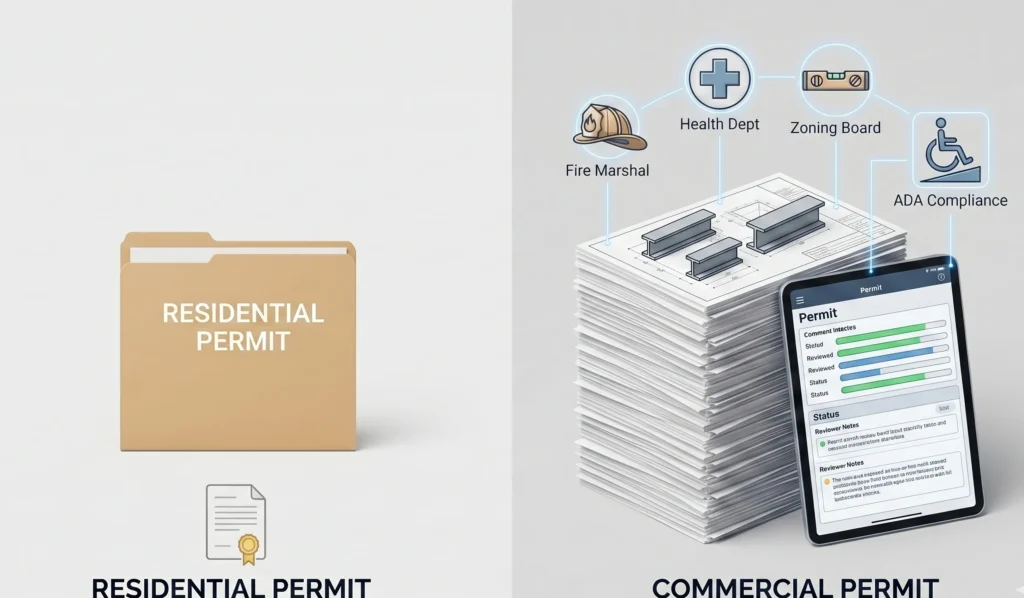
Residential construction in the U.S. falls under the International Residential Code (IRC), which is a simplified code developed specifically for one- and two-family dwellings and townhouses. It consolidates structural, mechanical, electrical, and plumbing requirements into a single document. Most municipalities adopt it with minor local amendments.
Commercial construction falls under the International Building Code (IBC), which is more comprehensive and more stringent. The IBC governs occupancy classifications, construction type, fire resistance ratings, means of egress, ADA accessibility, energy codes, and structural loads.
The practical estimating difference is significant. A residential permit in most U.S. markets costs $500–$2,500 and follows a predictable review timeline. A commercial permit for the same dollar value of construction can cost $5,000–$50,000+ and require review by multiple agencies including the building department, fire marshal, health department (for restaurants and medical facilities), and sometimes a zoning board, according toTM International Group’s 2026 commercial construction guide.
ADA compliance alone adds measurable cost to commercial projects that residential work does not carry. Accessible parking, accessible routes, compliant restrooms, elevator requirements in multi-story buildings, and tactile flooring systems all represent cost line items that do not appear in residential estimates.
2. Structural Systems and Materials
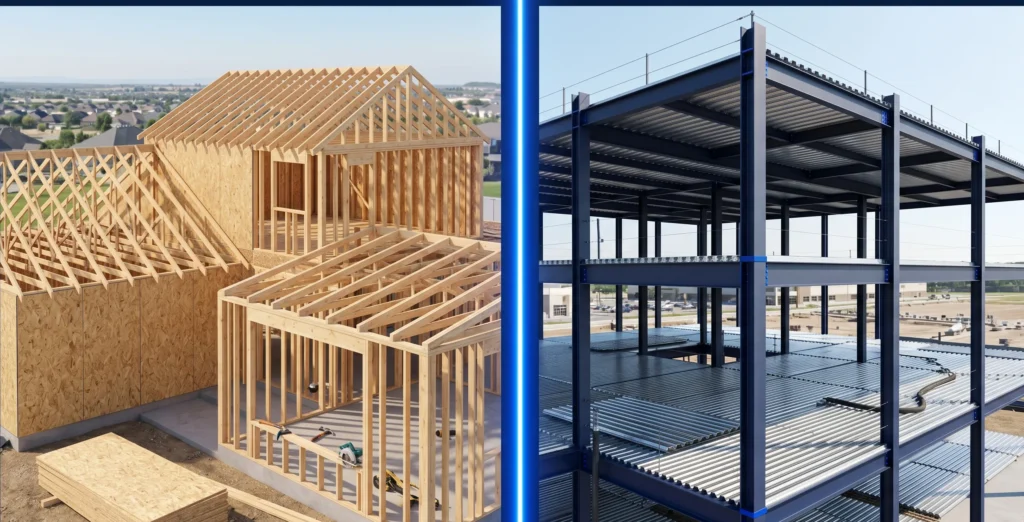
Residential construction relies primarily on wood framing systems. Platform framing using dimensional lumber (2×4, 2×6 studs) is the standard for single-family homes and small multifamily buildings across most of the U.S. Engineered wood products including LVL beams, I-joists, and parallel strand lumber handle longer spans where dimensional lumber is insufficient.
Commercial construction relies on structural steel, reinforced concrete, or heavy timber for primary structural systems. Wood framing appears in commercial construction but is typically limited to interior partitions and light-gauge steel framing is the standard for non-structural walls in most commercial building types.
The material cost difference is substantial. Structural steel framing costs approximately 3 times more per linear foot than wood framing of equivalent span capacity. Reinforced concrete structural systems add significant excavation, formwork, rebar, and pour sequencing costs that wood-frame residential construction does not require.
3. MEP Systems Complexity
Mechanical, electrical, and plumbing (MEP) systems represent one of the most significant cost differentiators between residential and commercial construction. Professional MEP Estimating Services help contractors quantify commercial mechanical, electrical, and plumbing scopes before procurement and bidding begin.
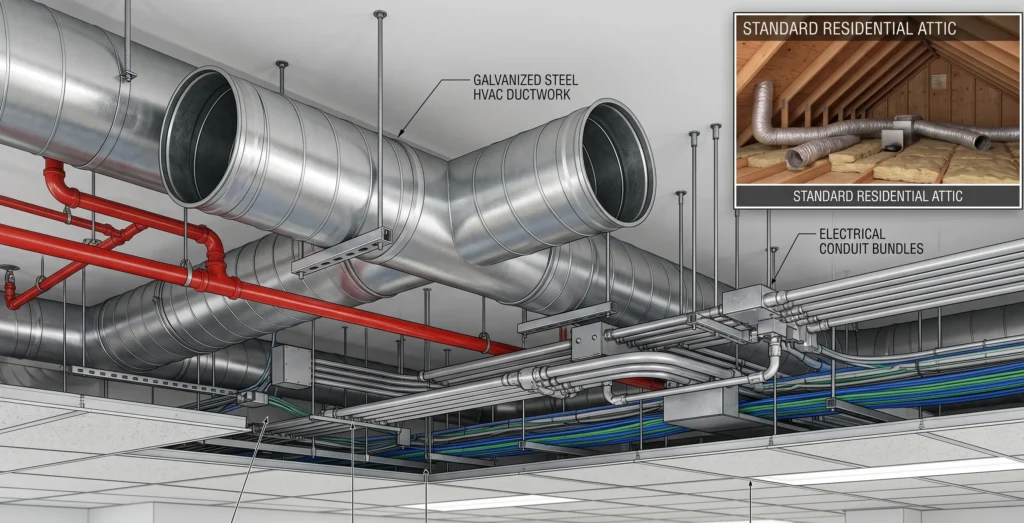
Residential MEP systems are standardized and relatively simple. A single-family home carries a residential HVAC system (typically a split-system heat pump or forced-air furnace), a simple electrical service of 200 amps, and conventional drain-waste-vent plumbing with predictable fixture counts. Residential MEP estimating follows well-established unit costs and can be performed by a generalist estimator with reasonable accuracy.
Commercial MEP systems are complex, specialized, and often the largest single cost category on a commercial project. A commercial office building requires engineered HVAC design with variable air volume distribution, dedicated exhaust systems, complex duct networks, commercial-grade electrical distribution panels, emergency lighting and power systems, fire alarm and fire suppression systems, and plumbing systems designed for occupancy load rather than household use. Professional HVAC Estimating Services help contractors calculate ductwork quantities, labor hours, and equipment costs for these complex systems.
The cost difference is not incremental. A full-service restaurant MEP package costs $40,000–$80,000 per 1,000 square feet. A residential MEP package for a comparable area costs $15,000–$25,000. The gap is driven by commercial-grade equipment, specialized subcontractors, and engineering design costs that residential work does not require.
4. Cost Per Square Foot
The cost per square foot gap between residential and commercial construction is consistent and measurable across U.S. markets. According to NAHB and other sources, cost per square foot for residential and commercial projects is:
| Project Type | National Average Cost/Sq Ft | Range |
| Residential (builder-grade) | $150 – $200 | $100 – $450+ |
| Residential (custom / luxury) | $250 – $450 | $200 – $600+ |
| Commercial (warehouse) | $65 – $210 | Varies by market |
| Commercial (office, suburban) | $150 – $220 | Varies by market |
| Commercial (office, mid-rise) | $330 – $870 | Varies by market |
| Commercial (hospital/medical) | $700 – $1,500+ | Varies by market |
Commercial construction costs run 20–30% higher per square foot than residential on comparable gross floor area, driven by heavier structural loads, stricter codes, and high-capacity systems, according to multiple 2026 market analyses. In major metropolitan markets, the commercial premium over residential rises to 40–60% due to union labor requirements, complex permitting, and specialized trade demand.
5. Permitting and Approval Timelines
Residential permits in most U.S. markets follow a predictable process. A standard single-family building permit involves submission of architectural drawings, structural calculations, and energy compliance documentation. Review timelines range from 2 weeks in rural markets to 8-12 weeks in high-demand urban jurisdictions. Most residential permits are issued by a single municipal department.
Commercial permits involve multiple review agencies, longer timelines, and higher fees. A mid-size commercial project in a major metro market can require 6 months to 2 years from design start to groundbreaking. This duration gap occurs due to building department review, fire marshal review, health department review (for food service and medical uses), ADA compliance review, and zoning board hearings.
Permit timeline is a direct cost driver. Every month of permitting delay represents carrying costs on construction financing, which runs at commercial lending rates of 7–10% annually on outstanding loan balances. A $5 million commercial project paying 8% interest on a 3-month permit delay absorbs $100,000 in financing cost before a single worker arrives on site.
6. Construction Timelines
Residential construction timelines are shorter and more predictable than commercial. A standard single-family home takes 6-12 months from groundbreaking to certificate of occupancy. A production home in a large residential development can be built in 4-6 months. A custom luxury home with complex systems can run 12-18 months.
Commercial construction timelines are longer and more variable. A straightforward commercial building takes 4-6 months to build once permitted. Larger, complex structures take 8-10 months or more. Healthcare facilities, data centers, and high-rise office buildings regularly run 18-36 months from design start to occupancy.
The timeline difference affects estimating in two ways. First, longer commercial projects require escalation provisions in the estimate to account for material price increases over the construction period. Second, extended commercial timelines require more detailed phasing plans and cash flow schedules that residential estimates do not typically include. This is why many developers and contractors rely on professional construction estimating services to maintain budget accuracy throughout longer construction timelines.
7. Labor Force and Workforce Requirements
Residential construction uses smaller, more flexible labor crews. A typical single-family home project employs a general contractor and 4-8 specialty subcontractors working in sequence. Crew sizes are small. Labor is typically non-union in most residential markets outside major Northeast and West Coast cities.
Commercial construction demands larger, more specialized workforces. A mid-size commercial project can coordinate 15-30 specialty subcontractors working simultaneously across multiple building systems. Commercial work is frequently unionized in major U.S. markets, requiring compliance with union wage scales, benefit rates, and work rules that significantly increase the loaded labor cost compared to residential equivalents.
BLS construction wage data shows that union commercial workers earn 20–35% higher wages than non-union residential workers performing equivalent trades, before accounting for the additional benefit contributions that union agreements require.
For commercial estimating, this means the loaded labor rate applied to each trade must reflect the local union jurisdiction, applicable prevailing wage requirements for public projects, and any project labor agreements that the owner has negotiated. Applying residential labor rates to commercial scope is one of the most common and costly estimating errors in construction.
ACON Engineering’scommercial construction cost estimating applies union wage schedules and regional labor data to produce loaded labor rates that reflect actual commercial market conditions by ZIP code.
8. Design and Customization
Residential construction offers more design flexibility to the individual owner than commercial construction. Homeowners make choices about floor plans, finishes, fixtures, exterior materials, and landscaping within the constraints of local codes and neighborhood standards.
Commercial construction design is driven by functional requirements, occupancy codes, brand standards, and operational performance rather than personal preference. An office building must meet minimum ceiling height requirements, egress width standards, restroom count calculations based on occupancy, and energy performance targets before the architect can address aesthetic choices. A restaurant must satisfy health department ventilation and equipment requirements before selecting countertop materials.
This difference in design freedom affects the estimation process. Residential estimates must account for owner-driven change orders, finish upgrades, and design modifications that occur during construction. Commercial estimates must account for regulatory-driven changes from plan review comments, accessibility compliance review, and engineering coordination that residential work encounters less frequently.
9. Funding, Financing, and Stakeholder Complexity
Residential construction is typically funded by individual homeowners through conventional construction loans, which convert to permanent mortgage financing at project completion. The stakeholder group is small: owner, architect, and contractor. Decision-making is relatively fast and concentrated.
Commercial construction is funded through a combination of commercial construction loans, equity investment, institutional financing, and sometimes public grants or tax credits. Professional Commercial Estimating Services help developers and contractors prepare accurate budgets, lender-ready cost reports, and competitive bid packages for complex commercial projects.The stakeholder group includes owners, investors, lenders, tenants, government agencies, and legal counsel. Decision-making is slower, more formal, and involves multiple approvals at each project milestone.
The financing complexity of commercial projects makes accurate, documented cost estimation more critical than in residential work. Lenders require formal cost certifications, independent cost reviews, and contingency provisions before releasing construction draws. A commercial estimate that lacks documentation, source attribution, and appropriate contingency lines will not satisfy lender due diligence requirements regardless of how accurate the underlying quantities are.
ACON Engineering’squantity surveyor services andconstruction management provide the documented, CSI-formatted cost data that commercial lenders and project owners require.
How Residential vs Commercial Construction Affects Cost Estimation?
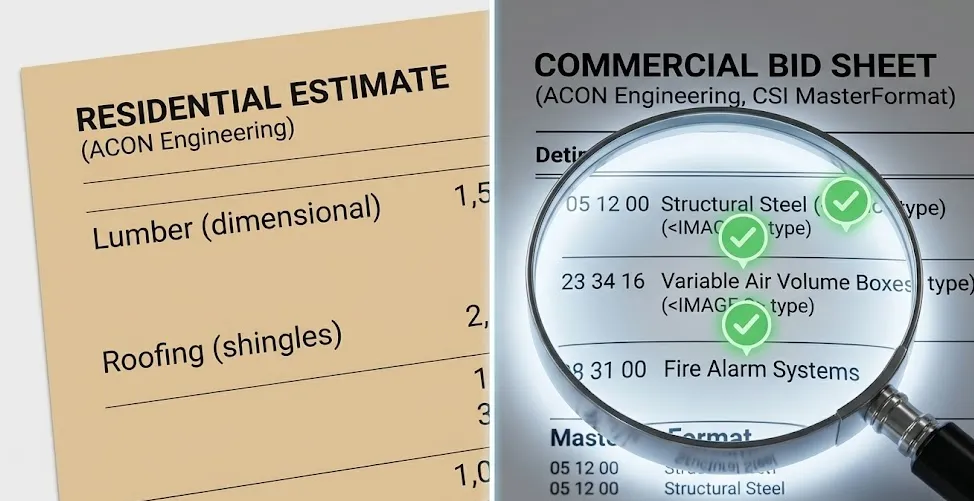
The differences between residential and commercial construction create distinct estimating requirements that affect every step of the process from quantity takeoff through bid submission.
Takeoff Complexity
Residential takeoffs follow standardized trade sequences. Framing, roofing, drywall, flooring, and MEP rough-in follow predictable assemblies with well-established waste factors. An experienced estimator can complete a residential takeoff on a set of standard plans in 4–8 hours using digital takeoff software.
Commercial takeoffs cover more trades, more drawing sheets, and more specification pages. A complete commercial takeoff for a mid-size office building can require 40–80 hours of estimating time across multiple trade specialists. The takeoff must address structural steel connections, curtain wall systems, fire suppression piping, electrical distribution equipment, and site utilities that residential projects do not include.
ACON Engineering’s construction takeoff services cover all CSI MasterFormat divisions for both residential and commercial work, with trade specialists assigned to each division to ensure accuracy at the level each project type requires.
Contingency Requirements
Residential projects with complete construction documents typically carry 5–10% contingency in the estimate. The construction documents are usually complete before bidding, the regulatory environment is predictable, and the primary risk is owner-driven change orders during construction.
Commercial projects carry 10–15% contingency or more during design phases, narrowing to 5–10% at the construction document stage. The additional contingency accounts for regulatory-driven scope changes during permit review, coordination issues between structural, MEP, and architectural systems, and market volatility over longer construction timelines.
Accuracy Standards
Both residential and commercial estimates can achieve 5–8% accuracy at the construction document stage with a complete drawing set, current cost data, and a structured QC review process. The difference is in the effort required to reach that accuracy level. Residential estimates reach bid-level accuracy with a fraction of the documentation and coordination that commercial estimates require.
A residential estimate produced in 24-48 hours by ACON Engineering achieves the same 5–8% accuracy standard as a commercial estimate that requires 3–5 days of multi-trade takeoff coordination. The process is calibrated to the project type, not applied uniformly regardless of scope.
Frequently Asked Questions
What is the main difference between residential and commercial construction?
Residential construction builds places where people live and falls under the International Residential Code. Commercial construction builds places where people work and gather, governed by the stricter International Building Code. The IBC adds fire suppression, ADA compliance, and multi-agency permitting that residential work does not require.
Is commercial construction more expensive than residential?
Yes. Commercial construction costs 20–30% more per square foot than residential nationally, rising to 40–60% more in major metro markets. Residential averages $150–$450 per square foot. Commercial averages $240–$870 per square foot depending on building type.
What type of construction is most profitable for contractors?
Commercial construction offers higher margins per project due to larger contract values. Residential offers faster project cycles and lower bonding requirements. The most profitable path depends on the contractor’s trade specialty, bonding capacity, and local market conditions.
How does ADA compliance affect commercial construction costs?
ADA compliance adds 2–5% to total hard construction costs on a typical commercial project. Accessible parking, routes, restrooms, entrances, and elevator requirements are all dedicated cost line items that residential construction does not carry.
What permits does commercial construction require?
Commercial projects typically require permits from the building department, fire marshal, health department (for restaurants and medical uses), and sometimes a zoning board. Total permit costs range from $5,000 for simple tenant improvements to $50,000 or more for large new construction.
How does the estimating process differ between residential and commercial construction?
A residential takeoff typically takes 4–8 hours for a standard home. A commercial takeoff for a mid-size project requires 40–80 hours across multiple trade specialists. Both achieve 5–8% accuracy at the construction document stage with current cost data and a structured QC review.

Tim C. is a construction estimating expert and Director at ACON Engineering, specializing in construction cost estimating, quantity takeoffs, and preconstruction planning. He has led thousands of successful project bids and helps contractors make informed, profitable decisions.