
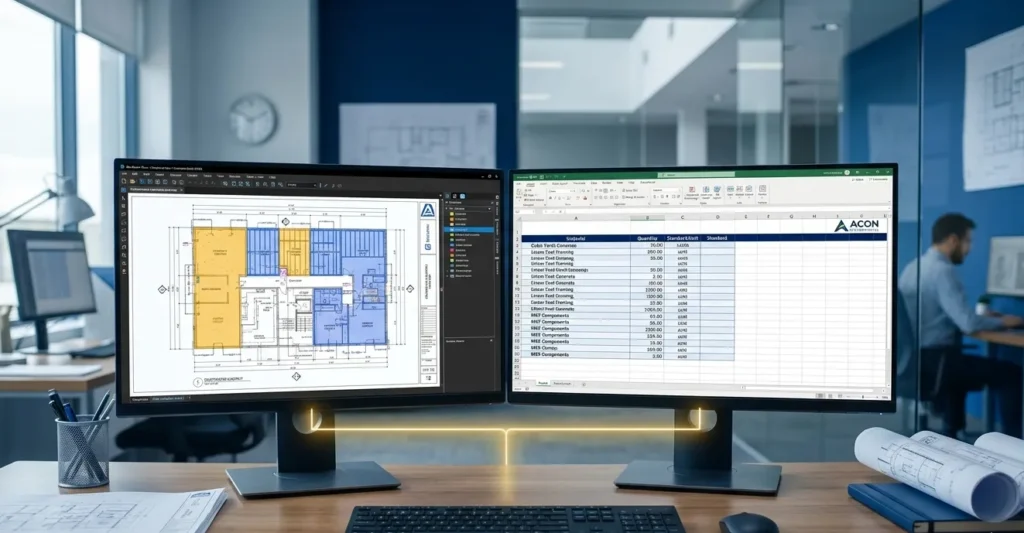
A construction takeoff is the process of reviewing project drawings and specifications to measure and list every material, labor unit, and equipment item a project requires. The takeoff is the first step in the estimation process and the foundation every cost line is built upon. An accurate takeoff produces a competitive, profitable bid. An inaccurate takeoff produces a contract that loses money.
A detailed takeoff carries a cost accuracy range of 5-8%, according to established ASPE estimating level standards. A rough internal estimate without a proper takeoff carries a 25-30% accuracy range. In a competitive bidding environment where the margin between winning and losing is 3–5% of contract value, that gap is decisive.
The takeoff process moves from drawing set review through quantity measurement, waste factor application, and structured output; all before a single dollar figure enters the estimate. Each step builds directly on the accuracy of the previous one.
Manual takeoffs, digital takeoffs, and outsourced takeoffs each produce the same output but differ dramatically in speed, error rate, and cost. Understanding which approach fits a specific project and firm size determines whether the takeoff strengthens or weakens the bid it supports.
What Is a Construction Takeoff?
A construction takeoff is a detailed document that lists every material required for a project along with its measured quantity, unit of measure, and cost when combined with pricing. The term comes from the practice of physically taking off quantities from paper drawings by measuring and recording each item. The discipline is identical whether performed manually or with software.
A takeoff is not an estimate. A takeoff is the measurement step that precedes the estimate. The estimate assigns dollar values to the quantities the takeoff has measured. Skipping the takeoff and estimating from memory or rule-of-thumb produces numbers that cannot be defended, verified, or updated when drawings change.
A takeoff answers how much. An estimate answers how much does it cost. Both questions are necessary. Neither is sufficient without the other.
Who Performs Construction Takeoffs?
At general contracting and subcontracting firms, construction takeoffs are performed by estimators who combine knowledge of construction methods, material specifications, and drawing interpretation to extract accurate quantities from project documents, according toAutodesk.
At large firms, multiple estimators divide the project by trade specialty. The concrete estimator measures foundation and slab quantities. The framing estimator counts lumber. The MEP estimator quantifies pipe, duct, and wire. Each specialist applies trade-specific knowledge that a generalist cannot reliably substitute.
At small and medium firms, a single estimator often handles multiple trades. This is where accuracy suffers most. A single estimator stretched across concrete, framing, drywall, roofing, and MEP cannot apply specialist knowledge to every trade simultaneously. Outsourcing professional Construction Takeoff Services gives small and medium contractors access to trade specialists across every CSI division without the cost of a specialist team.
How to Perform a Construction Takeoff: The 7-Step Process
Construction takeoffs follow a structured, sequential process regardless of project type or size. Skipping a step does not eliminate the cost of that step. It transfers that cost into a field shortage, a change order, or a margin loss that surfaces during construction rather than during estimating, where it could have been controlled.
1. Assemble and Review the Complete Drawing Set
Every takeoff begins with a complete drawing set review.
A complete bid package includes architectural drawings (floor plans, elevations, reflected ceiling plans, sections, and details), structural drawings (foundation plans, structural framing plans, connection schedules), MEP drawings (plumbing plans, electrical plans, HVAC plans), and site plans.
The estimator confirms that all drawing sheets are present, that all revision clouds and addenda are incorporated, and that the drawings are at a consistent, legible scale before measurement begins.
Missing drawings mean missing scope. A takeoff that proceeds without the structural drawings will miss all rebar, anchor bolt, and embedded hardware quantities. Missing MEP drawings will miss all rough-in materials. Completeness check is not optional. It is the first quality control step in the takeoff process.
ACON Engineering’s bid management services cover bid package review as a standard first step, ensuring no drawing is missing before a single quantity is measured.
2. Read the Specifications
Specifications define what the drawings do not show.
A floor plan shows a concrete slab. The specification defines whether that slab is 3,000 PSI, 4,000 PSI, or 5,000 PSI concrete, a cost difference of $8–$15 per cubic yard depending on market. A framing plan shows stud walls. The specification defines whether studs are 16 inches or 24 inches on center, a quantity difference of 33% in lumber count.
Estimators who skip specifications produce takeoffs that are dimensionally correct but materially wrong. Getting estimating building materials right means the correct material grade, thickness, product standard, and installation method must be verified in the specifications before measurement begins.
3. Establish the Measurement System
Before measuring begins, the estimator establishes a consistent measurement system and color-coding convention.
In manual takeoffs, each trade is assigned a distinct highlighter color. Concrete is yellow. Framing is orange. Drywall is green. As each item is measured and recorded, it is highlighted on the drawing. This prevents double counting and provides a visual quality check at the end of the takeoff. Any unhighlighted area that should have been measured is immediately visible.
In digital takeoffs using Planswift or Bluebeam, the same logic applies through annotation layers. Each trade occupies its own layer. The estimator toggles layers on and off to verify that every scope has been measured and that no area appears in two layers simultaneously.
ACON Engineering uses both Planswift and Bluebeam, assigning the appropriate platform based on the drawing format and project requirements.
4. Measure Quantities by Trade Division
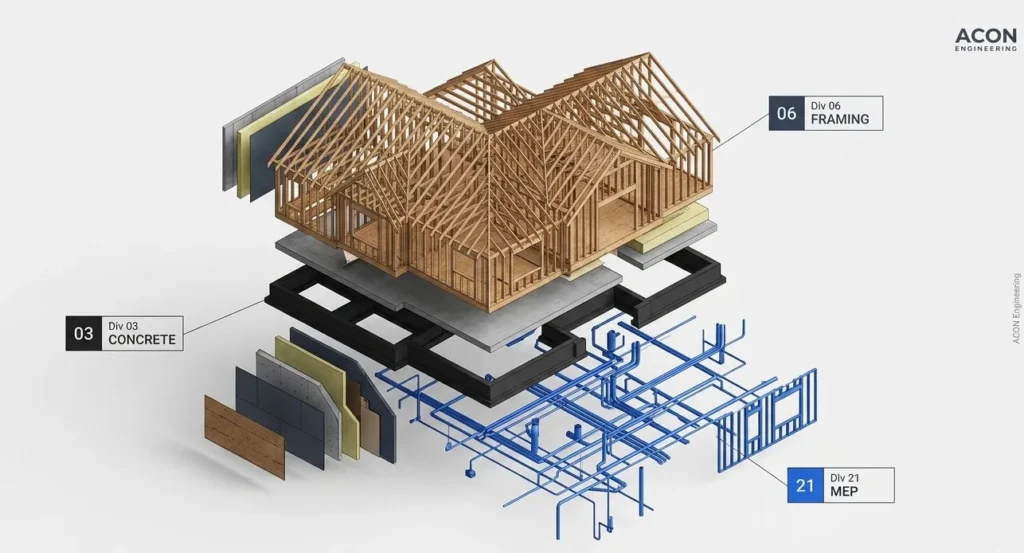
With the drawing set reviewed, specifications read, and color-coding established, measurement begins.
The estimator works through the drawings systematically, division by division, following CSI MasterFormat order. Measuring in CSI order ensures that the completed takeoff aligns with bid package structure, subcontractor scope letters, and the final estimate format without reorganization.
The following table shows the correct measurement unit for each major trade:
| Trade / Material | Measurement Unit |
| Concrete (slabs, footings, walls) | Cubic yards |
| Rebar | Linear feet, then converted to pounds/tons |
| Masonry (CMU, brick) | Square feet of wall area, then converted to unit count |
| Framing lumber | Linear feet by member size |
| Sheathing / decking | Square feet |
| Roofing | Squares (100 sq ft each) |
| Drywall | Square feet or sheets |
| Insulation | Square feet (batts) or cubic feet (spray foam) |
| Flooring | Square feet |
| Doors | Each |
| Windows | Each |
| Plumbing fixtures | Each |
| Pipe | Linear feet by diameter |
| Duct | Linear feet, square feet of surface area |
| Electrical conduit | Linear feet |
| Wire / cable | Linear feet |
Measuring in the wrong unit at this stage produces errors that compound through every subsequent calculation. Measuring framing in square feet of wall area instead of linear feet of individual members produces a lumber list that cannot be used for procurement.
5. Apply Waste Factors
Net quantities are not order quantities.
Every material requires a waste factor addition to account for cuts, breakage, installation inefficiency, and offcuts that cannot be reused. Applying the correct waste factor for each material prevents field shortages mid-project.
Standard waste factors by trade are: framing lumber 10–15%, drywall 10–12%, tile flooring 10–15%, roofing shingles 10–15%, concrete 5–10%, pipe and conduit 10%, and paint 5–10%. Complex layouts, diagonal tile installations, or non-rectangular rooms warrant adding 3–5% above standard waste allowances.
6. Transfer Quantities to the Takeoff Sheet
Every measured quantity transfers to a structured takeoff sheet organized by CSI division.
Each line on the takeoff sheet includes the item description, the drawing reference (sheet number and detail reference), the net quantity, the waste factor percentage, the waste-adjusted order quantity, and the unit of measure.
ACON Engineering delivers completed takeoff sheets as a detailed Bill of Quantities in Excel format, organized by CSI MasterFormat or UniFormat as required, with drawing references on each line so contractors and subcontractors can verify specific quantities against the source drawings.
7. Review and Quality Check
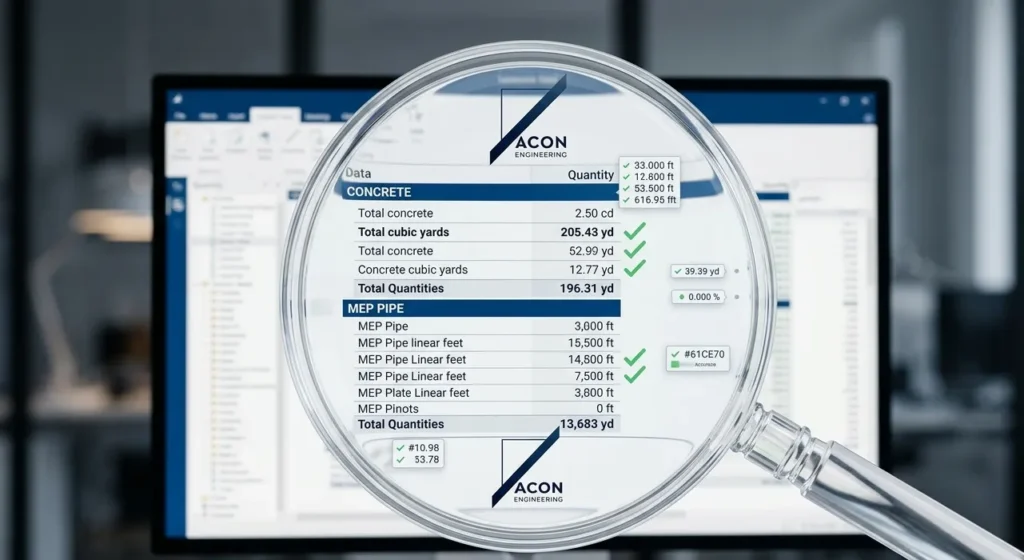
A takeoff that is not reviewed by a second set of eyes carries undetected errors into the bid.
Quality control review compares the takeoff totals to high-level parametric benchmarks. Does the concrete quantity per square foot of building area fall within the expected range for this building type? Does the drywall count align with the square footage of the building? Quantities that fall significantly above or below expected ranges indicate a measurement error that requires investigation before the takeoff is released for pricing.
ACON Engineering’s Construction Estimating Services apply a structured QC review on every takeoff before delivery, checking quantities against project-type benchmarks and cross-referencing measurement references to the drawing set.
Manual Takeoffs vs. Digital Takeoffs

Manual takeoffs and digital takeoffs produce the same output but differ significantly in speed, accuracy, and revision capability. The choice between them is not a preference decision. It is an operational decision that directly affects turnaround time, error rate, and the cost of incorporating drawing revisions.
Manual takeoffs use a paper drawing, a scale ruler, and a calculator. An experienced estimator can produce accurate manual takeoffs, but the process is time-consuming. A mid-sized commercial project can require 40–80 hours of manual takeoff time. Revisions when drawings change require re-measuring affected areas by hand.
Digital takeoffs using Planswift or Bluebeam allow the estimator to click and drag measurements directly on digital drawings. Software handles unit conversion automatically, eliminates mathematical transcription errors, and allows drawing revisions to be incorporated by re-measuring only the changed areas.
Digital takeoffs reduce takeoff time by 30–50% on comparable projects relative to manual methods, according toBluebeam. ACON Engineering performs all takeoffs digitally using Planswift and Bluebeam, enabling 24–48 hour turnaround on most projects.
For small residential projects with simple scope, an experienced estimator can produce a reliable manual takeoff efficiently. For commercial projects with complex MEP systems, multiple building levels, and frequent addenda, digital takeoffs are the professional standard. Using manual methods for complex commercial work introduces unnecessary error risk and timeline pressure.
Is PlanSwift Easy to Learn?
Planswift has a relatively accessible learning curve compared to enterprise estimating platforms, but mastery requires time and practice.
A new user with construction estimating knowledge can learn to produce basic area, length, and count measurements in Planswift within one to two days of focused practice. The software’s drawing import, measurement tools, and assembly database are logically organized and well-documented.
Producing accurate, fully formatted takeoffs that are ready for pricing requires 2–4 weeks of regular use. Correct waste factors, proper CSI organization, assembly pricing integration, and clean Excel export all require hands-on repetition before they become reliable.
Bluebeam has a steeper learning curve for takeoffs but integrates more deeply with document management workflows, making it the preferred platform for larger commercial projects where drawing control and version management are critical alongside quantity measurement.
For contractors who need professional-grade takeoffs without the software investment or learning curve, ACON Engineering providesoutsourced takeoff services using both platforms, delivering results in 24–48 hours.
Frequently Asked Questions?
Can ChatGPT do construction takeoffs?
ChatGPT cannot perform a construction takeoff. A takeoff requires reading actual construction drawings, measuring dimensions to scale, interpreting specifications, applying trade-specific waste factors to measured quantities, and organizing results in a structured format for pricing. ChatGPT has no ability to access, read, or measure construction drawings. It can explain what a takeoff is and describe the process, but it cannot produce a quantity list from a real project’s documents.
What are the 7 steps of construction?
The 7 steps of construction project delivery are: project initiation and feasibility, design and planning, permitting and approvals, procurement and contracting, site preparation and foundation, structural and systems construction, and finishing and closeout. The construction takeoff and cost estimation process occurs during steps 2 through 4, providing the cost data that drives procurement decisions, contract negotiations, and construction budgets.
What is the 3/4/5 rule in construction?
The 3/4/5 rule is a field technique for establishing a perfect 90-degree corner using the Pythagorean theorem. If a triangle has sides of 3 feet, 4 feet, and 5 feet, the angle opposite the 5-foot side is exactly 90 degrees. Layout crews use this rule to square building corners, foundation forms, and framing layouts before construction begins. It is a verification tool, not an estimating method. Layout accuracy directly affects whether material quantities from the takeoff match what is actually installed in the field.
What is the correct order of construction?
The correct order of construction for a typical building project is: site clearing and grading, foundation excavation and concrete, foundation waterproofing and backfill, structural framing, roofing and weatherproofing, rough MEP (mechanical, electrical, plumbing), insulation and air barrier, exterior finishes (siding, windows, doors), drywall and interior rough finishes, interior finish work (flooring, cabinets, paint), MEP trim and fixture installation, and final punchlist and inspections. A construction takeoff organized by CSI MasterFormat follows this same sequence, ensuring quantities are measured in the order they will be purchased and installed.
What is the difference between a quantity takeoff and a material takeoff?
A quantity takeoff measures all project quantities including materials, labor units, and equipment hours. A material takeoff focuses specifically on physical materials, their type, specification, and quantity. In practice, the terms are used interchangeably on most residential and commercial projects, where the primary output is a material quantity list. For complex industrial projects, the distinction matters because labor productivity and equipment selection are estimated separately from material quantities. ACON Engineering provides quantity takeoffs, material takeoffs, and combined estimates depending on what the contractor needs.
How long does a construction takeoff take?
Takeoff time depends on project size, trade complexity, and whether the takeoff is performed manually or digitally. A simple residential single-trade takeoff can be completed in 2–4 hours. A full multi-trade commercial takeoff for a mid-size project typically requires 1–3 days. A large or complex industrial project with extensive MEP systems can require a week or more. Digital takeoffs using Planswift or Bluebeam reduce takeoff time by 30–50% compared to manual methods. ACON Engineering delivers standard takeoffs in 24–48 hours and offers expedited delivery for bid-day deadlines.

Tim C. is a construction estimating expert and Director at ACON Engineering, specializing in construction cost estimating, quantity takeoffs, and preconstruction planning. He has led thousands of successful project bids and helps contractors make informed, profitable decisions.