
Construction estimating software is a digital tool that replaces paper drawings and manual calculations with a structured platform for measuring material quantities, applying labor rates, organizing cost databases, and producing formatted bid estimates.
The core decision in estimating software is not which platform has the most features. It is which platform fits the contractor’s trade, team size, project complexity, and existing workflows. A specialty electrical subcontractor and a large commercial general contractor have fundamentally different needs that no single platform optimally serves.
Software capabilities divide into four categories: digital takeoff, cost database integration, bid assembly, and team collaboration. Each category represents a distinct layer of the estimation workflow, and not every platform covers all four equally well.
No software replaces estimating expertise. A powerful platform in the hands of an inexperienced estimator produces fast, inaccurate results. ACON Engineering uses Planswift, Bluebeam, RS Means, FastPIPE, and FastDUCT in its professional practice. For contractors who need professional-grade estimates without the software investment or training overhead, ACON Engineering’s construction estimating services deliver accurate estimates using the full professional software stack within 24-48 hours.
What Does Construction Estimating Software Actually Do?
Construction estimating software handles five core functions that define its value to a contractor. Understanding how construction estimating software simplifies your work is the foundation of an informed buying decision.
- Digital takeoff measures material quantities directly from imported drawings. The estimator clicks and traces on a digital plan and the software calculates areas, lengths, volumes, and counts automatically, eliminating manual measurement and arithmetic.
- Cost database integration applies current unit costs to measured quantities. Databases such as RS Means, Craftsman, and proprietary assembly libraries store material and labor costs by trade and ZIP code. The software multiplies quantities by unit costs and calculates extended totals.
- Assembly management groups commonly used material and labor combinations into reusable templates. A wall assembly might include studs, plates, drywall, insulation, and installation labor for every linear foot of wall. Dragging that assembly onto a measured wall length prices the entire scope in seconds.
- Bid organization formats the compiled estimate into a structured document organized by CSI MasterFormat division, trade scope, or the client’s preferred cost code structure. A well-organized bid document is essential for subcontractor solicitation and owner review.
- Reporting and export generates Excel spreadsheets, PDF bid summaries, and subcontractor scope sheets from the completed estimate, eliminating the manual transcription step that introduces errors between the takeoff and the submitted proposal.
8 Best Construction Estimating Softwares
| Software | Best For | Pricing | Takeoff | Cost Database | Cloud | CSI Format |
| Planswift | Specialty trades, small-mid GCs | $1,595 one-time | Strong | External (RS Means) | No | Yes |
| Bluebeam Revu | Document control, collaboration | $260–$440/yr | Advanced PDF | External | Studio only | Manual |
| RS Means (Gordian) | Cost database only | $985–$2,325/yr | No | Comprehensive | Yes | Yes |
| STACK | Mid-size commercial GCs | $249/mo | Cloud-based | Built-in | Yes | Yes |
| ProEst | Large commercial/industrial | $5k/year | 3D capable | RS Means integrated | Yes | Yes |
| Buildertrend | Residential builders | Custom | Basic | Limited | Yes | Partial |
| FastPIPE | Plumbing and piping | Custom | Pipe-specific | Mechanical | No | MEP |
| FastDUCT | HVAC and sheet metal | Custom | Duct-specific | Mechanical | No | MEP |
| Sage Estimating | Sage ecosystem users | Custom | Included | Extensive | Partial | Yes |
The platforms below represent the tools U.S. contractors encounter most frequently. Each is evaluated on what it does best, where it falls short, and which type of contractor it serves. Pricing figures are sourced from G2, Capterra, and direct vendor data as noted.
1. Planswift
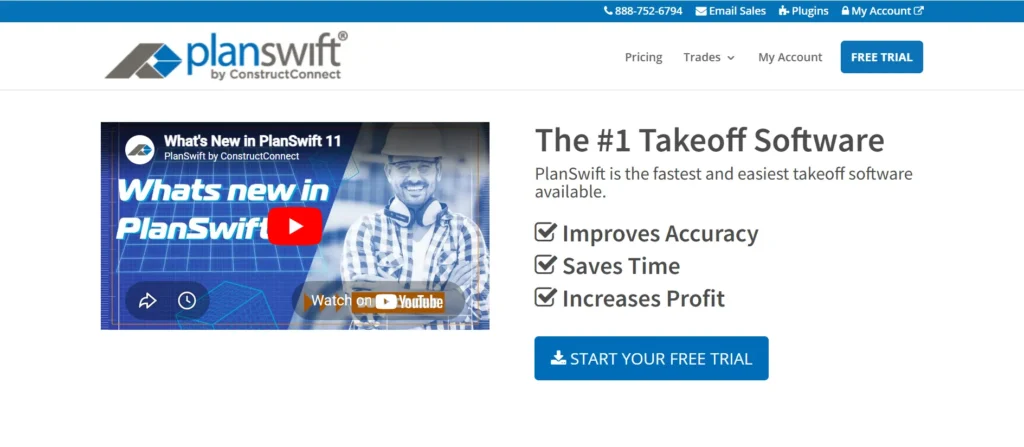
Planswift is best suited for specialty trade subcontractors and small-to-mid-size general contractors who need fast, accurate digital takeoffs and direct Excel integration.
Planswift is a desktop takeoff and estimating platform designed specifically for construction. Estimators import PDF or CAD drawings, perform point-and-click measurements to calculate lengths, areas, volumes, and counts, and apply drag-and-drop assemblies that calculate material and labor costs automatically.
Planswift’s assembly builder calculates materials and labor for grouped items. Its plan overlay feature helps estimators compare revisions against original drawings and identify scope changes quickly. The software exports directly to Excel, which is the standard format for most contractor bid documents and subcontractor scope packages.
Pricing:
Planswift is priced at $1,595 as a lifetime license including first-year updates and phone support, according to pricing listed directly by PlanSwift on G2. Annual updates and support after the first year start at $250 per license. That one-time structure makes it significantly more economical than subscription-based alternatives for firms with stable team sizes.
Limitations:
Planswift’s limitation is its Windows-only architecture and absence of cloud collaboration. Teams needing browser-based access or Mac compatibility must look to cloud-native alternatives. It also does not include a built-in cost database, requiring integration with RS Means or a custom assembly library for cost application.
ACON Engineering uses Planswift as a primary takeoff platform, enabling 24-48 hour delivery on residential and commercial projects of all sizes.
2. Bluebeam Revu
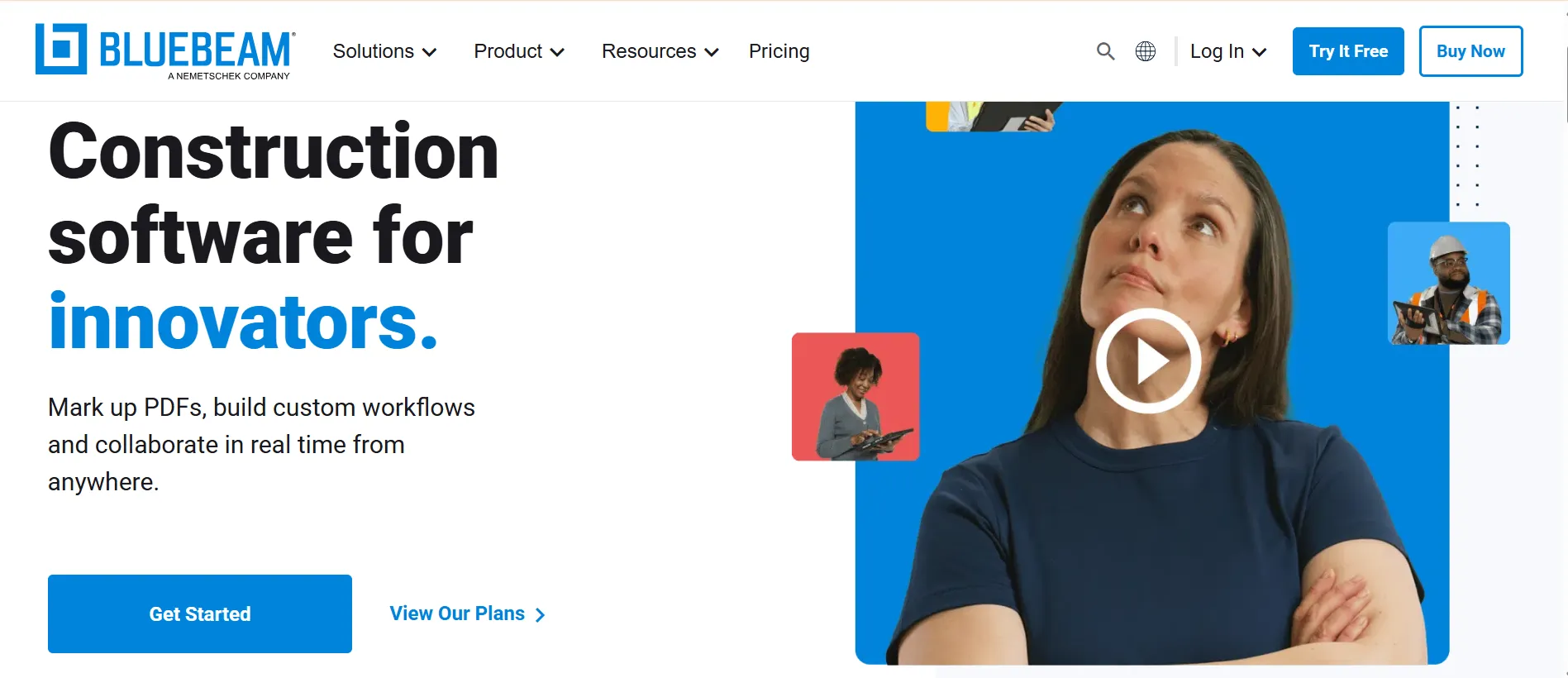
Bluebeam Revu is best suited for general contractors, architects, and engineering firms that manage large drawing sets and require document control, real-time team collaboration, and PDF markup alongside takeoff.
Bluebeam Revu is not primarily an estimating platform. It is a PDF markup, annotation, and document management tool that includes powerful measurement capabilities. Its Dynamic Fill feature automates area measurement on irregular shapes. Its Quantity Link function exports measurements directly to Excel in real time as annotations are placed.
Bluebeam Studio enables simultaneous plan review and markup by multiple team members, making it the standard platform for design-build firms, GCs managing multiple subcontractors, and owner-operators who need controlled document review workflows on top of takeoff.
Review and Pricing:
Over 90% of Bluebeam reviewers across G2 say they would recommend the platform, citing PDF editing capabilities, markup tools, and project collaboration as primary value drivers. Bluebeam Revu subscription pricing starts at $260 per user billed annually for the Basics plan and reaches $440 per year for the advanced tier.
Limitations:
Bluebeam’s limitation is its absence of built-in estimating and cost assembly functionality. Estimators using Bluebeam for takeoff must export quantities to a separate estimating platform or spreadsheet for pricing. Its learning curve is steeper than Planswift for pure takeoff workflows. It is also Windows-only.
ACON Engineering uses Bluebeam alongside Planswift for projects requiring detailed document annotation, drawing revision tracking, and team collaboration on complex commercial and industrial drawing sets.
3. RS Means Data (Gordian)
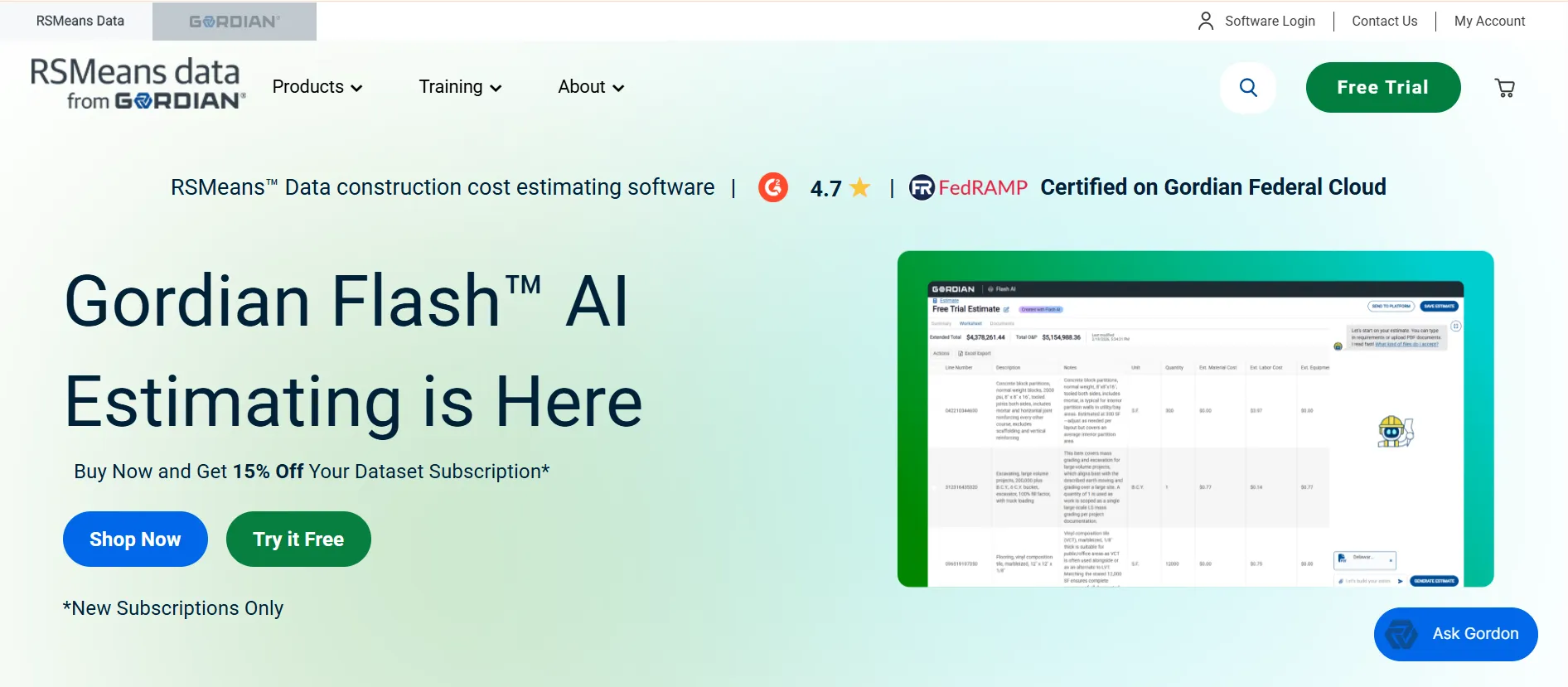
RS Means is best suited for estimators who need verified, ZIP-code-level material and labor cost databases to apply accurate unit costs to measured quantities.
RS Means is not a takeoff or estimating platform. It is a cost database. RS Means Data Online, published by Gordian, provides unit costs for thousands of construction assemblies and individual materials, organized by CSI division and adjusted for local labor and material markets by ZIP code.
Pricing:
Estimators who measure quantities with Planswift or Bluebeam apply RS Means unit costs to produce priced line items. RS Means is one of the most widely referenced construction cost data sources in the U.S. professional estimating community. RS Means Data Online subscription costs approximately $985-$2,325 per year depending on the scope of data included.
RS Means provides cost benchmarks, not live market pricing. For tariff-sensitive materials and rapidly shifting commodity prices, RS Means costs must be supplemented with direct supplier quotes to reflect true current pricing.
ACON Engineering uses RS Means in combination with Craftsman Cost Data and its own proprietary project-history databases to produce ZIP-code-accurate estimates across all U.S. markets.
4. STACK
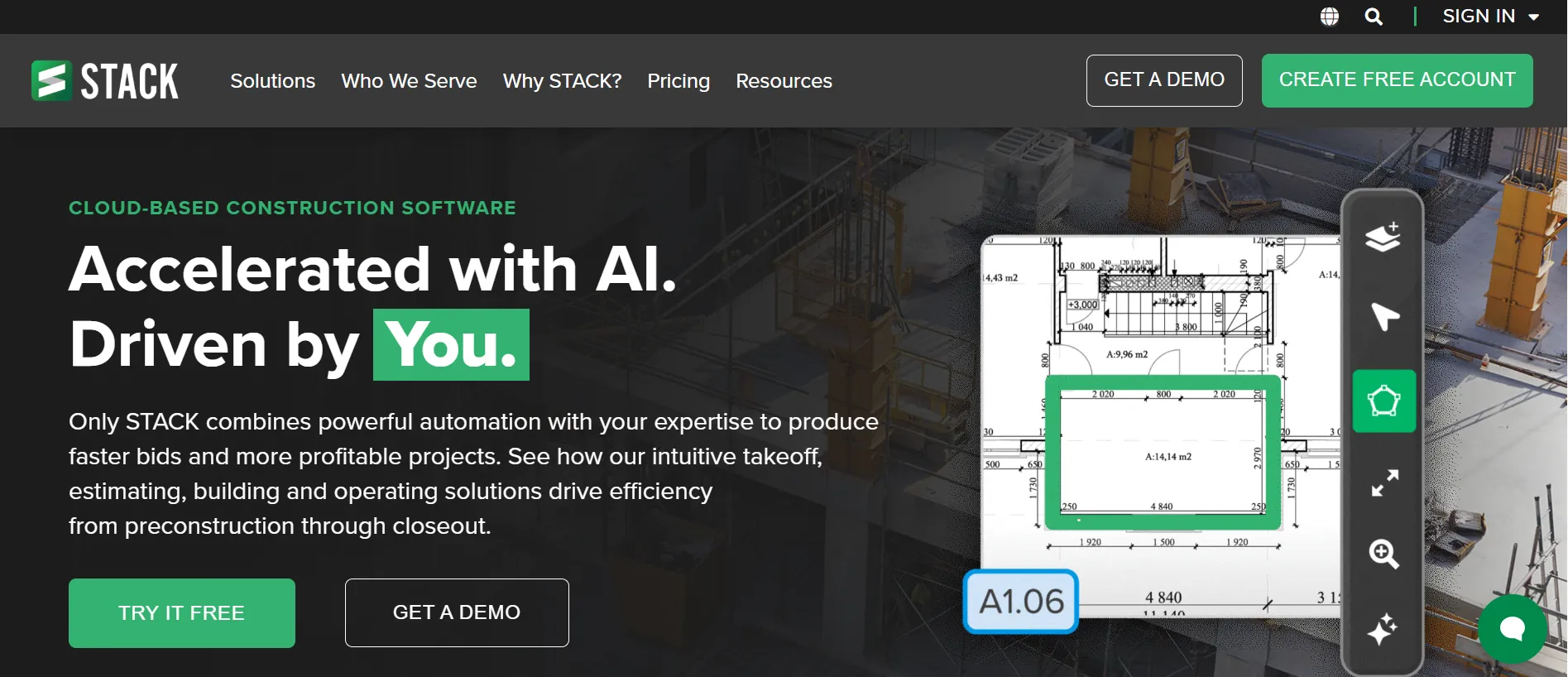
STACK is best suited for mid-size commercial general contractors and subcontractors who need a cloud-based platform accessible from multiple locations with built-in takeoff and estimating in a single subscription.
STACK is a cloud-native takeoff and estimating platform that eliminates the Windows-only limitation of Planswift and Bluebeam. Estimators access STACK from any browser, enabling remote teams and field staff to view and contribute to estimates without installing local software.
Pricing:
STACK starts at $249 per month according to G2. STACK’s built-in cost database covers common commercial construction items. Its subcontractor bid solicitation feature allows GCs to send scope invitations and collect pricing within the platform.
Limitations:
STACK’s limitation is its cost database depth. It is less comprehensive than RS Means for specialty trade and industrial work. Contractors doing complex mechanical or electrical work may find the built-in database inadequate for detailed assembly pricing.
5. ProEst
ProEst is best suited for large commercial and industrial contractors with complex multi-trade projects who need an integrated takeoff, estimating, and CRM platform with extensive cost database coverage.
ProEst is a comprehensive cloud-based platform that combines digital takeoff, cost estimating, subcontractor management, and bid tracking in a single environment. Its integration with RS Means data provides ZIP-code-accurate pricing across a wide range of commercial assemblies. ProEst includes 3D takeoff capability, automatic price updates, regional pricing, and multi-user real-time collaboration.
Pricing:
ProEst starts at $5k per year with unlimited users according to G2. That higher price reflects the platform’s depth and is justified only when the firm uses it across all preconstruction workflows simultaneously.
Limitations:
ProEst’s limitation is its cost and complexity for smaller operations. It is unsuitable for small contractors or specialty subcontractors with straightforward trade scopes. The platform requires significant onboarding investment and produces its full value only at scale.
6. Buildertrend
Buildertrend is best suited for residential builders, remodelers, and custom home contractors who need an all-in-one platform covering estimating, project management, client communication, and financial tracking in one subscription.
Buildertrend is not primarily an estimating tool. It is a construction management platform that includes estimating as one module within a broader residential workflow covering proposals, contracts, scheduling, client portals, and financial reporting.
Pricing:
Buildertrend don’t publish their prices. Its estimating module produces proposals and change orders for residential projects but lacks the detailed assembly-based takeoff functionality that commercial estimating requires.
Limitations:
Buildertrend’s limitation is its scope. It is designed for residential client-facing workflows, not competitive bid preparation. Commercial contractors who need detailed CSI-formatted estimates and subcontractor scope packages will find Buildertrend’s estimating module insufficient for their bid requirements.
7. FastPIPE and FastDUCT
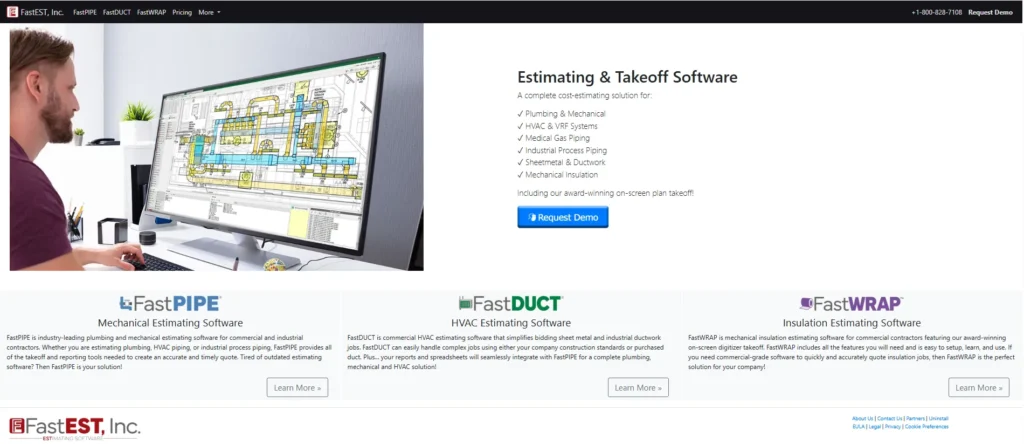
FastPIPE and FastDUCT are best suited for mechanical trade subcontractors: specifically plumbing and piping contractors (FastPIPE) and sheet metal and HVAC contractors (FastDUCT) who need trade-specific quantity takeoff and material pricing. Many subcontractors also use professional Plumbing Estimating Services to prepare accurate piping and fixture cost calculations before bidding.
FastPIPE and FastDUCT are specialized estimating tools for the mechanical trades. FastPIPE measures and prices plumbing and piping systems from drawings, applying pipe size-specific labor factors, fitting counts, and material costs that general estimating platforms cannot replicate accurately. FastDUCT performs the same function for ductwork and HVAC sheet metal systems. Professional HVAC Estimating Services help contractors calculate ductwork quantities, labor hours, and equipment pricing more accurately during bid preparation.
FastPIPE and FastDUCT are trade-specific. They have no value for general construction estimating or non-MEP trade scopes.
ACON Engineering uses both FastPIPE and FastDUCT for MEP estimating,plumbing estimating,HVAC estimating, and mechanical estimating on commercial and industrial projects.
8. Sage Estimating
Sage Estimating is best suited for mid-to-large construction firms already using Sage construction accounting software who want native integration between preconstruction estimating and project cost tracking.
Sage Estimating integrates directly with Sage’s construction accounting and project management platforms, enabling cost data to flow from estimate to contract to job cost without manual re-entry. Its cost database is extensive, covering both commercial and heavy civil work. Sage Estimating pricing is available through custom quotes.
Pricing:
Like Buildertrand, Sage Estimating’s pricing is not published.
Limitations:
The integration value is highest for firms already committed to the Sage ecosystem. Standalone, it is more complex to implement than Planswift, STACK, or Bluebeam for firms not using Sage accounting.
How to Choose the Right Construction Estimating Software?
Selecting the right platform requires matching four criteria to the contractor’s actual operating conditions. A platform that wins awards for a large commercial GC may be completely wrong for a drywall subcontractor producing 10 bids per month on residential projects.
Trade type is the first filter. Specialty mechanical subcontractors should evaluate FastPIPE and FastDUCT before any general platform. Electrical subcontractors should evaluate ConEst. General platforms such as Planswift, STACK, and ProEst serve multi-trade and GC estimating well but apply trade-specific knowledge less precisely.
Team size and collaboration needs determine whether a desktop or cloud platform fits. A single estimator produces faster results with a desktop tool like Planswift. A team of three or more estimators working simultaneously on a large project benefits from a cloud platform like STACK or ProEst, where multiple users access the same drawing set without file synchronization delays.
Project complexity determines the required database depth. Simple residential projects can be priced with custom assemblies built from local supplier quotes. Complex commercial and industrial projects often benefit from professional BIM Estimating Services that use coordinated 3D models alongside comprehensive cost databases to improve pricing accuracy across multiple CSI divisions.
Existing software ecosystem determines integration value. A firm using Procore for project management benefits from estimating software that integrates natively with Procore. A firm using Sage accounting extracts more value from Sage Estimating than from any platform that requires manual cost code mapping between systems.
Purchasing and implementing estimating software requires capital investment, training time of 2–4 weeks for proficiency on most platforms, and ongoing staff capacity to use it consistently. Contractors producing fewer than 60–80 estimates per year often achieve better economics by outsourcing to ACON Engineering’soutsource estimatingservices, which provide access to the full professional software stack without any capital outlay or training overhead.
Does Software Make Estimating Accurate?
Software makes accurate estimating faster. It does not make inexperienced estimating accurate.
AA trained estimator using Planswift produces a takeoff that is both fast and reliable. Professional Construction Takeoff Services help contractors generate accurate material measurements and organized scope quantities from project drawings before estimating begins.. An untrained estimator using the same platform produces a fast but unreliable result. The platform accelerates whatever quality of judgment the estimator brings to it.
The variables that determine estimate accuracy are completeness of the drawing review, correct application of waste factors, current market pricing, and quality control review against parametric benchmarks. These are judgment decisions that no software automates.
Professional estimating firms produce more accurate bids than in-house estimators who use sophisticated platforms occasionally because volume and practice build the judgment that software accelerates. ACON Engineering’s estimators perform hundreds of takeoffs annually across all trade types, building the project-type and market-specific knowledge base that produces defensible, accurate estimates on every project.
Frequently Asked Questions
What is the most popular construction estimating software?
Planswift and Bluebeam Revu are considered the most widely used takeoff platforms among U.S. specialty trade contractors and commercial estimators. Planswift leads for dedicated takeoff and estimating workflows. Bluebeam leads for document control and team collaboration. ProEst and STACK are the most-used cloud platforms among commercial GCs. RS Means Data Online is the most widely referenced cost database among professional estimators. Buildertrend dominates the residential construction management segment.
How much does construction estimating software cost?
Costs vary widely by platform. Planswift costs $1,595 as a lifetime license including first-year support, with annual updates starting at $250 thereafter. Bluebeam Revu starts at $240 per year. STACK starts at $299 per month. ProEst starts at $500 per month. RS Means Data Online costs $985–$2,325 per year. Buildertrend starts at $199 per month. Sage Estimating, FastPIPE, and FastDUCT are priced on custom quotes. Total cost of ownership must include training time and any integrated database subscriptions not included in the base license.
Is there free construction estimating software?
Several platforms offer free tiers or trial periods. STACK offers a limited free version. Planswift and Bluebeam both offer 14-day free trials. Fully functional, production-ready estimating for competitive commercial bidding requires a paid platform. Free tools typically lack integrated cost databases, CSI-formatted output, and the assembly management features that professional estimating demands.
What software do professional construction estimators use?
Professional estimators most commonly use Planswift or Bluebeam for digital takeoff, RS Means Data Online for cost database pricing, and Excel for bid assembly and client deliverables. MEP trade estimators use FastPIPE and FastDUCT. Large commercial GC estimating departments use cloud platforms such as ProEst or STACK. ACON Engineering uses Planswift, Bluebeam, RS Means, FastPIPE, and FastDUCT across its professional estimating practice.
Can AI replace construction estimating software?
AI tools are entering the preconstruction market, primarily in drawing recognition and scope detection. These tools assist estimators by flagging potential scope items but do not replace the judgment required to measure correctly, apply appropriate waste factors, evaluate specifications, or price at current local market rates. Bluebeam has begun integrating AI assistance through its Bluebeam Max feature. AI accelerates experienced estimators. It does not substitute for them.
Should a contractor buy estimating software or outsource estimating?
Buying and implementing estimating software is cost-effective when the firm produces 60–80 or more estimates per year with consistent project types and can justify the capital and training investment against stable bidding volume. For contractors producing fewer estimates, bidding variable project types across multiple trades, or needing overflow capacity during peak periods, outsourcing to ACON Engineering delivers the full software stack and specialist expertise without any fixed cost. A contractor paying $200–$500 per outsourced estimate on 5 bids per month spends $1,000–$2,500 monthly, a fraction of the combined software, database, and labor cost of maintaining an in-house estimating function.

Tim C. is a construction estimating expert and Director at ACON Engineering, specializing in construction cost estimating, quantity takeoffs, and preconstruction planning. He has led thousands of successful project bids and helps contractors make informed, profitable decisions.