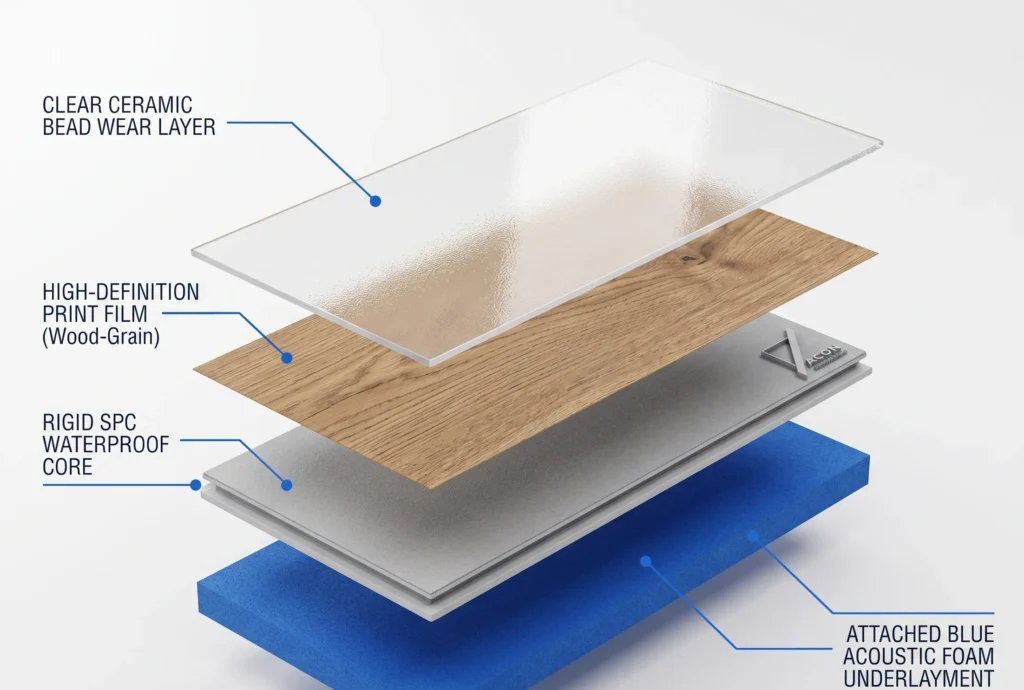
Vinyl plank flooring is incredibly popular right now. Homeowners love it because it is highly durable, completely waterproof, and comes in hundreds of different styles that look exactly like real wood or stone.
But when it’s time to plan your renovation, assessing the actual price can get confusing.
On average, you can expect to pay anywhere from $4 to $12 per square foot for a complete installation. This estimate covers both the physical materials and the labor required to lay the floors. To give you a quick idea, installing vinyl planks in a standard 100-square-foot room will usually cost you between $400 and $1,200.
Of course, your final bill will shift depending on a few different details. The specific quality of the planks you buy, the going rate for local labor, and the overall complexity of your floor plan all play a major part in the final price tag.
Today, we are going to break down all these numbers so you know exactly what it costs to install vinyl plank flooring.
What Factors Affect Your Vinyl Flooring Costs?
The total cost of your vinyl flooring project depends on the specific type of vinyl you choose, how it connects to the floor, and the layout of your rooms. While the flooring material has a set price, the hands-on labor required to prep the subfloor and cut planks around tricky corners is what really drives your final bill.
Here is a look at exactly what influences the numbers on your estimate:
The Type of Vinyl You Choose
The material you pick sets your baseline price. Different styles offer different levels of durability and aesthetics:
- Luxury Vinyl Planks (LVP): Designed to look exactly like real hardwood floors, bringing warmth and a high-end feel to your rooms.
- Luxury Vinyl Tiles (LVT): Mimics the look of natural stone or ceramic tiles, but feels much softer and warmer under your bare feet.
- Sheet Vinyl Flooring: Comes in large, flexible, continuous rolls. Because it lacks seams, it is highly water-resistant and perfect for bathrooms and kitchens.
- Rigid Core Vinyl (SPC or WPC): The most durable option you can buy for a home. It features a heavy, waterproof core that handles heavy foot traffic and prevents dents.
- Vinyl Composite Tile (VCT): An extremely tough, basic tile mostly used in heavy commercial settings rather than residential homes.
Labor Costs and Expertise
Hiring an experienced, licensed flooring contractor costs more per square foot than hiring a general handyman. However, paying for real expertise ensures the planks lock perfectly tight so the floor does not buckle or separate over time. Keep in mind that labor rates also vary wildly by geographic location; the same job will cost a different amount depending on the cost of living in your specific city.
The Installation Method
How the floor actually attaches to the ground drastically changes how many hours the installers have to work:
- Click-lock vinyl plank: Often called a floating floor, these planks snap together without the need for glue. It is the fastest and usually the cheapest labor option because it requires no adhesive.
- Glue-down vinyl plank: While the actual adhesive is quite inexpensive, directly gluing planks to the subfloor requires a very slow, precise, and labor intensive installation process.
- Loose lay vinyl plank: These thick, heavy planks grip the floor using friction and a specialized rubber backing. They require very little tape or glue, making the installation fast.
Site Conditions and Complexity
The physical condition of your house dictates the rest of your labor bill:
- Subfloor preparation: Vinyl needs a completely flat surface. If your concrete or wood subfloor is cracked, uneven, or damaged, installers have to patch and level it to make it smooth and stable before they can lay a single plank.
- Removal of old flooring: Ripping up old carpet, scraping away old tile mortar, and paying dump fees to dispose of the old materials adds up quickly.
- Room layout: A perfectly square, empty room is fast to the floor. But if installers have to make dozens of custom cuts around kitchen islands, closets, or uneven walls, the labor hours will spike.
- Stairs and custom patterns: Installing vinyl on a staircase requires custom-cut nosing and intense detail work. Laying planks in a special design, like a herringbone pattern, is highly labor-intensive.
- Geographic location: Where you live matters a lot. Local labor rates vary by region, so the exact same flooring job will cost a different amount depending on your local economy and cost of living.
Calculating your precise square footage, identifying the waste factor, and adding up all the necessary transition strips and underlayment gets complicated fast. Instead of making estimates for your budget or relying on rough online averages, you can hand the task over to professional construction estimating services like ACON Engineering. They provide a highly accurate, zip-code-based material takeoff within 24 to 72 hours.
How to Calculate Vinyl Plank Flooring Installation Cost
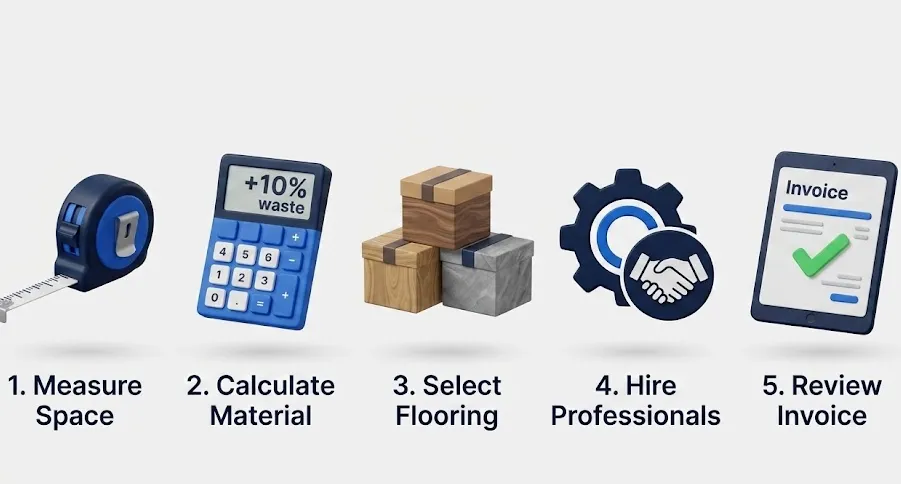
To price out your new vinyl floors, you just need your room measurements, a 10% waste factor for cuts, and your local material and labor rates.
Here is exactly how you calculate your project cost from start to finish:
1. Measure your room
Start by finding the total square footage of the space. Grab a tape measure and check the length and width of the room in feet. Multiply the length by the width. For example, a room that is 10 feet wide and 15 feet long gives you a baseline of 150 square feet.
2. Add a 10% waste factor
Installers have to cut planks to fit around corners, closets, and door frames, which creates unusable scraps and off-cuts. Always add 10% to your square footage to cover this waste. Simply multiply your room size by 1.10. For a 150-square-foot room, you actually need to order 165 square feet of flooring.
3. Estimate your material costs
Take the exact price per square foot of the vinyl planks you want to buy. Multiply that price by your new total square footage (the number that includes your 10% waste factor). This gives you the core price of your flooring.
4. Estimate your labor costs
Labor rates depend on where you live and the condition of your subfloor. Most flooring contractors charge a specific rate per square foot to lay down the planks. Check the going local rate for installers in your city, and multiply that rate by your square footage.
5. Add it all together
Combine your total material costs and your total labor costs. This final number gives you a highly realistic estimate of what you will actually pay to complete the floor installation.
Cost of Vinyl Plank Flooring Materials
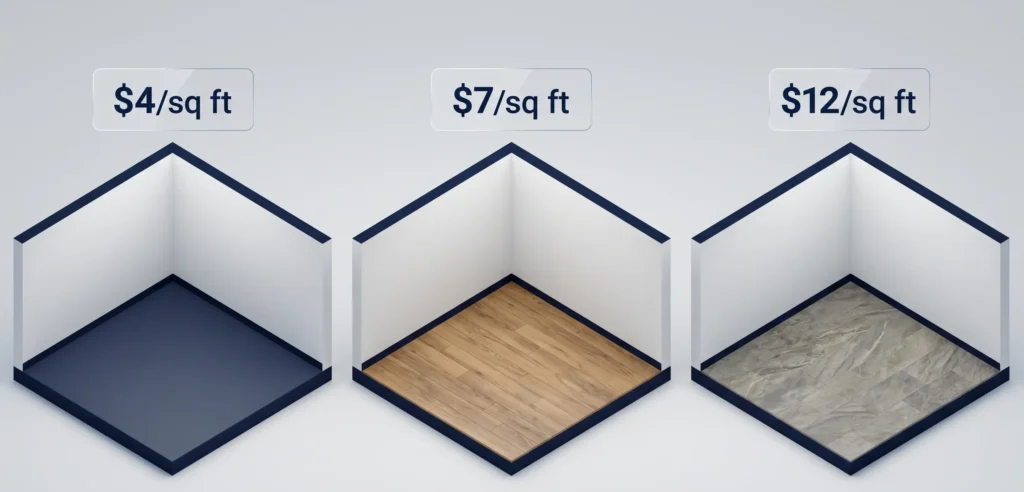
The cost of vinyl flooring materials ranges from $0.50 per square foot for basic sheets up to $7 or more for premium planks. What you actually pay depends on the thickness, wear layer, and overall quality of the product you choose.
Here is a look at the three main tiers of Luxury Vinyl Plank (LVP):
- Budget LVP: You will pay $1 to $3 per square foot. These planks have a thinner wear layer and a shorter lifespan. Installers usually use a basic click-lock or glue-down method for these.
- Mid-range LVP: Running $3 to $5 per square foot, this is a great choice for residential homes. It offers solid thickness, high durability, and a much more realistic wood texture.
- High-end luxury LVP: Expect to pay $5 to $7 or more per square foot. These premium planks feature very thick wear layers, total water resistance, and highly realistic premium designs.
Other popular options include Rigid Core Vinyl (SPC) at $3 to $6 per square foot, which provides a heavy, stone-plastic core. If you need cheaper alternatives, opt for Vinyl Composite Tile (VCT), which would cost you around $1 to $3.
| Material Type | Average Cost |
| Budget LVP | $1 to $3 per sq ft |
| Mid-Range LVP | $3 to $5 per sq ft |
| High-End Luxury LVP | $5 to $7+ per sq ft |
| Rigid Core Vinyl (SPC) | $3 to $6 per sq ft |
| Vinyl Composite Tile (VCT) | $1.00 to $3.50 per sq ft |
| Sheet Vinyl | $0.50 to $5 per sq ft |
Beyond the actual planks, you need a few extra materials to finish the room. A good foam underlayment costs around $0.50 per square foot or less, while the matching trim and molding for your walls run between $1 and $2 per linear foot. If you are unsure how to estimate building materials accurately, a good rule of thumb is to always buy an extra 5 to 10 percent of your total material. You need this extra flooring to cover the standard waste factor for the custom cuts made around corners, closets, and door frames.
Vinyl Plank Flooring Cost by Room Size
The final cost to install vinyl plank flooring in any room depends heavily on the material quality, the local labor rates, and the amount of subfloor preparation required.
Here is an estimate of what you can expect to pay to floor different rooms in your house:
| Room Name | Room Size | Estimated Total Cost |
| Bathroom | 50 sq ft | $300 to $600 |
| Bedroom | 100 sq ft | $600 to $1,200 |
| Average Bedroom | 150 sq ft | $900 to $1,500 |
| Large Bedroom | 200 sq ft | $1,200 to $2,400 |
| Living Area | 300 sq ft | $1,500 to $3,600 |
| Large Living Room | 350 sq ft | $2,200 to $4,500 |
| Basement | 750 sq ft | $4,500 to $7,500 |
These numbers give you a solid baseline to start planning your budget. Keep in mind that choosing premium materials or running into unexpected subfloor damage will push your actual costs higher. On the other hand, you can significantly lower these final numbers through DIY savings if you decide to pull up the old floors, prep the surface, or handle the entire installation yourself.
Labor Costs for Vinyl Plank Flooring
The typical installation labor rate to put down vinyl planks falls between $1.50 and $3 per square foot. However, if your project involves a highly complex layout, those professional flooring installation costs can jump up to $8 to $10 per square foot.
To give you a better idea of the total cost, hiring a crew for a small 150-square-foot room will generate about $450 to $900 in LVP labor charges. If you are flooring an average 300-square-foot room, expect to pay between $900 and $1,600 for the labor alone.
Keep in mind that the base rate only covers laying down the new planks. You will see extra charges on your bill if the installers have to prep the site first.
Here are the most common labor add-ons:
- Removing old flooring: Tearing out old carpet, tile, or wood costs an extra $1 to $2 per square foot.
- Subfloor preparation: Patching holes and leveling out dips runs about $1 to $3 per square foot.
- Stairs: Wrapping stairs in vinyl is slow, detail-heavy work. You will usually pay between $40 and $120 per step.
At the end of the day, four main things influence your final labor bill. The complexity of the installation drives the price up. Heavy subfloor preparation adds hours to the job. Lastly, the material type and the material installation method dictate the workload.
Hidden Costs of Vinyl Plank Flooring Installation
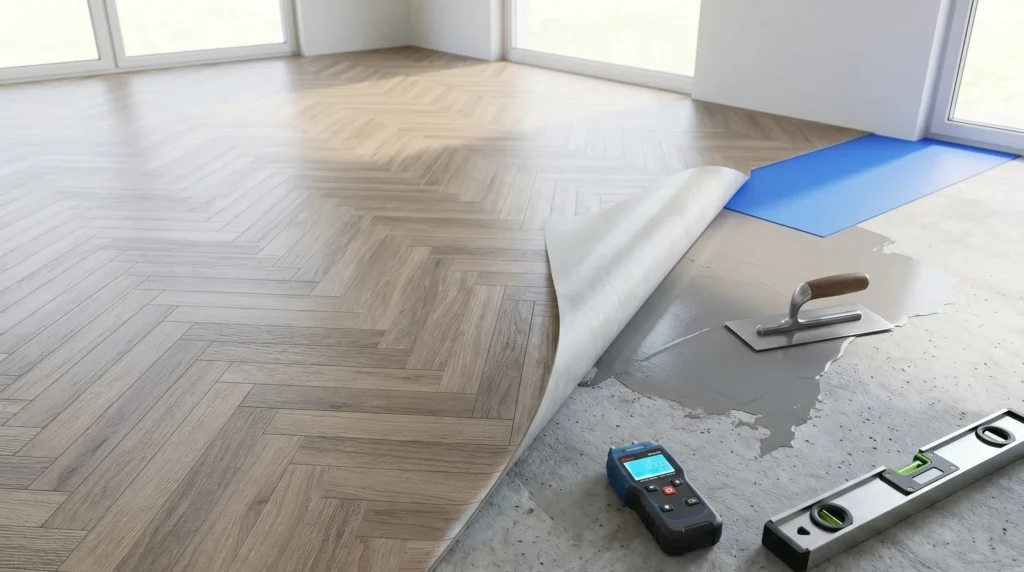
The base price you see on a box of vinyl planks never covers the complete job, as hidden expenses like subfloor repairs, demolition, and finishing trims often add hundreds of dollars to your final bill.
When planning your budget, you need to account for the physical condition of your room and the extra materials required to finish the edges. Here is a breakdown of the most common hidden costs you will encounter:
- Subfloor preparation: Leveling the subfloor by patching dips and grinding down high spots is mandatory before laying any planks. This specific prep work adds $1 to $4 per square foot to your budget.
- Underlayment: If your planks lack a built-in pad, you might need a separate underlayment for soundproofing and moisture protection. Adding this layer costs about $0.50 to $1 per square foot.
- Trimming and transition strips: You need transition strips to safely connect the new vinyl to other rooms and existing flooring types. Expect to pay $1 to $3 per linear foot for these pieces.
- Baseboard removal and replacement: Installers must pull off your baseboards to lay the floor tightly against the walls. Taking them down and putting them back up costs roughly $0.50 to $2 per linear foot.
- The waste factor: Installers always have to cut pieces to fit your room dimensions perfectly, which creates unusable scraps. You must buy an extra 5% to 10% of flooring material upfront just to cover these necessary cuts.
- Old flooring removal and disposal: Tearing out the old carpet, wood, or tile and paying the local dump fees to get rid of it will cost an extra $1 to $2 per square foot.
- Furniture moving: If the installation crew has to clear heavy couches, beds, and tables out of the way before they work, they usually charge a flat fee of about $50 per room.
How Much Do Top Vinyl Flooring Brands Charge?
The brand you choose plays a huge part in your total material budget. Well-known manufacturers price their planks based on the thickness of the wear layer, total water resistance, and the realism of the design.
Here is a quick look at what the top vinyl flooring brands currently charge for their materials:
- Mohawk: $3 to $6 per square foot
- Armstrong: $2.50 to $4 per square foot
- Shaw Floorté: $2.50 to $6.50 per square foot
- Mannington: $3 to $6 per square foot
- Karndean: $4.50 to $7 per square foot
- CORETec: $3.80 to $7 per square foot
DIY vs. Professional Vinyl Plank Installation
You can easily handle the installation yourself if you have a small, basic square room and plan to use click-lock planks. Snapping these pieces together is a very straightforward process. Handling the labor yourself is the absolute best way to save a large chunk of money on your total budget. However, DIY work takes up your weekends and carries a high potential for mistakes. You also need a basic toolkit on hand, including a pull bar, a tapping block, and a quality saw to make your cuts.
Hiring a professional installation crew is the smartest choice for large rooms, open floor plans, or areas requiring a flawless, high-value finish.
An experienced crew works highly efficiently and easily navigates complex projects like custom stair wrapping or cutting around kitchen islands. While bringing in a pro drives up your total cost, their expertise guarantees a perfect finish, prevents the floor from buckling over time, and often keeps your flooring manufacturer’s warranty fully intact.
How to Save Money on Vinyl Flooring Installation?
Flooring projects get expensive quickly, but you do not have to empty your bank account to get a great result. Here are a few practical ways to cut your overall costs without losing quality:
- Do it yourself: If you have a simple, square room that does not require highly complex cuts, handle the installation yourself. Eliminating the professional labor fee is the absolute best way to drop the final price.
- Shop your materials wisely: Do not just buy the first planks you see. Check different local retailers, compare prices across supply houses, and look out for discounted items or overstock sales.
- Compare multiple quotes: Never accept the first bid you receive. Ask a few different contractors for their labor pricing so you can compare rates and negotiate a fair deal.
- Book during off-peak seasons: Flooring contractors usually slow down during the late fall and winter months. Hiring a crew during this off-peak time often gets you a much better labor rate.
- Keep the layout and materials simple: You do not need ultra-premium planks or complicated patterns to make a room look good. Sticking to standard materials and simple, straight layouts keeps both your material and labor costs low.
- Pick a cost-effective installation method: Choose click-lock floating floors over glue-down planks. The fast snap-together design significantly reduces the hours a professional spends on the job, directly lowering your final bill.
- Bundle your rooms together: If you plan to put new floors in two or three different rooms, do them all at the same time. Contractors typically offer a solid volume discount when they can tackle a larger project all at once instead of making multiple trips.
Final Thoughts
Knowing exactly what your new floors will cost keeps your project moving smoothly and prevents bad surprises when the bill arrives. Getting your measurements right and budgeting for the actual local labor rate protects your bank account from day one. If figuring out how to estimate construction costs, exact material quantities, and local pricing feels like too much work, you do not have to guess. You can reach out to ACON Engineering to get a fast, highly accurate cost estimate and start your flooring project on the right track.
Frequently Asked Questions (FAQs)
Does vinyl flooring cost a lot?
Compared to real hardwood or natural stone, vinyl is very budget-friendly. It gives you the high-end look of wood or tile for a fraction of the price.
Can you put vinyl planks directly over old tile?
Yes, as long as the tile is completely flat and firmly attached to the ground. If there are deep grout lines or cracked tiles, you have to level the surface first so the new planks do not bend or break.
Will heavy furniture dent or ruin vinyl floors?
Vinyl is incredibly tough, but heavy couches or refrigerators can leave small dents over time. You can easily protect the floor by putting felt furniture pads under the legs of heavy items.
How much extra vinyl material do I need to order?
Always buy 10% to 15% more flooring than your exact room measurements require. You need this extra material to cover the necessary custom cuts, accidental mistakes, and any future board repairs.
How much time does it take to lay down 500 square feet of vinyl?
For a standard square room without major subfloor damage, a professional crew can usually finish a 500-square-foot click-lock installation in a single full working day.
Is it cheaper to put in carpet or vinyl planks?
The upfront price to buy and install both materials is actually very similar. However, vinyl is a much better investment because it lasts significantly longer than carpet and is much easier to keep clean.
What is the actual lifespan of a vinyl plank floor?
Depending on the thickness and overall quality of the planks you buy, a good vinyl floor will easily hold up for 10 to 25 years.

Tim C. is a construction estimating expert and Director at ACON Engineering, specializing in construction cost estimating, quantity takeoffs, and preconstruction planning. He has led thousands of successful project bids and helps contractors make informed, profitable decisions.