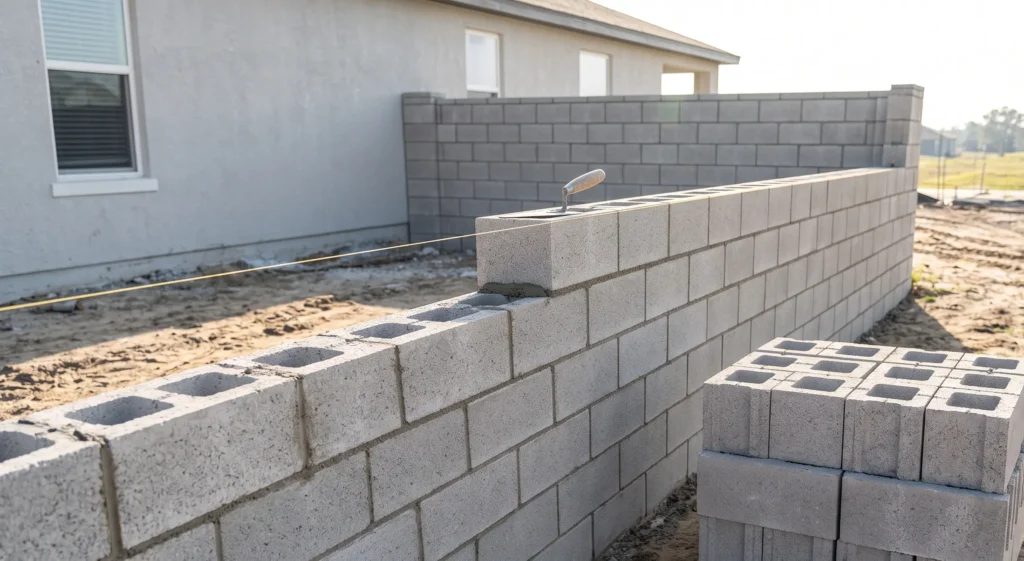
Installing a cinder block wall typically costs between $15 and $30 per square foot. Depending on the wall size, that works out to roughly $60 to $240 per linear foot.
Most projects land between $1,500 and $6,000 for a standard wall, though the total moves with the height, the length, and the reinforcement.
Cinder blocks, also called concrete masonry units or CMUs, are hollow concrete blocks used to build walls, fences, foundations, and retaining structures. They are strong, fire resistant, and cheaper than poured concrete or brick.
Builders use them because they go up fast, last for decades, and hold up well against weather and impact. This guide breaks down the cost by size, type, and project, and shows what drives the final number.
Average Cinder Block Wall Cost
The average installed cost of a cinder block wall ranges from $15 to $30 per square foot. For linear measurements, expect to pay about $60 to $240 per linear foot. That is the fully installed cost, with materials and labor included. For a standard project, expect $5 to $13 per square foot for materials, which covers the blocks, the mortar, and the rebar, and $10 to $17 per square foot for labor.
The price changes with the wall itself. A taller wall needs more blocks and more reinforcement. A deeper footing adds concrete and excavation. The block type matters too, since specialty and decorative blocks cost more than standard ones. Site preparation plays a part, and so does the amount of grout and rebar the wall requires.
Permits can add to the total. Many cities require a permit for a wall over four feet tall, which brings inspection and administrative fees. Because of these factors, the same wall can cost far more on one lot than another, so the ranges above are a starting point.
Cinder Block Wall Cost by Size
A cinder block wall’s cost rises with its length and height, since both add blocks, mortar, and labor. The table below shows the total installed cost across common wall sizes, including the footing and basic reinforcement.
| Wall Length | 4′ Tall | 6′ Tall | 8′ Tall |
| 10′ | $600 – $1,200 | $900 – $1,800 | $1,200 – $2,400 |
| 15′ | $900 – $1,800 | $1,350 – $2,700 | $1,800 – $3,600 |
| 25′ | $1,500 – $3,000 | $2,250 – $4,500 | $3,000 – $6,000 |
| 50′ | $3,000 – $6,000 | $4,500 – $9,000 | $6,000 – $12,000 |
| 100′ | $6,000 – $12,000 | $9,000 – $18,000 | $12,000 – $24,000 |
| 150′ | $9,000 – $18,000 | $13,500 – $27,000 | $18,000 – $36,000 |
| 200′ | $12,000 – $24,000 | $18,000 – $36,000 | $24,000 – $48,000 |
A taller wall costs more per foot, since it carries more courses of block and often a deeper footing. The block type also shifts the number. A standard 8x8x16 block runs $1 to $3 each, while specialty and decorative blocks can reach $5 each. Labor, footing, and reinforcement are built into the totals above.
Cinder Block Wall Cost by Project Type
A cinder block wall costs $8 to $60 per square foot installed, depending on what you are building. A privacy fence sits at the lower end, while a retaining wall or a garage runs higher because of the added reinforcement and structural work. Here is the cost broken down by project type.
Cinder Block Retaining Wall Cost
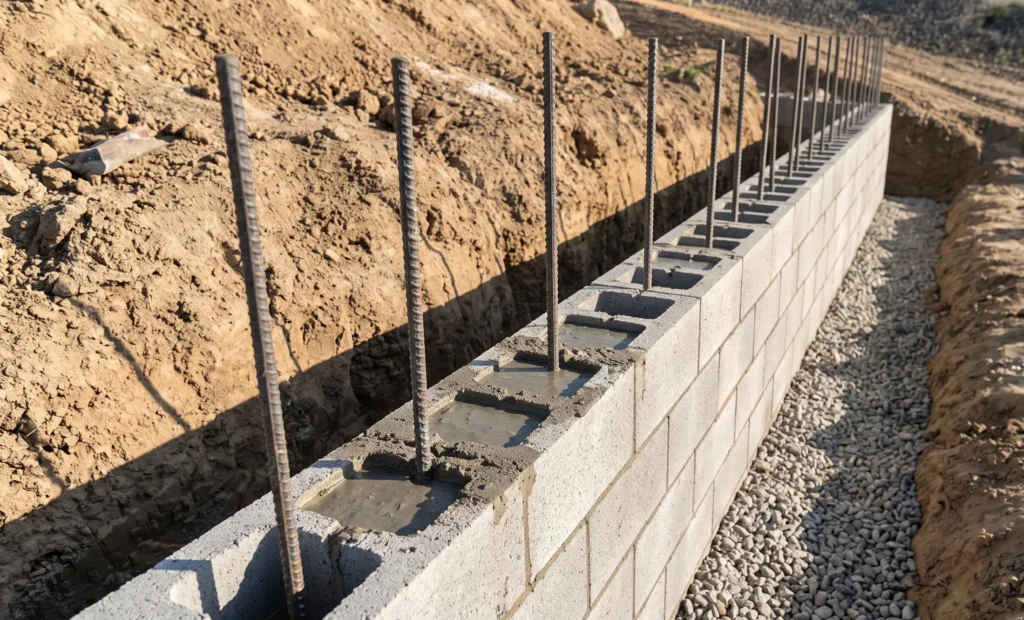
A cinder block retaining wall costs $20 to $55 per square foot installed. For a 100 square foot wall, expect $2,000 to $6,000. A retaining wall holds back soil, so it needs more rebar, more grout, and a solid footing, which raises the price over a standard wall.
Materials run $5 to $15 per square foot, since the wall carries extra rebar and block. Cinder blocks cost $1.50 to $5 per unit. Professional labor adds $15 to $40 per square foot, and masons charge $35 to $100 per hour. Gravel and drainage behind the wall cost $15 to $60 per linear foot.
Wall height is the biggest cost factor. A wall over four feet tall usually needs an engineered plan and a structural permit. Site preparation adds cost when an old wall has to come out, or a steep grade needs excavation. Finishes such as stucco or caps add to the per-square-foot price.
Cinder Block Privacy Fences and Boundary Walls
A cinder block privacy fence costs $75 to $150 per linear foot installed, or $15 to $30 per square foot. A standard six foot boundary wall runs $3,000 to $8,000 total, depending on the length, the finish, and the site access.
Materials cost $2 to $10 per square foot, which covers the concrete block and mortar. Labor runs the same $10 to $17 per square foot as a standard wall. Delivery adds a flat fee for the heavy block. If the wall needs an engineered design or has to meet seismic code, that raises the cost.
Cinder Block Home Foundations and Basements
A cinder block foundation costs $12 to $24 per square foot, or $8,000 to $42,000 for a full foundation, depending on the structural requirements. A crawl space foundation runs $6 to $15 per square foot, while a basement foundation runs $10 to $20. Excavation is the swing factor. On difficult soil or a sloped lot, it can add up to $30,000 on its own. A standalone cinder block privacy foundation wall runs $62 to $120 per linear foot.
Cinder Block Garages and Storage Sheds
A cinder block two car garage costs $25,000 to $60,000, or $35 to $60 per square foot. The block walls alone run $10 to $35 per square foot, or $40 to $150 per linear foot. The total swings with the reinforcement, the finishes, and local labor rates.
The block work is only part of the cost. The concrete slab, the permits, the insulation, the garage door, and the electrical all add to the total, along with any local masonry or zoning code the build has to meet.
Uses of Cinder Block in Construction
Cinder blocks are made mostly from Portland cement, which makes them strong, cost effective, and versatile. They come in several types and serve many roles across a project. Here is where they are commonly used.
- Non-load-bearing partitions that divide interior space.
- Landscaping and gardening walls, including retaining walls and decorative borders.
- Outdoor features like fire pits, outdoor kitchens and barbecues, thanks to the block’s thermal resistance.
- Small structures such as sheds, garages, and utility spaces.
- Hardscape features like patios, carports, driveways and pathways.
How Many Cinder Blocks Do You Need?
You need about 1.125 blocks per square foot of wall, using standard 8x8x16 blocks. To find your total, multiply the wall’s length by its height for the square footage, then multiply that by 1.125. Add 5 to 10 percent for cuts and breakage.
Here is the block count for common projects:
| Project | Wall Area (Approx) | Blocks Needed (Approx) |
| Small garden retaining wall | 30 sq ft | 34 |
| Backyard privacy fence | 120 sq ft | 135 |
| Standard wall section | 200 sq ft | 225 |
| Single garage wall or outbuilding | 640 sq ft | 720 |
| House foundation wall | 1,000 sq ft | 1,200 – 1500 |
| Full house (all exterior walls) | 2,000 sq ft | 12,000 – 14,000 |
The count rises with the number of stories and the wall height, so measure each wall and total them for an accurate figure.
What Does a Pallet of Cinder Blocks Cost?
A pallet of cinder blocks costs $150 to $250 at retail, and $120 to $200 in bulk. A standard pallet holds about 90 blocks of standard 8x8x16 CMU. Buying by the pallet lowers the per block price, which is why contractors rely on accurate concrete estimating services to order the exact bulk amount needed. Delivery is a separate cost and can add up to $200, depending on the quantity and the distance. Specialty and decorative blocks cost more per pallet than standard CMU, so the final price depends on the block type you order.
Cost of Different Types of Cinder Block
Cinder block ranges from $1 to $12 per block, depending on the size, shape, and finish. A standard block sits at the low end, while decorative and foundation blocks cost the most. Here is the cost by type.
- Standard CMU (8x8x16): $1.25 to $3 each. The most common block, gray and hollow, used for walls and foundations. Buying by the pallet, about 90 blocks, brings the unit cost down.
- Specialty blocks (half, cap, corner): $1 to $3 each. Used for wall endings and finishing the top of a wall.
- Solid concrete blocks: $2 to $5 each. Heavier, with no hollow cores, used in higher load areas.
- Decorative blocks (split faced, slumped, breeze): $3 to $8 each. Textured or geometric designs used for finished, visible walls.
- Foundation blocks: $8 to $12 each. Used to set posts and support structures without pouring concrete.
Specialty Cinder Block Prices
Specialty cinder blocks cost $1.50 to $15 each, depending on the type and the job they do. These blocks manage corners, reinforcement, wiring, and foundations that a standard block cannot. Here is the cost by type.
- Bond beam blocks: $2.50 to $3.50 each. Used for horizontal reinforcement, with channels that hold rebar and grout across the top of a wall.
- L-corner and U-corner blocks: $1.50 to $3 each. Used for 90 degree corners and pillars where a standard block will not fit.
- Pier and column blocks: $2 to $5 each. Strong hollow core blocks that carry a high load, used for posts and columns.
- Knockout or header blocks: $1.50 to $3 each. Feature breakable sections that make room for plumbing and electrical runs.
- Deck blocks: $10 to $15 each. Heavy duty blocks with grooves that set posts and joints for above ground foundations.
Materials Needed for Cinder Block Construction
Cinder block construction uses a few core materials beyond the block itself. Each one has a role in the strength and the finish of the wall. Here is what a standard build requires.
- CMU concrete blocks. The main building unit for the wall.
- Masonry mortar. Type S mortar bonds the blocks together.
- Steel rebar. Placed vertically and horizontally in the hollow cores to reinforce the wall.
- Grout. A fluid mix of sand, cement, and fine gravel that fills the cores and locks the rebar in place.
- Concrete mix. Standard structural concrete poured to form and level the footing the wall sits on.
- Cap blocks. Flat blocks set on the top course to give the wall a finished look. Optional, but common.
What Factors Affect Your Cinder Wall Cost?
The cost of a cinder block wall depends on the wall size, the block type, the reinforcement, the finish, and a few site conditions. Each one changes how much material and labor the wall needs. Here is how each factor affects the price.
Wall Size and Height
Size is the biggest factor. A longer, taller wall needs more blocks, more mortar, and more labor, so the cost climbs with the square footage. Height matters on its own too. A wall over four feet tall carries more courses of block and usually needs a deeper footing and more reinforcement, which raises the price per square foot.
Block Type and Style
The block you choose sets a large part of the material cost, since a wall holds hundreds of units. A standard 8x8x16 concrete block runs $1 to $3 each. Decorative and specialty blocks cost more, with split-faced and rounded blocks at $3 to $5 each. A plain fence uses the cheapest block, while a finished wall with decorative units costs more.
Reinforcement
Reinforcement changes both the strength and the price. Filling the block cores with rebar and grout ties the wall together and adds load capacity. A taller or load bearing wall needs more of it, which is why retaining walls and foundations cost more than a simple garden wall. Most building codes require some reinforcement, so it is rarely optional.
Footings and Site Preparation
Every wall over two feet needs a concrete footing, and the site has to be cleared and levelled first. Excavation, grading, and removing an old wall all add to the cost before a block goes down. A sloped or rocky lot takes more digging, and difficult soil can raise the footing cost sharply.
Finishes
The finish decides how the wall looks and how well it holds up. Paint is the cheapest option, stucco costs more, and stone veneer costs the most. Waterproofing sealant matters most on foundations and retaining walls, since bare block absorbs water and cracks over time.
Permits, Location and Extras
A permit is required for most walls over four feet, and the fee changes by city. Location also shifts the labor and material rates, since city crews charge more than rural ones. On top of that, delivery brings a fee for the block, since a pallet weighs over 2,500 pounds. Insulation adds cost on garage and house walls that need it.
Cinder Block Wall Finishing Costs
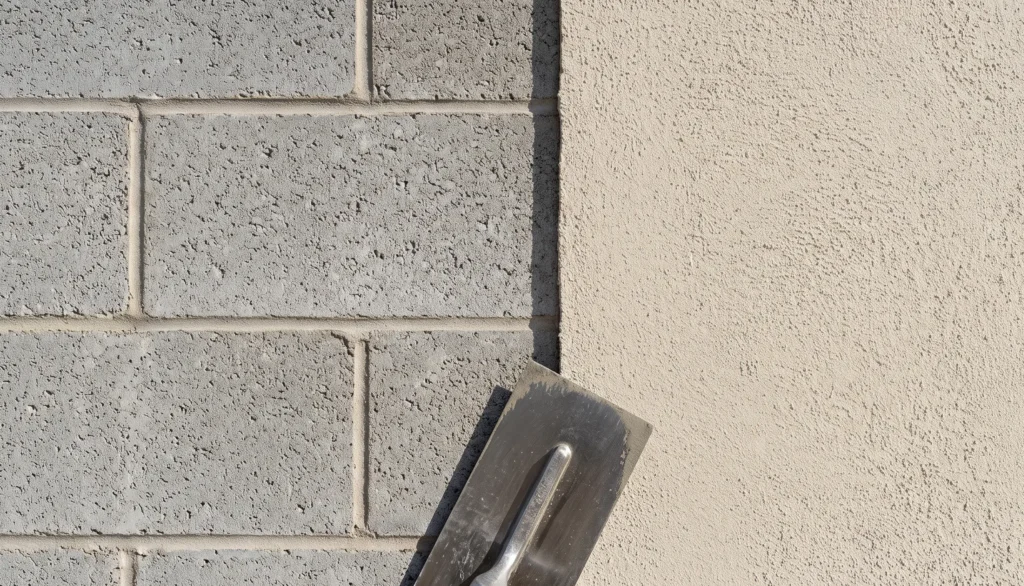
A cinder block wall finish costs $1.50 to $18 per square foot, depending on the option. The finish protects the block from water and sets the look of the wall. Here is what each one runs.
- Masonry paint: $1.50 to $5 per square foot. A low-cost, eco-friendly option that adds color and light protection.
- Stucco or cement coating: $3 to $8 per square foot. A layer of cement mortar that smooths the surface for a uniform exterior.
- Exterior stucco: $6 to $18 per square foot. A decorative, textured finish that is more durable and weather-resistant.
- Interior drywall: $3 to $6 per square foot. Attached to the block over metal or wood furring for a finished interior wall.
- Stone veneer: $3 to $18 per square foot. The most expensive decorative option, glued directly to the wall for a natural stone look.
Remember that installation adds to the material cost above. The final price depends on the site preparation, the formwork, and the finishing work the wall needs.
What Are the Benefits of Using Cinder Block for Construction?
Cinder block is one of the most durable and cost-effective building materials available. It holds up to disasters, cuts energy costs, and lasts for generations, which is why it is used for everything from foundations to boundary walls. Here are the main benefits.
- Durability and longevity. A well built cinder block wall lasts 100 years or more in the right soil, when built with quality materials and proper reinforcement.
- Disaster resistance. Cinder block achieves up to a four-hour fire rating, withstands winds up to 250 miles per hour, and, when reinforced with rebar and grout, holds up well in earthquakes.
- Energy efficiency. The high thermal mass absorbs and releases heat slowly, which can lower heating and cooling costs by up to 50 percent.
- Soundproofing. The dense block blocks outside noise, giving a quieter indoor space.
- Cost-effectiveness. Cinder block carries a low maintenance cost, since it resists mold and mildew, and its large size covers more area than standard brick, which speeds up construction.
- Lower insurance. The fire resistance and durability often earn a lower insurance rate, which saves money over time.
- Sustainability. Many blocks are made with fly ash and other recycled content, which reduces the need for new raw materials.
- Easy modification. Cinder block is straightforward to cut for openings and to shape for custom wall designs.
- Pest resistance. The solid material resists termites and other pests that damage wood construction.
How Long Does It Take to Build a Cinder Block Wall?
A cinder block wall takes one to two weeks to build, depending on the scope. A small garden wall can go up in about three days, while a standard six foot wall takes around two weeks, since it requires digging, pouring, reinforcement, and concrete curing. Here is how the timeline breaks down.
- Site preparation: 1 to 2 days for clearing and leveling.
- Foundation block: about 1 day to set.
- Concrete curing: 3 to 5 days for the footing to set.
- Laying blocks: about 4 days for a three-person crew, which lays 100 to 120 blocks per day.
- Reinforcement and grouting: about 2 days.
- Final cure: up to two weeks to reach full structural strength.
A larger or reinforced wall can push the total to two or three weeks. The curing time is fixed, so it sets the floor on how fast any wall can be finished, no matter the crew size.
How to Estimate Your Cinder Block Wall Cost
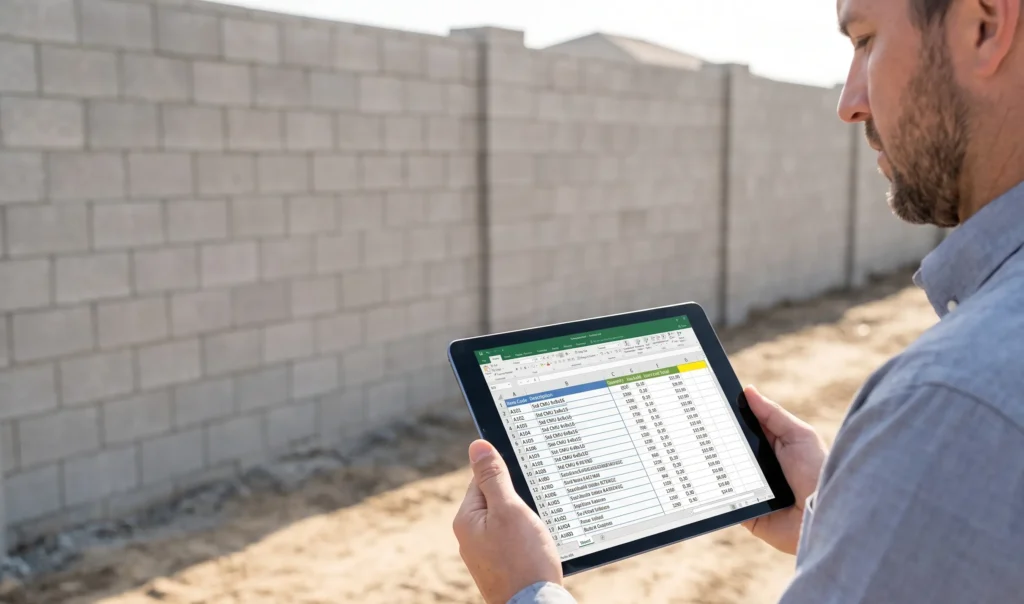
A cinder block wall costs about $15 to $30 per square foot installed, or $75 to $150 per linear foot. If you do the block work yourself, materials run $5 to $8 per square foot. A professional mason charges $50 to $100 per hour. Here is how to work out your own estimate step by step.
Step 1: Measure the wall area. Multiply the wall’s length by its height. A 50-foot wall at 6 feet tall is 300 square feet. Subtract any openings for gates or doors.
Step 2: Count the blocks. Multiply the area by 1.125 to get the block count, then add 10 to 15 percent for cuts and breakage. Standard 8x8x16 blocks run $1.50 to $2.50 each.
Step 3: Add mortar and rebar. Budget $1 to $3 per square foot for reinforcement. Mortar runs $7 to $10 per 80-pound bag, which covers about 100 blocks, and rebar costs about $6 to $10 per 20 foot stick.
Step 4: Add labor. A mason charges $45 to $100 per hour, or $10 to $17 per square foot. This is usually about half the total cost.
Step 5: Add site work and permits. Factor in the concrete footing, delivery fees of around $200, a permit, and any grading the site needs.
Put together, a standard six foot, 50 foot wall of about 300 square feet runs close to $2,000 in materials, and $5,000 to $7,000 installed by a professional. Running your own numbers this way gives you a solid ballpark before you request quotes.
For a project of any real size, a professional takeoff removes the assumption. ACON Engineering prepares detailed masonry estimates that count the blocks, the mortar, the rebar, the footing and the labor, priced to your local rates.
Alternatives to Cinder Blocks and Their Costs
Cinder block is not the only wall material. A few alternatives cost more but offer better insulation, faster installation, or a different look. Here is what each one costs installed.
- Insulated concrete forms (ICF): $4.50 to $7 per square foot with concrete and installation. Interlocking foam blocks stacked and filled with concrete and rebar, used for energy-efficient walls and full home builds.
- Wood framing: $1 to $5 per square foot for materials, or $7 to $16 installed. A timber skeleton used for above grade walls and interior partitions.
- Poured concrete walls: $16 to $20 per square foot installed. Concrete poured into forms, used for load bearing walls, retaining walls, and foundations.
- Interlocking retaining wall blocks (eco blocks): about $8 per square foot, or $50 to $150 per block. Large concrete blocks that stack without mortar and hold loads, used for landscaping and large retaining walls.
- Aircrete (AAC) blocks: $3 to $5 per square foot. Lightweight autoclaved aerated concrete, used in eco friendly builds and areas that need strong thermal efficiency.
DIY vs Hiring a Professional
DIY works best for small, non load bearing walls under three feet, such as garden walls or raised beds. Labor typically makes up about half of the total installation cost, so doing the work yourself can lead to significant savings. Professional labor often costs around $10 to $17 per square foot. If you have basic masonry skills and the site is level, a small wall is a practical DIY project.
The savings come with hidden costs, though. Tool rentals, delivery fees, and the price of fixing mistakes add up fast. A first timer often gets the footing or the leveling wrong, and an error early on can throw off the whole wall’s stability. Work like digging deep footings and hauling block is demanding, so DIY only makes sense on short, simple projects where a mistake is cheap to fix.
For anything over four feet, a load bearing wall, or a foundation, hire a certified professional. These structures need permits, engineering, and building code compliance, and a mason manages all of it. A pro works faster and gets the reinforcement and footing right the first time. The trade off is a higher cost and working around their schedule, but for a structural wall it is worth it, since a failed foundation costs far more to fix than it saves.
Frequently Asked Questions
How long do cinder block walls last?
A well built cinder block wall lasts 50 to 100 years with basic maintenance. Sealing the wall and keeping water away from the base are the two biggest factors. A reinforced wall with proper drainage holds up longest.
Is a cinder block wall cheaper than poured concrete?
Yes, slightly. A block wall costs $15 to $30 per square foot installed, while a poured concrete wall runs $15 to $50. Block is cheaper on labor and works better in tight or hard to reach spots. Poured concrete is stronger and easier to waterproof.
How many cinder blocks do I need?
You need about 1.125 blocks per square foot of wall. Multiply the wall’s length by its height, then multiply by 1.125, and add 10 percent for cuts and breakage. A 200 square foot wall needs about 225 blocks.
Do I need a permit for a cinder block wall?
Most cities require a permit for a wall over four feet tall, and retaining walls often need one at a lower height. Check with your local building department before you start, since the rules change by city.
How thick should a cinder block wall be?
A standard 8 inch block manages most fences and single-story walls. Taller walls, load bearing walls, and foundations often need a 10 or 12 inch block for the added strength. The wall height and the load decide the thickness.
Can I build a block wall without footings?
Not for anything permanent. A footing spreads the load and keeps the wall from shifting or cracking as the ground moves. A short decorative wall may sit on a compacted gravel base, but any real wall needs a concrete footing.
How much does it cost to fill a cinder block with concrete?
Filling costs $1 to $5.25 per square foot for the grout and rebar. One standard 8x8x16 block takes about 0.25 cubic feet of concrete to fill. Filling adds strength and is required by code on most load bearing walls.
Do cinder block walls add value to a home?
Yes. A block wall is durable, low maintenance, and fire resistant, which appeals to buyers. A finished privacy wall or a solid retaining wall can add curb appeal and usable yard space, both of which support resale value.
How much concrete is needed to fill a cinder block?
A standard 8x8x16 cinder block takes about 0.25 cubic feet of concrete to fill. An 80 pound bag yields about 0.6 cubic feet, so one bag fills roughly 2.5 blocks. To find your total, multiply the number of blocks by 0.25 for the cubic feet needed, then divide by 0.6 to get the number of bags. For a larger project, a professional estimate can help you a lot. A US based firm like ACON Engineering offers certified estimators, fast turnaround, and flexible pricing that works for any budget.
Is a concrete block the same as a cinder block?
No, they differ. A concrete block is heavier and carries a high load, which suits industrial and commercial construction. A cinder block is lighter and better finished, used for simpler, non structural work. The two terms are often used for the same product today, but the block rating tells you which one you are getting.

Tim C. is a construction estimating expert and Director at ACON Engineering, specializing in construction cost estimating, quantity takeoffs, and preconstruction planning. He has led thousands of successful project bids and helps contractors make informed, profitable decisions.