A Bill of Quantities (BOQ) is a core document used during the tendering phase of a construction project. It provides a detailed, itemized list of all the materials, labor, and services required to build a specific design. Having this document ensures everyone involved understands exactly what the project needs before any actual work begins.
In this guide, we will break down how a BOQ works and who is responsible for creating one. You will learn how to structure this document, why it is critical for accurate bidding, and how you can use it to keep your project budget under control from start to finish.
What Is a Bill of Quantities (BOQ)?
A Bill of Quantities is a formal contract document that lists all the labor, materials, and services needed to complete a construction project. It provides accurate measurements, rates, and total costs for each specific task. This structure gives the project owner a clear guiding document that details exactly how the work will get done and what materials are required.
This document is usually created right after the initial project design receives approval. The project owner typically asks their architect or a professional cost estimator to draft the Bill of Quantities. Doing this ensures both the owner and the contractors share a clear picture of the expected pricing and the total scope of the work.
When an owner is looking for contractors, they hand out this document. Because the BOQ provides the exact same measurements and requirements to everyone, contractors can submit accurate bids based on a leveled playing field. The project owner can then easily compare these bids and choose the best option without worrying about hidden costs.
Why BOQs are Essential for Construction Projects
A Bill of Quantities prevents budget overruns and keeps the bidding process fair by serving as the central reference point for the entire build. If you want to know how to bid construction projects fairly, this document provides an equal opportunity for all contractors. Because everyone receives the same itemized list, project owners can compare bids side-by-side without worrying about hidden fees or missing variables. It also guarantees accurate cost estimation by breaking down the project into specific material costs and labor rates.
Beyond the bidding phase, the Bill of Quantities acts as a milestone tracker for a structured payment process. As work progresses, quantity surveyors verify the physical progress on-site against the document, allowing the owner to confidently release interim payments for the work actually completed. Finally, a Bill of Quantities reduces misunderstandings by defining the exact scope of work and enabling efficient project planning. Contractors use it as a daily roadmap to know exactly what materials to order and how many labor hours to schedule.
Different Types of Bills of Quantities
Not every construction project uses the same document format. Depending on the stage of the design and how the work is divided, cost estimators use different types of Bill of Quantities to match the specific needs of the job.
- Elemental BOQ: This format breaks the project down into major functional components, such as the foundation, walls, or roof. It makes it easy for owners to do a high-level cost comparison of the building’s main sections.
- Trade BOQ: This group items by specific subcontractor disciplines, like plumbing, masonry, or electrical work. It is the best choice for projects that rely on multiple specialized subcontractors.
- Operational BOQ: Instead of just listing physical materials, this format focuses on construction methods, processes, and sequences. It helps contractors build a highly detailed resource and labor plan.
- Firm BOQ: Used when the blueprints and project specifications are 100% complete. It provides exact measurements and a finalized scope of work that contractors can bid on with absolute certainty.
- Approximate BOQ: Used in the early stages when the design is mostly done, but some variables remain. It works on estimated measurements to start a tendering procedure before the drawings are finalized.
- Unmeasurable BOQ: Used when the design details cannot be finalized before construction begins. The work scope would be re-measured and updated during the execution phase
- Provisional BOQ: This includes specific “provisional sums” of money set aside for work that is not yet fully defined. It allows the budget to stay flexible as those final details are decided.
- Preliminaries BOQ: This format isolates all the indirect costs of running a project. It covers items that do not physically become part of the building, such as temporary site facilities, scaffolding, management fees, and insurance.
- Annotated BOQ: This includes extra essential notes, detailed specifications, and extended descriptions alongside the standard measurements. It is nicely detailed to prevent any chance of miscommunication regarding the materials or methods required.
Bill of Quantities (BOQ) vs. Bill of Materials (BOM)
A Bill of Quantities acts as a complete financial map for a construction project. It contains every detail about the scope of the work. You will find labor rates, specific work items, and all commercial costs inside this document. Quantity surveyors or construction estimators usually prepare the BOQ. Owners use it for project bidding and tendering to get a clear picture of the final price.
A Bill of Materials serves a different purpose. As the name suggests, it focuses entirely on the physical parts. It lists the raw materials and components needed to build a structure or product. Product managers or design teams usually create the BOM. They use it strictly for inventory tracking, procurement, and supply chain operations.
The Bill of Quantities tracks the complete progress and cost of the work. The Bill of Materials tracks the physical items in the warehouse. For example, a BOM lists the exact number of bricks needed for a wall. The BOQ lists those bricks, the cost to deliver them, and the hourly rate of the mason hired to lay them.
Who Prepares the Bill of Quantities?
Project owners rely on experts to build an accurate Bill of Quantities. A professional quantity surveyor typically takes on this task. The owner explains the complete project scope to this independent consultant. The consultant then measures the drawings and creates a detailed list of exact measurements and costs.
Sometimes, the engineering firm in charge of the project design will create the document. These firms often keep an in-house consultant on staff to prepare the BOQ right alongside the final blueprints.
The contractor must then review the BOQ document to determine their exact costs. Outsourcing construction estimating to certified professionals is the smartest way for contractors to address this review step. ACON Engineering provides this exact service with affordable pricing plans.
Our certified estimators use specialized tools to review your plans and deliver highly accurate takeoffs. We apply zip code-based pricing to capture precise local rates for your specific area. We deliver these detailed reports with a fast turnaround time of 24 to 72 hours, so you can submit your bid with total confidence.
When Should You Use a Bill of Quantities?
Project owners primarily use the BOQ during the tendering phase, right before construction starts. It provides a clear comparison of quantities and specifications. This allows contractors to price out the scope of work fairly and creates a level bidding environment.
You also use this document during the planning and design stages to estimate costs before breaking ground. You can spot expensive materials or high labor requirements early. If costs run high, you can substitute cheaper alternatives to keep the budget on track.
The BOQ remains active during the actual construction phase. It acts as a baseline to evaluate completed work. Project managers tie milestone payments directly to the items checked off this list. It also helps project teams control scope variations. If the design changes, they adjust the budget using the established baseline rates before the new work begins.
How to Create a Bill of Quantities
Learning how to estimate construction costs with an accurate BOQ requires total precision. You must extract exact measurements from architectural drawings and assign current market rates to every single item. Here is the step-by-step process to build a reliable document.
1. Set Up Your Spreadsheet
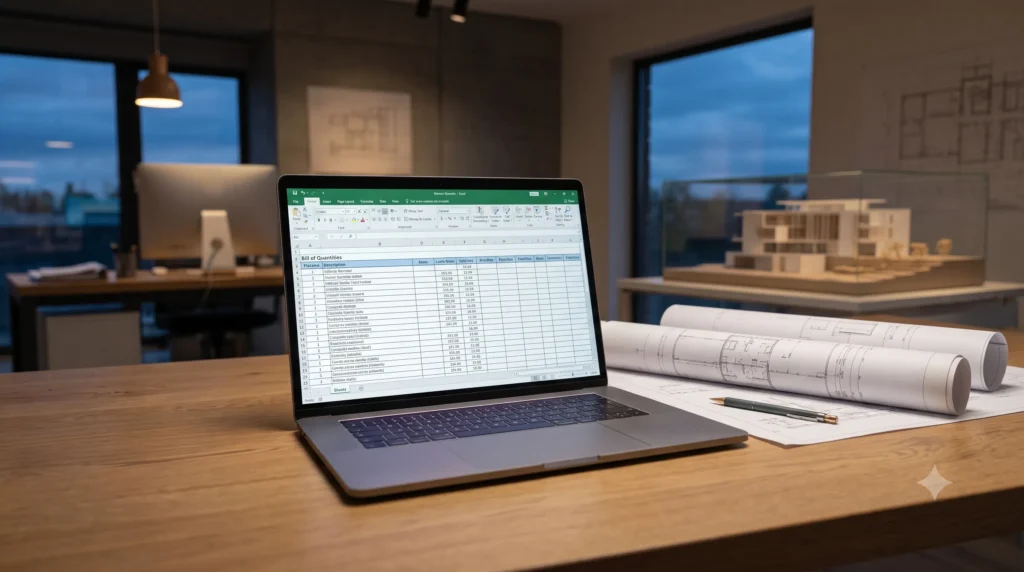
Start with a simple Microsoft Excel or Google Sheet document. Create dedicated columns for the Item Number, Description, Unit of Measurement, Quantity, Unit Rate, and Total Cost. This grid forms the backbone of your estimate.
2. Perform the Quantity Takeoff

Review the architectural drawings carefully to figure out how to do construction takeoffs. Extract the exact measurements for every material required. You must measure the lengths, areas, and volumes accurately to figure out exactly how much material the project needs.
3. Categorize the Work
Break the project down into logical sections so contractors can read the document easily. Group similar tasks together under clear headings. Common sections include Preliminaries, Substructure, Superstructure, MEP (Mechanical, Electrical, and Plumbing), and Finishes.
4. Assign Unit and Labor Costs
Apply current market prices to your measured quantities. You must estimate the labor hours required to install each item and add that to the raw material price. This gives you a true unit rate for every line item.
5. Add Taxes and Contingencies
Construction projects rarely go perfectly. Add a 10% contingency buffer to cover unexpected delays or unproductive costs. You also need to calculate and apply the relevant state or local taxes based on the exact project location.
6. Review and Refine
Do a final sweep of the document. Check every calculation for absolute accuracy. Read through the descriptions to verify they are clear and easy to scan. A thorough review prevents costly bidding errors later.
Standard Bill of Quantities Example
To fully understand a BOQ, you need to see how it organizes information. A standard BOQ uses a highly structured grid. This layout ensures that anyone reading the document can immediately find the specific materials, the exact amounts needed, and the expected costs without any confusion.
Here is a simplified example of what a typical BOQ structure looks like to estimate a Concrete Slab Cost in 2026.
| Item No. | Description of Works | Unit | Quantity | Unit Rate ($) | Total Amount ($) |
| 1.0 | Substructure (Foundation) | ||||
| 1.1.1 | Excavation of trenches for continuous strip footings | Cu. Yd | 150 | $25.00 | $3,750.00 |
| 1.1.2 | Disposal of excavated material off-site | Cu. Yd | 150 | $15.00 | $2,250.00 |
| 1.1.3 | Supply and pour 3000 PSI ready-mix concrete for footings | Cu. Yd | 40 | $140.00 | $6,300.00 |
| 1.14 | Supply and install #4 rebar for foundation reinforcement | Ton | 1.5 | $1,200.00 | $1,800.00 |
Total Cost: $14,100.00
Common BOQ Mistakes and How to Avoid Them
Even small errors in a Bill of Quantities can lead to massive budget blowouts during construction. Because this document serves as the financial foundation for the entire project, accuracy is critical. Here are the most frequent mistakes estimators make and how you can prevent them.
- Using Outdated Drawings: Estimators often pull measurements from early design drafts instead of the final “Issued for Construction” blueprints. Always verify that you are working from the absolute latest set of architectural drawings before you start your takeoff.
- Vague Item Descriptions: If a description lacks specific details, contractors will guess. This leads to underbidding or using the wrong materials. You must use precise, standardized construction terminology so everyone understands exactly what is required.
- Mixing Up Units of Measurement: Recording an area in square feet when the pricing is based on square meters will ruin the entire estimate. You must double-check that every unit matches the standard pricing matrix for your region.
- Omitting Secondary Materials: Estimators often remember the primary materials (like bricks) but forget the dependent items (like the mortar, wall ties, and scaffolding). You must break down every task into multiple stages to ensure you capture every necessary component.
- Ignoring Market Fluctuations: Material prices change daily. If you use outdated pricing data, your budget will fall short when it is time to buy. Always update your unit rates to reflect current market conditions and include a contingency fund to absorb sudden price spikes.
- Poor Document Structure: Handing contractors a messy, non-standardized list confuses. You must format your takeoff into the standard BOQ structure (as shown above) so all subcontractors can read, understand, and price it easily.
What is the Importance of the Bill of Quantities in Construction?
A Bill of Quantities brings complete transparency to a construction project. It details the exact material and labor requirements so owners and contractors share the same expectations. This shared document cuts down miscommunication right from the start.
With a BOQ in hand, you get highly accurate cost estimates. You see the true price of every item before construction begins. This clear view stops unpredictable costs from catching you off guard and keeps your budget firmly under control. If material prices suddenly shift, you can adjust specific line items without ruining the entire financial plan.
This document also drives fair payment management. Construction managers use the BOQ to track daily site progress. They check the completed physical work against the listed milestones. Once they verify the physical progress, they release the interim payments. This clear tracking process stops financial disputes before they happen and drastically reduces your overall project risk.
Get Precise Cost Estimates with ACON Engineering
ACON Engineering delivers highly accurate material and labor takeoffs to keep your bids competitive. We provide professional construction estimating services to keep your bids competitive and base our pricing on your exact zip code to capture true local market rates.
Our team brings over 15 years of direct experience to the construction industry. Our certified estimators use the best construction estimating software, including PlanSwift, RSMeans, and Bluebeam. You receive clear and detailed deliverables that make total sense for your project. We also respect your strict deadlines and provide a fast turnaround time of 24 to 72 hours. With our estimators doing the task, you can bid on your next project with absolute confidence.
Frequently Asked Questions (FAQs)
How does a BOQ handle design changes once construction starts?
When plans change mid-project, the BOQ provides a fixed starting point for new costs. Project managers apply the original line item rates to any new additions or removals. This keeps budget updates fair and prevents random price hikes.
What happens if a bidder finds a missing item or mistake in the BOQ?
If a contractor catches an error, they immediately submit a Request for Information (RFI) to the project owner. The owner then sends out a formal update, called an addendum, to everyone bidding.
Do small residential projects really need a Bill of Quantities?
Yes. While common for massive commercial builds, smaller home projects still benefit from them. A basic BOQ replaces vague “per square foot” assumptions with material counts. This protects homeowners from surprise bills and stops arguments over what the contract actually includes.
What is the difference between a BOQ and a Schedule of Rates?
A BOQ gives you both the item quantities and their prices for a complete project. A Schedule of Rates only lists agreed upon prices for labor and materials, without detailing total amounts. Managers typically use rate schedules for ongoing maintenance work where the final scope remains unknown.
Are “Provisional Sums” and “Contingencies” the same thing?
No. A provisional sum sets aside money for a specific, planned task that still needs final design details, such as custom lighting. A contingency is a general safety fund built into the total budget to manage completely unexpected problems, like hidden pipe damage or severe weather.

Tim C. is a construction estimating expert and Director at ACON Engineering, specializing in construction cost estimating, quantity takeoffs, and preconstruction planning. He has led thousands of successful project bids and helps contractors make informed, profitable decisions.